


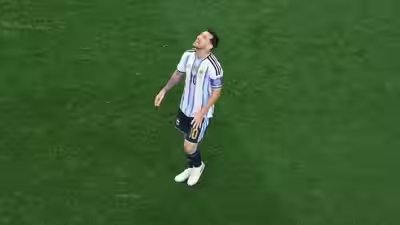

In celebrated Argentine writer Jorge Luis Borges’ short story “El Aleph”, the eponymous character is a mystical point in space that contains all other points in the universe, allowing whoever looks into it to see every place on Earth from every angle simultaneously without distortion.According to the giant of Latin American literature who died on June 14 in 1986 — eight days before Maradona’s two mythical goals against England at the World Cup in Mexico that Argentina would go on to win — a man is both the victim and the flow of his destiny.This Sunday, Lionel Messi — the Aleph in Argentina’s football atmosphere — will seek the infinite in the finite at the very place in New Jersey where, lonely and defeated a decade ago, he had decided to quit the game. The flow of his destiny has taken him thus far and it has drawn us in because of its rhapsodical and redemptive surface.Yet, Spain will be there, seeking their own moment of truth in this dreamspace and placing Messi’s journey in two parallels in this World Cup final. On the one hand, here’s a country which has put a neat bow on the process of making Messi complete; on the other hand there’s a now challenger who will be more than eager to cook the very performer’s goose in an engaging immersion into the reverie in which we might just see ourselves.If this continues to be a painful point of ambiguity in the narrative, it also becomes the contest’s central driving force because it always transports us into a new possibility.This is a final that speaks Spanish but it’s more than a contest, brimming with a banquet of emotional turbulence and enchantment while allowing so many subplots and such a stirring confluence of ideas layering upon each other.Never in the World Cup’s history had the reigning Copa América winners come to take on European champions in a final. The ‘Finalissima’ between the two continental kings was cancelled in March because of the war in the Gulf. But it’s happening now on the grandest stage and with the biggest stakes.This contest is also unraveling with a number of possibilities.Spain’s pass-heavy tiki-taka with all its fluidity and fantasy which had consumed France’s ambitions in the semifinal, will now meet its match in La Scaloneta’s counter-pressing and never-say-die attitude. This also holds attention with another convenient narrative taking stock of their past and present. Spain’s colectivismo — “Simply being ourselves as a team,” as De la Fuente said — is now up against Argentina’s play-for-Messi joie de vivre.Spain are unstoppable having remained unbeaten in normal or extra time for 37 matches. Argentina, themselves on an unbeaten run of 14 matches, provide them the ultimate test. It remains to be seen how Messi and his entourage make their trip against Marc Cucurella, Fabian Ruiz and Rodri into a complex odyssey across the landscape of two teams’ aspirations.Football is often played with a degree of mysticism which also makes it fold back on itself. Back in 2017 when Lionel Scaloni was at the Spanish football association’s coaching academy, he found in one Luis de la Fuente a teacher from whom he was more than happy to learn the craft.The two coaches, standing on the touchline and guiding their teams to immortality, may now be tempted to reflect on their shared past.


