


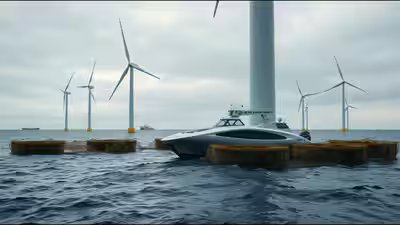
A vessel recently sailed through the Hollandse Kust Zuid wind farm off the Dutch coast to collect the first-ever harvest of seaweed grown between operating turbines, marking a milestone for a project testing whether offshore wind farms can serve more than one purpose at once. The farm, called North Sea Farm 1, sits roughly 18 kilometres off the coast of Scheveningen and occupies open water between 139 turbines rather than a separate stretch of ocean set aside just for cultivation. It is run by North Sea Farmers, the body representing Europe’s seaweed sector, together with research partners including Deltares, Plymouth Marine Laboratory and Silvestrum Climate Associates, with funding from Amazon’s Right Now Climate Fund. Beyond producing a usable crop, the project is meant to show whether seaweed farming can survive the rougher waves and currents typical of the open North Sea, and whether growing it inside a working wind farm could ease pressure on other coastal waters and land-based farming.
How the harvest inside the wind farm actually works
The seaweed at North Sea Farm 1 grows on nets that float just below the surface, held in place by an anchoring system of chains running down to piles driven into the seabed on either side. According to North Sea Farmer, the project’s current production system covers a reserved area of five hectares and was designed to be safe, robust and efficient enough to operate in the challenging conditions of an active offshore wind farm, including its proximity to turbines, its distance from shore and its exposure to wind, waves and strong currents. To gather the crop, a specially equipped vessel had to navigate carefully between the turbines and lift the nets before the seaweed could be brought ashore for processing. It was the first time such a harvest had ever been carried out inside the boundaries of a working wind farm anywhere in the world, according to research institute Deltares, which is one of the scientific partners studying the site.
Why researchers are watching this harvest so closely
The harvest itself is only one part of what the project is trying to learn. Researchers from North Sea Farmers and Plymouth Marine Laboratory have been monitoring the farm using satellite imagery and regular site visits to track how the seaweed grows and how it might be affecting the surrounding marine environment. Deltares, meanwhile, is focused on modelling how the farm interacts with the wider North Sea system, including how seaweed fragments that break off during storms or harvesting move through the water. Frank Kleissen, a researcher at Deltares, has said the institute uses models to study the distribution of seaweed from the cultivation site, alongside other models that examine how far seaweed farming can scale up before it starts to have any real negative effects on the sea. Scientists are also building computer models to understand how carbon moves through coastal ecosystems, hoping the farm can offer real evidence on whether seaweed cultivation could meaningfully draw down carbon and where the safe limits for scaling it up might lie.
What a successful seaweed and wind farm combination could mean
If the model proves workable, the implications extend well beyond a single patch of the Dutch North Sea. North Sea Farmers, the initiator of the project, sees enough room within current and future planned wind farms across the North Sea to scale up production substantially, and according to Deltares, the expectation is to grow one million tonnes of fresh seaweed a year by 2040. The harvested seaweed from this first crop is already being processed into early samples of food ingredients, packaging material, textiles and cosmetic ingredients, offering an early test of whether European markets are genuinely ready for seaweed grown at scale. For now, researchers say the priority remains proving that cultivation and offshore energy production can share the same stretch of water without one undermining the other, since any long-term expansion will depend on showing that seaweed farms can support local marine life rather than strain it.


