









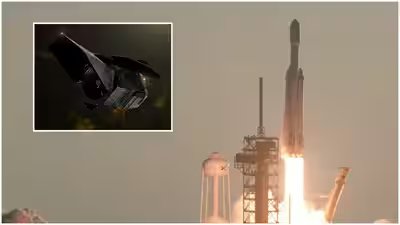
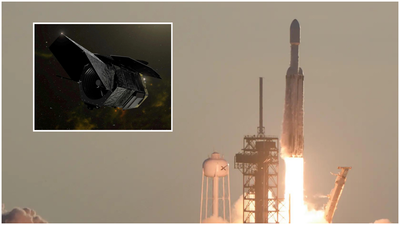
Nasa‘s newest flagship space observatory, the Nancy Grace Roman Space Telescope, blasted off from Florida on Sunday on a mission to search for planets beyond the Solar System and investigate some of the universe’s biggest mysteries, including dark matter and dark energy.A SpaceX Falcon Heavy rocket carrying the roughly $4.3 billion telescope lifted off shortly after daybreak from Nasa’s Kennedy Space Centre.The bus-sized observatory is now headed towards Lagrange Point 2, an observation point about 1 million miles (1.6 million kilometres) from Earth that is also home to the James Webb Space Telescope.Roman is expected to take more than three months to reach its destination.
A wider view of the universe
Named after the late Nancy Grace Roman, Nasa’s first chief astronomer, the telescope is designed to survey the universe at unprecedented speed and scale.“It’s going to find thousands of supernovae, tens of thousands of planets, billions of galaxies and tens of billions of stars,” Nasa science mission director Nicky Fox said, according to news agency AP.“It’s going to be able to do things that we’ve never been able to do before with its massive field of view,” she added.Roman’s field of view is more than 100 times wider than Hubble’s, while its wide-field infrared camera matches Hubble’s sensitivity but is around 1,000 times faster.One month of Roman observations of the Milky Way would take Hubble about a century to complete.“It will be as if Hubble and James Webb kind of peered through a keyhole at the universe, while Nancy Grace Roman will kick the door down,” Fox told reporters, according to Reuters.
Searching for dark matter and dark energy
One of Roman’s key objectives will be to investigate dark matter and dark energy, the largely unseen components believed to make up most of the universe.According to Reuters, ordinary matter, including stars, planets, gas and dust, accounts for about 5% of the universe’s contents. Dark matter may account for around 27%, while dark energy may make up about 68%.Roman will create what is expected to be the most comprehensive 3D map of the universe to date. Its main survey, which will take more than a year to complete, is expected to cover more than 2 billion galaxies.Scientists hope the observations will help them better understand dark matter’s gravitational effects and dark energy’s role in the accelerating expansion of the universe.
Thousands of new planets expected
Roman will also conduct one of the most comprehensive searches yet for exoplanets, or planets orbiting stars beyond the Solar System.Nasa expects the telescope to discover thousands of new planets and provide what Reuters described as the first statistical census of planetary systems similar to our own.“Roman’s vast reach will allow us to find the weird, the rare and the unusual,” senior project scientist Julie McEnery said.“We’ll redefine what it means to find a needle in a haystack.”The telescope also carries an experimental coronagraph, an instrument designed to block starlight and allow direct imaging of faint planets orbiting masked stars.
Roman joins Hubble and Webb
Roman will build on the work of Nasa’s other major space observatories, including the Hubble Space Telescope, launched in 1990, and the James Webb Space Telescope, launched in 2021.While Webb is designed to probe deep into the universe with high sensitivity, Roman will provide a much wider panoramic view.These observatories will also complement other major projects, including the European Space Agency’s Euclid spacecraft and the National Science Foundation’s Vera C. Rubin Observatory in Chile.Once Roman identifies new worlds and other objects of interest, Webb could conduct more detailed observations, helping scientists fill in further information.
Falcon Heavy launch and successful separation
Several minutes after Sunday’s launch, the Falcon Heavy rocket’s two reusable side boosters descended tail-first and landed at Cape Canaveral, producing sonic booms.The Roman telescope later separated successfully from the rocket’s upper stage.The observatory’s planned mission is five years, although Nasa has said it may have enough fuel for up to five additional years. The telescope is also designed to be refuelled if a robotic tanker becomes available in the coming decade.Roman launched nearly a year ahead of schedule and within budget, according to AP, while Reuters reported that the launch came nine months ahead of schedule.
A tribute to Nasa’s first chief astronomer
Roman is Nasa’s first space telescope to be named after a woman.Nancy Grace Roman joined the newly formed Nasa in 1959 and played a major role in promoting space-based observatories. Retired Nasa scientist Ed Weiler, who coined the phrase “Mother of Hubble” for Roman, said the honour was long overdue.Roman died in 2018 at the age of 93.The telescope’s primary mirror is the same size as Hubble’s, measuring nearly 8 feet (2.4 metres) in diameter. The mirror was originally surplus hardware from a spy satellite programme and was donated to Nasa by the National Reconnaissance Office more than a decade ago.