








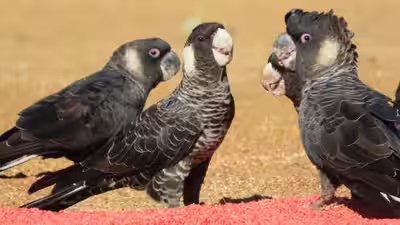
Scientists tracked endangered Australian cockatoos for three breeding seasons and found pesticides in 80% of seed samples, some hundreds of times above regulatory limits

Zoe Kissane says the birds often ate at seed spills around agricultural operations (Supplied: Murdoch Univeristy) Scientists tracking endangered Carnaby’s black cockatoos across Western Australia’s Wheatbelt over three breeding seasons found worrying levels of chemical contamination in the birds’ food. Four out of five seed samples tested positive for pesticides, with some containing chemical levels…
Read More

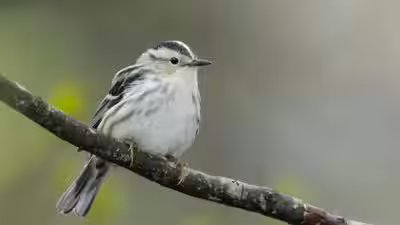
40 bird species were seen less often in New York when Canadian wildfire smoke increased, after scientists matched smoke pollution with 99,000 bird observations

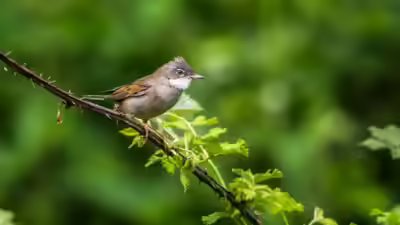
Black-and-white warbler (Mniotilta varia) is less likely to be seen when pollution level rises. Smoke from Canada’s record-breaking wildfires in recent years have done more than reduce air quality across parts of the United States. A new study suggests the wildfires made many birds harder for people to spot in New York State during the…

Read More

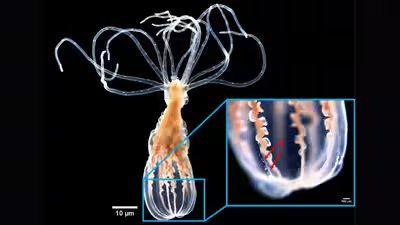
Scientists found that a sea anemone can distinguish helpful bacteria from harmful bacteria without antibodies or immune memory cells

The sea anemone Nematostella vectensis. In the enlarged section, the nematosomes—which are key to the immune system of these invertebrates—are highlighted. (Credit: HHU/Nida Kaya) A simple sea anemone (a small plant with white, red, blue or purple flowers that are shaped like cups and have dark centres) can distinguish helpful bacteria from harmful invaders despite…

Read More

Avian Malaria Uk: Mosquito species in the UK are potential carriers of avian malaria, new study finds

A mosquito lands on a blackbird’s wing. It pierces the skin, draws blood, and moves on. Somewhere in that moment, a parasite called Plasmodium slips into the bird’s bloodstream. Researchers have long known this happens across the UK, but they weren’t sure which mosquitoes do the transmitting. They finally have answers to that puzzle. A…

Read More

A human-bred aquarium fish prized for its bright colour and head hump has escaped into a Philippines crater lake, where scientists fear it may threaten native biodiversity

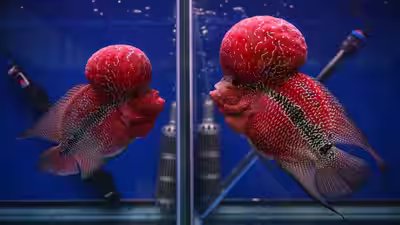
Flowerhorn cichlids are aquarium fish prized for their bright-gold colour and prominent head humps. Photograph: Lillian Suwanrumpha/AFP/Getty Images A human-bred aquarium fish prized for its bright gold colour and distinctive head hump has escaped into a volcanic crater lake in the Philippines, where scientists fear it is threatening native wildlife and spreading into local aquaculture.Flowerhorn…

Read More

Scientists marked this West African coral reef as probably dead in the 1960s; underwater drones found it alive more than 50 metres below the sea

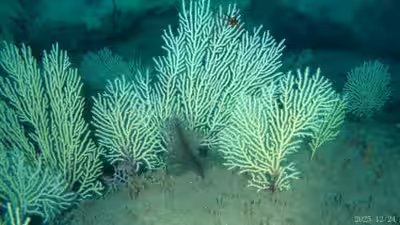
An image of the rediscovered coral reef by Gérard Zinzindohoué (Photo: Gérard Zinzindohoué) A deep-water coral reef off the coast of West Africa that was believed to be dead for six decades has been discovered alive and thriving more than 50 metres below the ocean surface.The forgotten reef was first identified off the coast of…

Read More

Hunter-gatherers carried trout past waterfalls into fishless Norwegian mountain lakes 7,000 years ago; their descendants are still caught there today

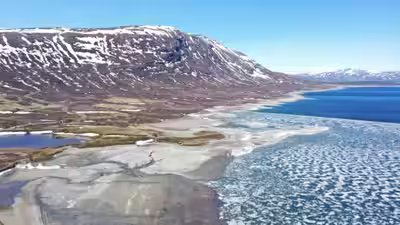
7,000-year-old fish traps show hunter-gatherers brought fish to Norway’s mountains centuries before farming Ancient hunter-gatherers carried live brown trout past steep waterfalls to stock empty mountain lakes in Norway 7,000 years ago, creating managed fisheries whose descendants are still being caught by local anglers today.Archaeologists at the University of Oslo discovered well-preserved wooden fish traps…

Read More

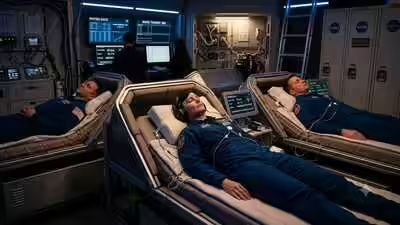
Nasa explored putting astronauts into a hibernation-like state for Mars missions, but scientists are still trying to make the science-fiction idea safe for humans |

Sending humans to Mars is one of Nasa’s greatest ambitions, but the journey presents enormous challenges. A round trip could take well over a year, exposing astronauts to dangerous cosmic radiation, muscle and bone loss caused by microgravity, psychological stress and the need to carry vast amounts of food, water and supplies. To tackle these…

Read More

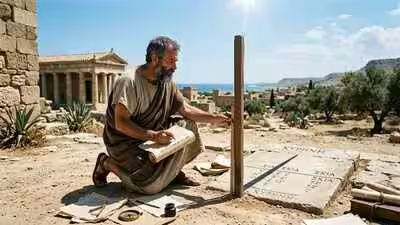
More than 2,200 years ago, an ancient Greek scholar calculated the Earth’s circumference with a stick and the Sun |

More than 2,200 years before satellites, GPS and space missions revealed the Earth’s true size, an ancient Greek scholar calculated the planet’s circumference using nothing more than a stick, sunlight and basic geometry. Around 240 BCE, Eratosthenes, the chief librarian of the Library of Alexandria, carried out one of history’s most brilliant scientific experiments. By…

Read More

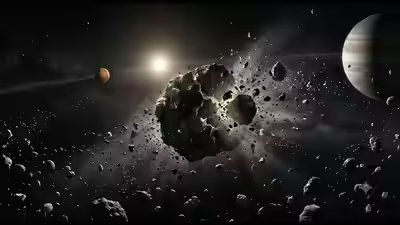
An asteroid shattered near Jupiter’s gravitational gateway 800 million years ago; scientists say the debris may have bombarded Earth for 150 million years

Asteroid breakup 800 million years ago may have triggered impacts on Earth, the Moon and Mars (AI photo) A massive asteroid that broke apart around 800 million years ago may have sent a huge number of rocky fragments towards Earth, the Moon and Mars, according to a new study led by researchers at the Southwest…

Read More