


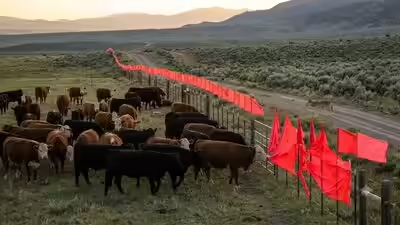
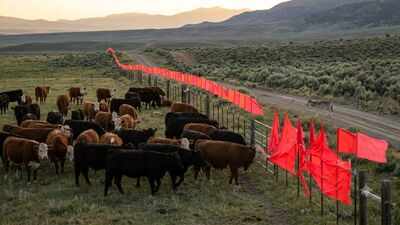
In 2003, scientists began closely examining how an old hunting technique called fladry could be transformed into a modern, non-lethal tool for reducing conflicts between wolves and livestock. Originally used in parts of Eastern Europe and Russia to guide wolves toward traps, lines of hanging flags were later tested as a way to keep wolves away from vulnerable livestock areas. Research showed that wolves often hesitated to cross the unusual visual barrier, creating a temporary protective zone around pastures and holding areas.As wolf populations recovered in regions such as the northern Rocky Mountains after reintroduction efforts in the 1990s, ranchers and conservationists searched for alternatives to lethal control methods. Studies found that ordinary fladry could discourage wolves for a limited time, but animals eventually learned to overcome the barrier. The journal published in Conservation Biology, titled ‘Wolf Depredation Trends and the Use of Fladry Barriers to Protect Livestock in Western North America’ revealed that electrified fladry, or “turbo-fladry,” provided stronger and longer-lasting protection by combining visual and physical deterrents. While not a permanent solution, fladry has become a valuable short-term tool, helping livestock owners protect vulnerable animals while supporting coexistence between humans and returning wolf populations.
The origins of fladry : How an old wolf-hunting technique became a modern wolf protection tool
The use of flags to influence wolf behaviour did not begin with American ranchers. In parts of Eastern Europe and Russia, hunters used lines of cloth for generations to guide wolves towards certain areas, often helping drive them into traps. The animals appeared reluctant to cross the unfamiliar boundary created by the moving flags.Decades later, wildlife researchers began asking whether the same reaction could be used in reverse. Instead of directing wolves towards hunters, could the visual barrier encourage them to stay away from livestock? That question led to renewed interest in fladry as a non-lethal way of reducing conflicts between wolves and people. The idea was especially relevant in regions where wolf populations were returning after years of decline.
How the return of wolves created new challenges for ranchers
The recovery of wolves in the northern Rocky Mountains changed the relationship between predators and livestock producers. The study published in Conservation Biology revealed that after wolves were reintroduced to Yellowstone National Park and central Idaho during the 1990s, populations gradually expanded into surrounding landscapes.For conservationists, the return represented an important restoration effort. For some ranchers, it created a practical challenge. Cattle and sheep operations that had existed for generations were now sharing parts of the landscape with a recovering predator.Managing those encounters is complicated. In many areas, regulations limit when and how wolves can be killed, while some livestock owners have looked for methods that reduce losses without relying on lethal control. Fladry became one of the tools tested for that purpose.
What happened when wolves faced the unfamiliar barrier
Early experiments examined whether wolves would actually avoid crossing a simple line of hanging flags. The setup was not complicated. Researchers attached strips of brightly coloured material to nylon rope and placed the line on posts around the height of a wolf’s body.In controlled tests involving captive wolves, the animals were reluctant to cross the barrier even when food was placed on the other side. Some remained near the boundary for many hours, investigating it by sniffing and moving back and forth before eventually overcoming their hesitation. Field trials produced similar patterns, although with important differences. Around cattle pastures in Alberta, wolves approached the flag lines repeatedly but did not cross during the trial period. The animals appeared interested and cautious, but the protected areas remained untouched.A larger test in Idaho showed the limits of the method. Wolves eventually learned that the barrier was not a permanent obstacle. After several weeks of exposure, some crossed the line and livestock losses occurred. The flags had worked, but only for a period of time.
The science behind why wolves stop and investigate fladry lines
The effectiveness of fladry seems to come from a wolf’s natural reaction to unfamiliar objects rather than fear of the flags themselves. A fence blocks movement. A flag line does not. A determined animal can walk through it. The challenge is that wolves often investigate unusual changes in their surroundings before committing to a decision.During trials, wolves spent more time near the barriers, sniffing and watching rather than simply walking across. That hesitation created a window of protection. For ranchers, that window can matter. The goal is usually not to protect an entire property indefinitely, but to guard smaller areas during periods when livestock are most vulnerable, such as when calves or lambs are young or when animals are gathered overnight.
Protection for one pasture does not remove the wider risk
Fladry’s success also depended heavily on where it was used. The method helped protect the specific areas surrounded by the flags, but it did not change wolf behaviour across an entire landscape. Wolves that avoided one protected pasture could still move into nearby unprotected areas. During field studies, livestock losses continued on neighbouring properties without flag barriers. The flags influenced where wolves went, but they did not eliminate their need to search for food. That distinction is important. Fladry is a barrier around a location, not a solution to every wolf-livestock conflict.
Tests with wolves and coyotes showed a difference
Later work in Michigan added more evidence that fladry affected wolves in a particular way.Researchers studying pastures in the eastern Upper Peninsula found that wolves entered areas protected by flag lines much less often than nearby open areas. Pastures without fladry did not show the same pattern. The response was not shared by coyotes, which appeared less affected by the presence of the flags. The result suggested that the caution created by fladry may be linked specifically to wolf behaviour rather than simply confusing all predators.
Adding electricity created a stronger barrier
Because ordinary fladry eventually loses effectiveness, scientists explored whether the system could be improved. The answer was electrification.Known informally as “turbo-fladry”, the modified version combines the visual warning of flags with a mild electric deterrent. The idea is simple: a wolf that tests the boundary receives a physical reminder not to cross.Tests with captive wolves showed that electrified fladry lasted much longer than standard flag lines. Field trials in Montana also suggested stronger results, with wolves avoiding electrified areas while crossing ordinary fenced areas during comparisons.It did not turn the barrier into an unstoppable defence, but it extended the period during which wolves stayed away.
A temporary tool with a practical role
Fladry is not designed to replace every method of livestock protection. It requires installation, maintenance, and regular checking. Wind, weather, and animals can damage the flags, and wolves that repeatedly encounter the barrier may eventually overcome their hesitation.Its usefulness comes from timing. For many ranchers, a few weeks of added protection can be valuable. A flag line placed around a calving area or temporary holding space during a vulnerable period can provide an extra layer of defence when it matters most.A simple piece of fabric moving in the wind may look insignificant, but years of testing have shown that it can influence one of North America’s most adaptable predators.


