


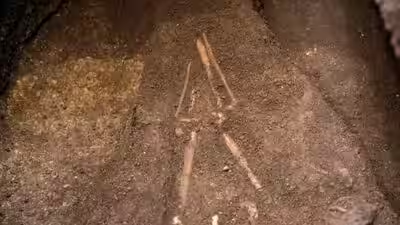
There are no limits to a human’s materialistic wants and emotional feelings. Attachment is the quickest development to happen and the slowest to recede. This is possibly why archaeologists in El Salvador found a 2,800-year-old burial of a person clutching a sea turtle vessel.The Mesoamerican burial found a face-down human skeleton that may be from a pre-Maya civilisation that practised human sacrifice. According to a translated statement from El Salvador’s Ministry of Culture, the burial was found on July 2 in Antiguo Cuscatlán, a suburb of San Salvador, during excavation work directed by Carlos Flores Manzano, an archaeologist and doctoral student at Yale University.Although the skeleton has not been radiocarbon-dated yet, it was discovered underneath a layer of volcanic ash from an eruption of the Plan de la Laguna volcanic crater thought to date between 850 and 830 BC, during the Middle Preclassic period (roughly 1000 to 400 BC) in Mesoamerica.
At that time…
During this period, societies in southeastern Mesoamerica were becoming more sedentary and developing more complex cultures, archaeologists have found. But in addition to archaeological remains of crop cultivation and painted ceramics discovered over the years in Antiguo Cuscatlán, experts have pointed to some burials as evidence of human sacrifice and the newly uncovered burial may be similar.In the late 1970s, archaeologist William R. Fowler excavated at Chalpchuapa, an ancient town east of Antiguo Cuscatlán with thousands of years’ worth of history. While digging in an area known as Structure E3-7, Fowler found 33 human skeletons, mostly adult males, that he interpreted as sacrifices of war captives, due to the signs that their feet and arms were bound.As per the ministry’s statement, the newly uncovered burial is likely not the only one in the area. Archaeologists may eventually find a burial mound with several dozen skeletons, similar to what Fowler uncovered at Chalchuapa. However, Fowler’s interpretation of human sacrifice has been questioned in recent years, including by Flores Manzano in a 2020 study.Instead of being linked to sacrifice, the unusual burial position might be related to an ancient understanding of the cosmos and underworld, Flores Manzano told Diario El Salvador. If that’s the case, the sea turtle ceramic vessel found near the skeleton’s hand may be associated with Orion’s Belt, which features in later Maya astronomy as part of a sacred journey.
The sea turtle vessel
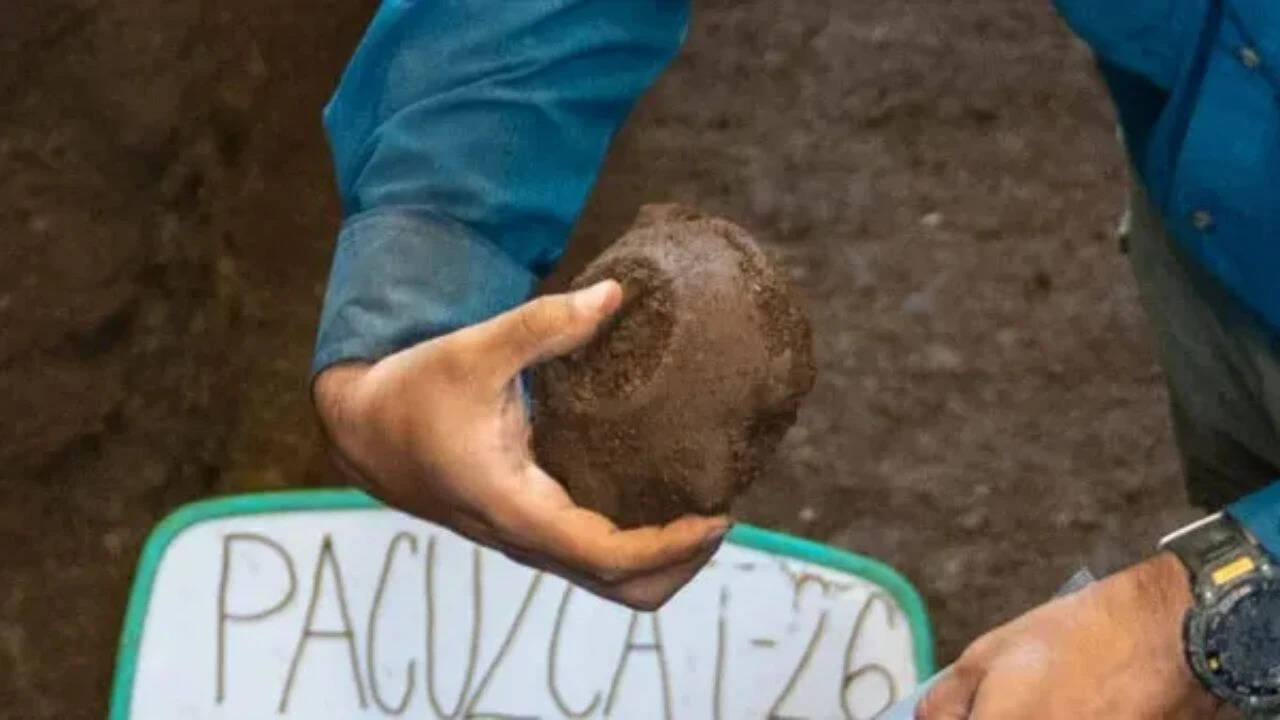
Shaped to evoke a sea turtle, its rounded carapace forming the body of the container, its form immediately recognisable even after a millennium in the soil.
The ceramic sea turtle vessel is at the centre of this discovery. Shaped to evoke a sea turtle, its rounded carapace forming the body of the container, its form immediately recognisable even after a millennium in the soil. It was found cradled in the skeleton’s hands in what appears to be a deliberate embrace. The craftsmanship places it within the Usulután ceramic tradition, a distinguished pre-Hispanic pottery style characterised by a distinctive resist-painting technique that produces pale, wavy patterns against a darker background. Usulután-style ceramics are named after a region of El Salvador, and they have been found distributed across a remarkably broad Mesoamerican zone, suggesting both the quality of the tradition and the reach of the trade networks that carried its products.The presence of such a vessel in a burial, held in the hands of the deceased, signals that this was an object of significance, not a utilitarian jar repurposed for the grave, but something chosen, perhaps something that belonged to this person in life, perhaps something made or acquired specifically for this moment.Alongside the skeleton and ceramic vessel, the burial pit contained remnants of cassava branches, something that will help in analysing the discovery. Plant materials are among the most fragile categories of archaeological evidence. Organic matter breaks down. Roots, leaves, and wood are consumed by soil chemistry and time in ways that ceramic and bone resist. The survival of cassava remnants across 2,800 years is an extraordinary stroke of preservation and gives the researchers a window they would not otherwise have. Cassava was a foundational crop across ancient Central America. In many traditions across the region, plants associated with sustenance also carried spiritual resonance, with fertility, with the cycle of planting and harvest, with death understood not as an ending but as a form of going into the ground from which new life eventually emerges. Cassava, in this context, is not just food. It is a symbol of continuation.
Under study
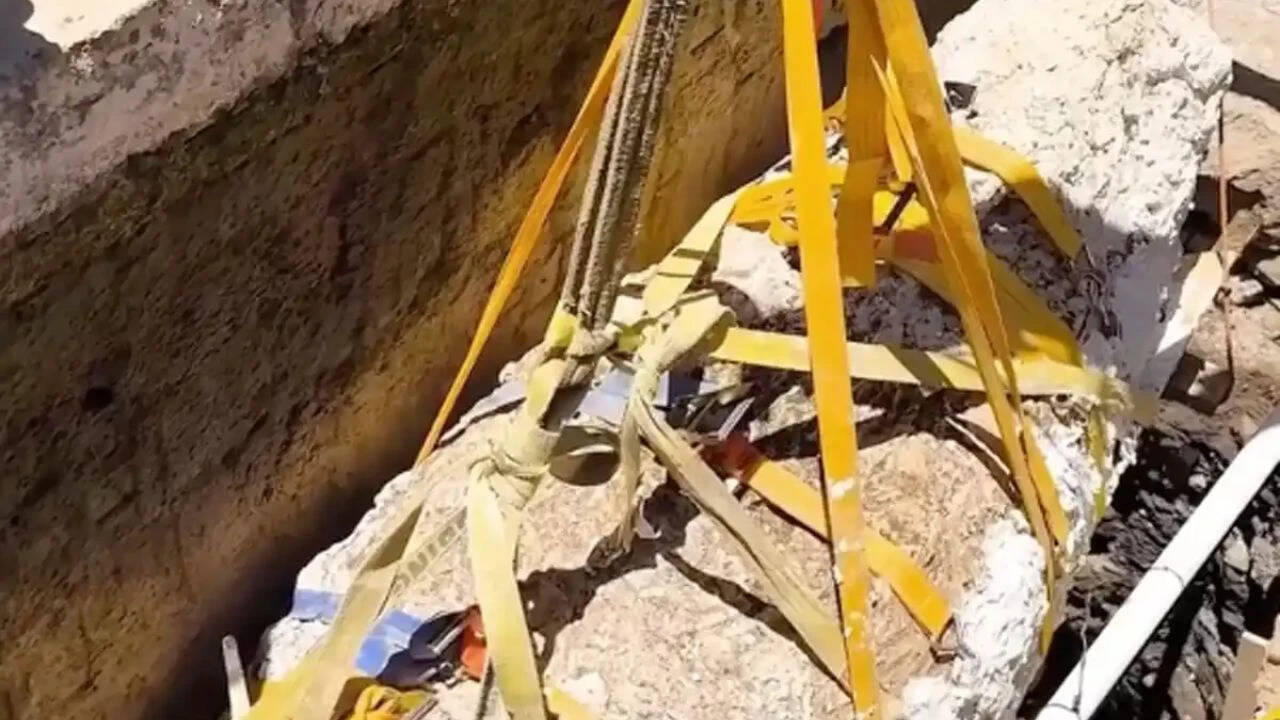
Flores Manzano said the skeleton will now undergo chemical analysis so researchers can learn more about the individual’s life, diet and possible cause of death.
The fragile burial was encased in plaster before being removed for further study. Flores Manzano said the skeleton will now undergo chemical analysis so researchers can learn more about the individual’s life, diet and possible cause of death. He expects the analyses to take about a year, after which the results will be announced to the public.Antiguo Cuscatlán is not a remote jungle clearing or a wind-swept highland plateau. It is a busy municipality in the greater San Salvador metropolitan area, a place of traffic and commerce and modern life pressing in on all sides. That makes the emergence of a burial this old feel all the more remarkable, the deep past rising through the noise of the present like a hand breaking the surface of still water.El Salvador tends to be overshadowed in archaeological imagination by its larger neighbours. When people think of ancient Mesoamerica, they think of the Chicen Itza, of Tikal rising above the Guatemalan canopy, of the colossal Olmec heads photographed in textbooks. El Salvador quietly sits within the same cultural corridor that produced all of those wonders and yet receives a fraction of the fascination. But now, discoveries like this one may change the status quo.


