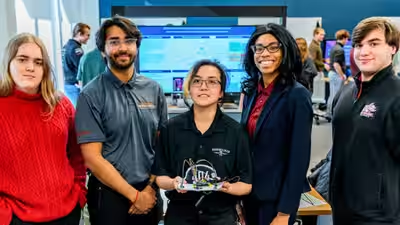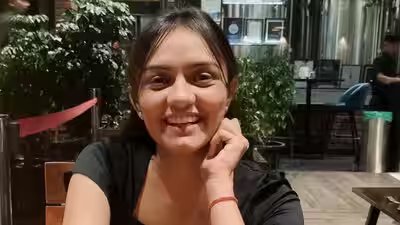


Great discoveries rarely announce themselves with fanfare. More often, they begin with a moment so ordinary that almost everyone else overlooks it.For California middle-school student Seungah Chung, that moment arrived while watching ants march purposefully across the ground. Like countless others, she had seen the tiny insects carrying food and disappearing into their nests. Unlike most people, however, she didn’t simply move on.How could creatures with brains no bigger than a grain of sand travel long distances so confidently? What invisible map were they following?That simple curiosity eventually grew into an award-winning research project, earning Seungah recognition as a finalist at the 2025 Thermo Fisher Scientific Junior Innovators Challenge, one of the United States’ most respected competitions for young scientists.But perhaps the biggest achievement wasn’t the award itself. It was proving that meaningful science can begin with nothing more than a question.
When observation becomes investigation
Children are naturally curious, but curiosity often fades when answers are easy to find online. Seungah chose a different path.Instead of searching the internet for explanations, she decided to collect the evidence herself. She wanted to understand whether ants depend entirely on chemical signals or whether they also remember what they see around them.It was a question that demanded patience rather than expensive technology. Her classroom project soon evolved into a carefully controlled behavioural study.
Turning nature into a laboratory
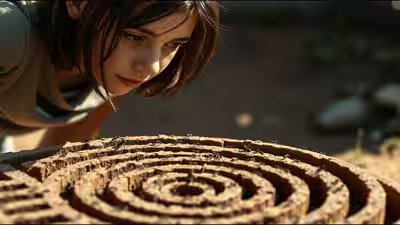
Rather than observing ants in the wild, Seungah recreated an environment where every variable could be controlled.She worked with nearly 200 red harvester ants, allowing them to repeatedly travel towards a food reward placed inside a specially designed maze.Around the route, she positioned everyday objects, artificial leaves, colourful blocks and decorative stones, not as obstacles, but as potential signposts.The insects were given enough time to become familiar with their surroundings. Then came the experiment’s defining moment.Without changing the food’s location, Seungah rearranged the objects that lined the path. The destination remained exactly where it had always been. But, the landscape kept changing.
Tiny insects, unexpected behaviour
The results surprised even seasoned observers. Instead of confidently reaching the food, many ants hesitated, wandered, or selected incorrect routes.The only thing that had changed was the scenery. That behavioural shift suggested the insects were paying close attention to the world around them. Rather than following scent alone, they appeared to build a visual memory of their surroundings.For animals possessing remarkably small nervous systems, that ability is far more sophisticated than many people imagine.The experiment offered fresh evidence that landmarks are an important part of how red harvester ants navigate their daily journeys.
How Seungah uncovered the ants’ secret navigation system
Seungah designed a simple yet carefully controlled experiment to find out whether ants rely only on scent trails or also use visual cues to navigate. The T-maze she constructed was used by nearly 200 red harvester ants in groups, with the fruit being placed at the end of the right pathway as a reward for the ants. She then positioned several artificial landmarks around the maze in the form of leaves, stones, and brightly coloured blocks to give the ants an opportunity to get used to the new landmarks by visiting the food repeatedly.After they had memorized the path to the food source, she moved the landmarks but kept the food in its place. The findings were quite surprising in that after having been able to get to the food easily before, the ants were confused and would hesitate in the pathways as well as choose the wrong paths to take. It is clear that the insects did not only use chemical signals but also used visual cues in forming a map.
Lessons far beyond the insect world
At first glance, an experiment involving ants may seem disconnected from modern technology. In reality, it touches one of engineering’s biggest challenges.Autonomous vehicles, delivery robots and space exploration machines all face the same problem: how to find their way through unfamiliar environments when information is limited.Nature has already solved many of these puzzles. Ants achieve extraordinary precision using minimal biological resources, making them valuable models for scientists developing efficient navigation systems for intelligent machines.Sometimes the smallest creatures become the greatest teachers.
Science is not about age
Seungah’s success also contradicts another widespread fallacy that science is only conducted within universities and professional laboratories.Indeed, this project needed careful planning, repeated observations, and thorough testing, which are some of the basic characteristics of any scientific experiment.The success at the national contest was just the result of applying the scientific approach with patience and diligence.Apart from conducting experiments, Seungah enjoys painting art works and volunteers painting murals in shelters and senior homes. Seungah dreams of building her career in microbiology.
The extraordinary hidden inside the ordinary
History shows that science advances because someone notices what everyone else ignores. A strange light in the sky. An unexpected reaction in a laboratory.A curious pattern in nature.Or a line of ants crossing a pathway.Seungah Chung’s story is ultimately not about insects. It is about the habit of paying attention.In an age where information is available instantly, her journey reminds us that discovery still begins the old-fashioned way—with careful observation, thoughtful questions and the determination to test an idea instead of assuming the answer.That is what transforms everyday curiosity into science. And sometimes, that is enough to inspire discoveries that travel far beyond a school classroom.