


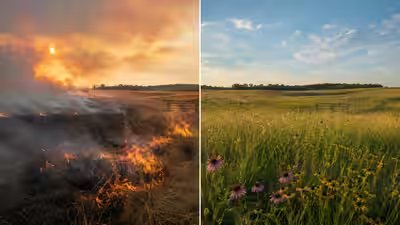
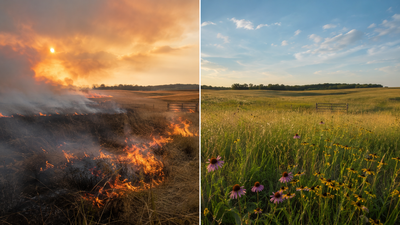
When Mike Moddrell purchased 320 acres of land in southwest Douglas County, Kansas, in 2002, the land was tired. In the years of neglect, weeds and cedar trees had invaded the land. More than two decades later, that same patch is once again thick with native grasses and wildflowers. His method was simple: fire, set deliberately, late every winter. This story fits a wider pattern. According to the U.S. Fish and Wildlife Service, tallgrass prairie across the Great Plains has declined by roughly 99 per cent, making a recovery story like Moddrell’s truly rare.A quiet climate story hiding in plain sightTypically, when people hear about Kansas, farmland comes to mind. However, Moddrell’s land lies in the area where the soil was too rocky to grow crops. Perhaps this is why it was never cultivated. The only things people could do on the piece of land were to graze cattle and harvest hay. Moddrell told the Kansas Reflector in December 2024 that he kept burning the land, and the native grass responded.It’s taken more than two decades for the native grass to come back.Why setting land on fire actually saves itIt sounds backwards: burning an area to preserve it is exactly what prairie grass does best. Since they sprout from deep underground buds, surface fires leave them untouched. Invasive species, however, lack this defence mechanism.Researchers from Kansas State University tracked more than 3,000 woody plants at the Konza Prairie Biological Station after a prescribed burn. The study by Jesse B. Nippert et al., published in the journal Rangeland Ecology & Management, found severe burn damage and high mortality among young woody plants, including eastern red cedar, one of the prairie’s biggest threats. Fire does not kill all invaders everywhere; some plants resprouted in dense, low-lying shrub cover. Still, done consistently, it remains one of the few methods stopping woody plants from taking over completely.An idea that is thousands of years oldModdrell did not invent the method; he revived it. Kansas’s native grasslands began to emerge about 12,000 years ago, at the end of the last ice age, alongside Indigenous communities that managed them with controlled burning to stimulate grass growth and support hunting.
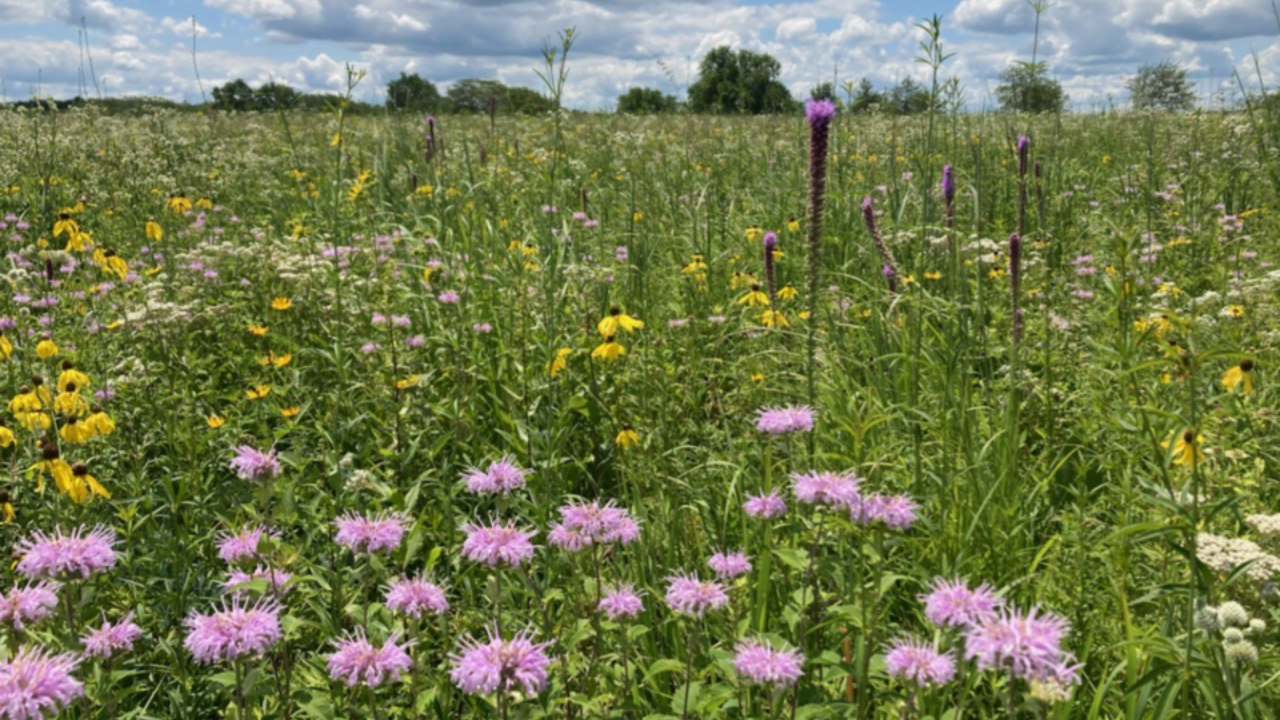
Native grasses and wildflowers now cover land that was once overrun by invasive species. Image Credits: Wikimedia Commons
That old idea still stands up to modern scrutiny. The study, ‘Conservation of Earth’s biodiversity is embedded in Indigenous fire stewardship,’ published in the Proceedings of the National Academy of Sciences in 2021, examined the relationship between fire and biodiversity across the globe. Research suggests that areas where Indigenous fire stewardship has continued tend to show higher biodiversity than areas where such practices have been suppressed. Grasslands never had fire as an enemy; the real damage came from decades of fire being kept out of the landscape entirely. The challenge modern land managers face is how to safely bring it back.What’s actually at stakeWhile it is easy to shrug off one man’s 320 acres, the bigger picture is more concerning. Tallgrass prairies once covered most of America’s Midwest. Currently, less than one per cent of tallgrass prairie has survived intact without being tilled up, according to data from the Fish and Wildlife Service mentioned above. Much of the remaining prairie survives in small, scattered sections, often in areas that cannot be farmed, just like in Moddrell’s case. This loss is not only about wildflowers; prairie soil holds carbon, filters water and supports birds and insects found almost nowhere else.The chemicals nobody loves, but many still useFire alone is not sufficient. Moddrell also relies on herbicides to deal with invasive, non-indigenous species like old world bluestem and Chinese bush clover, plants that fire alone cannot kill off. According to Moddrell in the Kansas Reflector interview, some people are anti-chemical, but without chemicals one would just lose the whole thing. Many land managers accept an unspoken compromise: an ecological cost now to avoid a much larger one later.Mapping what is left, before it disappearsIn 2023, Jennifer Moody and Jennifer Delisle of the Kansas Biological Survey at the University of Kansas travelled over 600 miles through Douglas County, hunting down examples of native prairie still surviving and unplowed on private ranch lands and hay fields. In their survey, they found sixteen sites, of which they identified thirteen as native prairie, typically between thirty and seventy acres in extent, and containing over 80 per cent native perennials. It wasn’t nostalgia. The purpose was to provide local authorities with real data on what is worth protecting.Why this should matter, even from a city apartmentYou do not need to own land to care about this. Grasslands such as Moddrell’s help absorb carbon, provide the pollinators which then become part of our diet and protect us from harsh weather conditions. His approach is not about longing for the old prairie. It is a low-tech, low-cost blueprint that works, playing out quietly, one winter burn at a time, on a patch of Kansas most of us will never see.


