









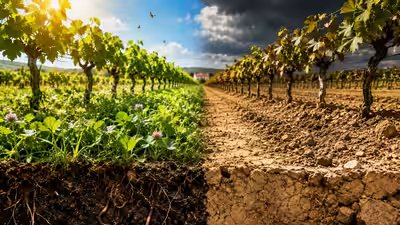
For more than two decades, the soil between rows of grapevines in a Spanish vineyard has remained covered with spontaneous vegetation instead of being repeatedly tilled. The unusual approach was associated with a striking difference beneath the vines: soil managed with long-term vegetation cover contained more than twice as much organic matter in its top layer as nearby soil that was conventionally tilled. The finding offers a glimpse into how leaving the ground undisturbed and maintaining plant cover could help improve soil health in dry, water-limited vineyards. The findings come from a 2026 study published in Frontiers in Soil Science, which compared a rainfed vineyard in central Spain managed with spontaneous cover cropping for more than 20 years with an adjacent vineyard managed through conventional tillage. Researchers examined physical, chemical and biological characteristics of the soils, including organic matter, porosity, water retention, nutrients and microbial activity.
Two different ways of managing soil
The study was conducted near Mota del Cuervo in Cuenca province, in central Spain. The region has a semi-arid Mediterranean climate, making water availability an important challenge for vineyards. According to the study, the farmer reported managing one of the vineyards for more than two decades without irrigation, pesticides or other external inputs. Instead of repeatedly removing vegetation between the grapevines, the farmer allowed spontaneous plants to grow and maintain ground cover. Vegetation was manually removed only immediately around individual vines.The neighbouring vineyard followed a much more conventional approach. Its soil was tilled regularly; researchers noted that vineyards in the region typically undergo several tillage operations each year to control weeds and maintain bare soil. This created a useful comparison because the two plots were adjacent and had comparable soil conditions. Rather than comparing vineyards from completely different environments, the researchers could examine how contrasting management practices were associated with differences in soil properties.
Organic matter more than doubled
The clearest difference appeared in the amount of organic matter contained in the topsoil. Researchers found an average organic matter content of 1.74% in the topsoil under spontaneous cover cropping, compared with 0.83% in the conventionally tilled soil. That means the covered soil contained slightly more than twice the organic matter of the tilled comparison. Organic matter is an important component of healthy soil. It comes largely from decomposing plant and animal material and contributes to processes that influence soil structure, nutrient cycling and water behaviour.The researchers also found differences in soil structure. At depths of 10 to 30 centimetres, soil under long-term cover cropping had porosity of about 51.2%, compared with 44.0% under tillage. The cover-cropped soil also showed greater biological activity, with several enzyme activities elevated compared with the conventionally managed soil. The results suggest that keeping vegetation on the ground for long periods can gradually alter the soil environment. Plant roots continually add organic material, while fallen vegetation decomposes at the surface. At the same time, reduced soil disturbance may allow soil structure and biological communities to develop with less disruption.
A possible lesson for dry vineyards
The findings are particularly relevant because vineyards in Mediterranean regions often face a difficult combination of limited rainfall, soil degradation and the need to control vegetation around crops. Conventional tillage can keep vineyard rows visibly bare, but repeated disturbance can also break apart soil aggregates and accelerate organic matter loss. Cover crops offer an alternative by keeping living vegetation on the soil for at least part of the year and reducing the amount of bare ground exposed to wind and water erosion. Previous research has similarly linked ground cover with improvements in soil organic carbon, aggregate stability and infiltration.However, the study does not suggest that cover cropping is automatically suitable for every vineyard. Plants growing between vines can compete with grapevines for water, particularly in dry climates. Recent research in Mediterranean vineyards has found that cover crops can sometimes reduce vine growth under severe drought conditions. That makes the Spanish vineyard studied in Frontiers in Soil Science particularly interesting. It represents a long-running real-world example of how a farmer maintained spontaneous vegetation without irrigation or pesticides and allowed the soil to develop under relatively low disturbance for more than 20 years.Rather than treating every plant growing between the vines as a problem to be removed, the system allowed vegetation to become part of the vineyard’s soil-management strategy. According to researchers, their findings support the idea that long-term spontaneous cover cropping can improve soil structure, organic matter and biological functioning in semi-arid vineyards. The results do not prove that the practice will eliminate the need for irrigation everywhere, but they show how maintaining living ground cover can potentially strengthen the soil’s ability to function under challenging conditions. For vineyards facing increasing pressure from drought and soil degradation, the lesson is relatively simple: sometimes, healthier soil may begin with disturbing it less and allowing plants to remain.