


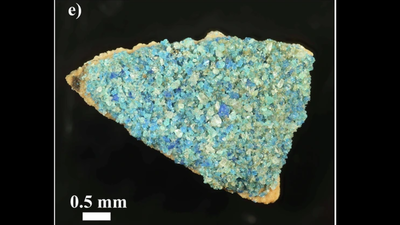
A vivid blue pigment used in ancient Egypt has revealed a far more complicated story than its striking colour suggests. Known as Egyptian blue, the material dates back around 5,000 years and is regarded as the world’s oldest synthetic pigment. Scientists have now recreated different versions of it to understand why its colour could vary so widely. According to the study published in Nature, titled ‘Assessment of process variability and colour in synthesised and ancient Egyptian blue pigments’, experiments show that the blue was shaped not only by cuprorivaite, the pigment’s main colour-producing compound, but also by other minerals, glass and particle size. The findings offer new clues about how ancient Egyptian blue was made, traded and used in objects thousands of years ago.
What makes Egyptian blue such a complex pigment
Scientists found that Egyptian blue is not simply one uniform substance. The study describes it as a “heterogeneous multi-phase blue pigment”, with cuprorivaite acting as the primary chromophore. However, the researchers found that the colour of the powdered pigment also depends on factors including other phases and particle size.The researchers’ experiments showed how complicated that mixture can be. Their synthetic samples contained cuprorivaite alongside different forms of silica, while many also contained wollastonite and some contained tenorite. The researchers also found that materials produced in ancient times and modern experimental versions can consist of intergrown cuprorivaite, silicate glass and silica phases rather than isolated particles of individual minerals.
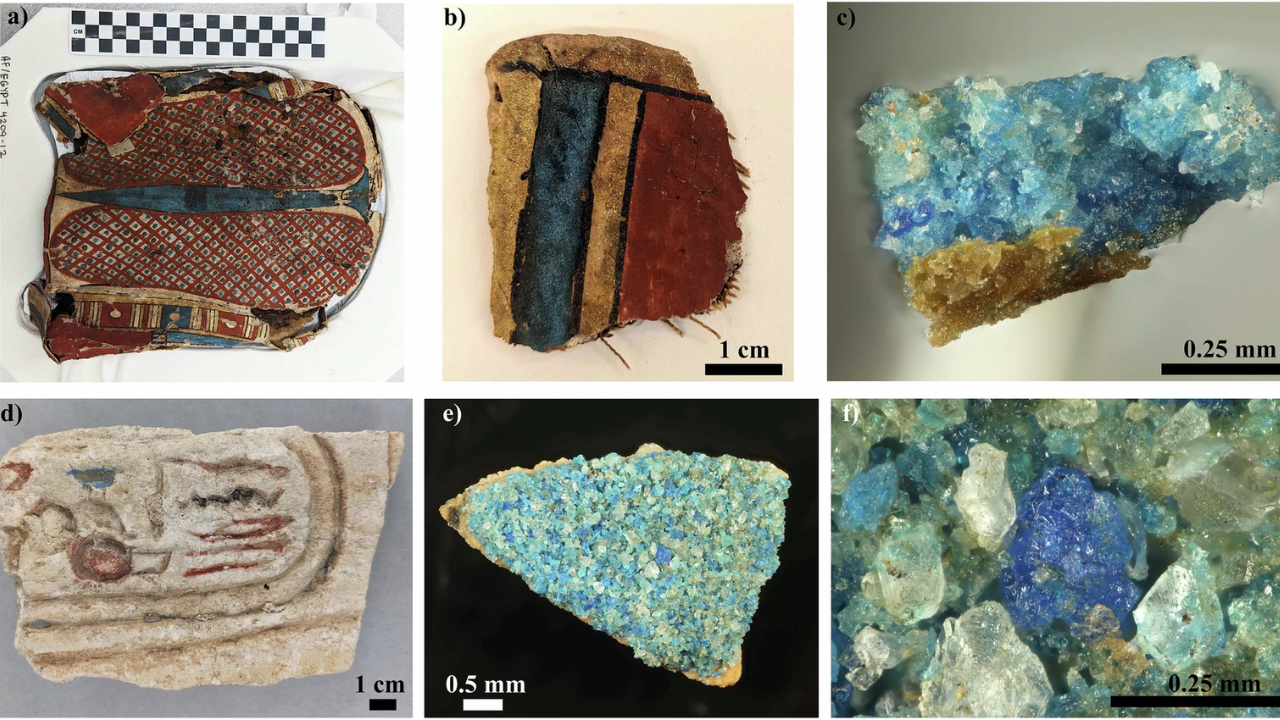
PC: Study: Assessment of process variability and colour in synthesised and ancient Egyptian blue pigments
Scientists trace the origin of Egyptian blue
The study shows why identifying the precise composition of an ancient blue material can be important. The researchers used several analytical techniques, including powder X-ray diffraction, Raman spectroscopy, photoluminescence measurements, visible absorption spectroscopy, visible near-infrared spectrometry, electron-beam X-ray microanalysis and nanoscale X-ray tomography. Together, these methods allowed them to examine the pigment’s phases, chemistry, structure and colour.Provenance is another reason this detailed analysis matters. The paper explains that Egyptian blue was probably produced at specialised sites and subsequently transported to other locations for processing and use. Archaeological evidence includes portable pieces of the pigment, such as “loaves”, ingots and balls, found in different contexts, suggesting that the material was formally traded. The researchers also note that trace compounds in Egyptian blue can carry information about provenance, manufacture, application and ageing.
How did researchers recreate the ancient blue pigment
To understand how ancient makers could have produced different forms of Egyptian blue, the researchers recreated the pigment themselves. They developed 12 different recipes using materials including silicon dioxide, copper oxide, azurite or malachite, calcium carbonate or calcium oxide, and, in some recipes, sodium carbonate. The experimental samples were heated at 1,000°C for one to 11 hours.The experiments revealed that production conditions could significantly influence the resulting colour. The researchers found that blue colour primarily came from cuprorivaite, while particle size and the presence of copper-doped glass could alter the hue.


