


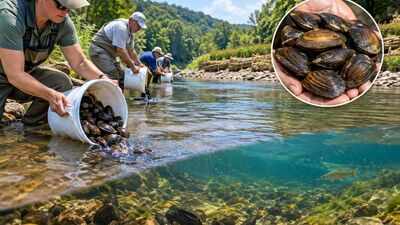
A river once reshaped by human intervention is now being helped back to health by some of its smallest residents. About 1,500 rare native freshwater mussels were released into Alabama’s Paint Rock River on August 25, 2026, as part of a long-running effort to restore the watershed’s habitat and recover threatened species. According to a report by Outdoor Alabama, the Alabama Department of Conservation and Natural Resources (ADCNR), U.S. Fish and Wildlife Service, The Nature Conservancy, Alabama Rivers Alliance and private landowners have worked together on streambank restoration and other conservation projects before reintroducing the mussels. The animals are expected to contribute to the river’s recovery because freshwater mussels naturally filter water, recycle nutrients and provide food for wildlife.
A release involving three rare mussel species
The latest release took place on property belonging to Huntsville businessman and Alabama Conservation Advisory Board member Raymond Jones Jr. in rural Jackson County. Representatives of state and federal agencies, conservation organisations and local officials gathered at the site as the mussels were returned to the Paint Rock. The approximately 1,500 mussels included two endangered species, the Pale Lilliput and Tennessee Bean, along with the Cumberland Moccasinshell, which is proposed for federal listing. The Pale Lilliput and Tennessee Bean were among 20 freshwater mussel species first listed as endangered by the U.S. Fish and Wildlife Service in 1976. The Cumberland Moccasinshell remains in only two locations in Alabama, according to ADCNR’s Alabama Aquatic Biodiversity Center (AABC).According to Paul Johnson of the Alabama Aquatic Biodiversity Center, the release also marked the first introduction of Cumberland Moccasinshell into the middle section of the Paint Rock River. Conservationists are using these reintroductions to expand populations of these rare species and establish them in additional parts of their historical range.
Why mussels are important to a river
Freshwater mussels play a much larger role in aquatic ecosystems than their size might suggest. They are filter feeders, meaning they remove material from the water as they feed. They also recycle nutrients, provide food for other wildlife and can serve as indicators of water quality. That makes restoring mussel populations part of a broader effort to improve the river itself. As populations become established, the animals can contribute to the ecological functions of the watershed while conservationists work to rebuild populations of species that have declined.The AABC has been carrying out mussel recovery work on the Paint Rock for years. Since 2010, it has released more than 23,000 mussels at the Jones property alone and 53,000 mussels representing six species throughout the Paint Rock River. Those releases have included Tennessee Bean, Pale Lilliput, Cumberland Moccasinshell, Alabama Lampmussel, Oystermussel and Birdwing Pearlymussel.
Restoration began long before the latest release
The mussel release is only one part of a much larger restoration effort. The Paint Rock watershed experienced significant changes after sections of the upper river were artificially channelised in the late 1960s as part of an effort to reduce flooding. The channelisation contributed to severe bank loss and erosion, damaging property and causing land loss along the watershed. On the Jones property, restoration work began in 2012, followed by streambank stabilisation projects completed in 2017 and 2019. Those improvements helped create conditions suitable for renewed mussel recovery work.The restoration effort extends well beyond one property. The Nature Conservancy’s Alabama chapter established the Paint Rock River Initiative in 1994. Over the following two decades, 45 streambank and channel restoration projects were completed through cooperation among ADCNR, the U.S. Fish and Wildlife Service, The Nature Conservancy, Tennessee Valley Authority, Jackson County, the USDA Natural Resources Conservation Service and private landowners.
A biodiversity hotspot in northeast Alabama
The Paint Rock is considered one of the most biodiverse watersheds in North America. The river is just under 59 miles long and its watershed covers about 460 square miles. It supports more than 150 tree species, nearly 100 native freshwater fish species and 52 freshwater mussel species, including 12 listed under the Endangered Species Act. Conservation partnerships have also helped secure 38,000 acres of public land in the watershed for conservation and outdoor recreation. The effort combines habitat restoration with protection of land surrounding the river.For private landowners, such cooperation is particularly important in Alabama, where more than 95% of land is privately owned. The U.S. Fish and Wildlife Service’s Partners for Fish and Wildlife Program provides technical and financial assistance to landowners working to improve wildlife habitat.
The mussels are already showing results
According to Paul Johnson of the Alabama Aquatic Biodiversity Center, the restoration work is beginning to produce evidence that reintroduced mussels can establish themselves in the watershed. AABC officials have verified recruitment, or the addition of young mussels to established populations, for Pale Lilliput, Birdwing Pearlymussel, Oystermussel and Alabama Lampmussel in the middle and lower Paint Rock. According to Johnson, Pale Lilliput has also been reintroduced at five locations in cooperation with the Tennessee Wildlife Resources Agency, with reproducing populations established at three of those sites. Cumberland Moccasinshell has likewise been reintroduced to Bear Creek in Alabama, where it is reproducing.The Paint Rock project therefore combines two connected goals: rebuilding populations of rare freshwater species and improving the river habitat on which they depend. With streambanks stabilised, damaged sections restored and native mussels returning, conservationists are working towards a river system where the ecosystem can increasingly perform its own natural functions.


