


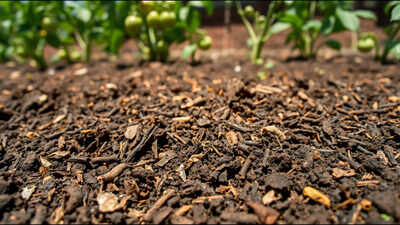
A seventh-grade student in Puerto Rico has turned plantain peels thrown away by her school cafeteria into a bioplastic mulch that reduced weed growth by as much as 53% in a four-week experiment. Wileidy Enid Feliciano-Rivera, a student at Escuela Intermedia Rafael Irizarry Rivera in Peñuelas, developed EcoMusa after learning that materials with properties similar to plastic could be made from vegetables or fruits. Her project, “Evaluation of the Effect of EcoMusa: Bioplastic Mulch Based on Musa paradisiaca for Weed Control (Phase II),” is among the 30 finalists in the 2026 Thermo Fisher Scientific Junior Innovators Challenge. Society for Science says her two EcoMusa mulches reduced weed growth by 47% and 53% and were comparable to commercial black plastic mulch sheeting in the experiment. The profile does not identify which version produced which result or specify the baseline used for calculating the two reductions.
How Wileidy turned plantain peels into EcoMusa mulch
Feliciano-Rivera’s project began with plantain peels being thrown away from her school cafeteria. She chopped the peels into small pieces, blended them with water, acetic acid, glycerin and cornstarch, then heated the mixture and allowed it to dry in trays, producing the bioplastic material used for the mulch. She created two versions, called EcoMusa 1 and EcoMusa 2.The idea grew from her concern about plastic use in agriculture. Society for Science quotes Feliciano-Rivera saying she found it interesting that materials with properties similar to plastic could be created “by using vegetables or fruits.” She then decided to investigate whether she could create a biodegradable mulch using plantain peels discarded by her school cafeteria. The project title itself describes the resulting material as a bioplastic mulch, while the finalist profile records biodegradable mulch as the project’s goal rather than reporting a quantified biodegradation result. She compared both EcoMusa versions with unprotected soil and commercial black plastic mulch sheeting. The experiment was designed to examine weed density as well as soil moisture, soil temperature and plastic degradation over four weeks.
EcoMusa was tested for four weeks
According to Society for Science, the two EcoMusa mulches reduced weed growth by 47% and 53% during the experiment and were comparable with the commercial plastic sheeting. The profile does not say which of the two versions produced the 47% result and which produced the 53% result. It also does not state the exact baseline used to calculate those percentages or provide the weed-reduction figure recorded for the commercial black plastic mulch. The mulch also affected the soil conditions measured during the test. Society for Science reports that the plantain-based material kept soil between 1 and 3 degrees Celsius cooler than uncovered soil and helped keep the soil moist. Because the experiment lasted four weeks, these observations do not establish how the material would perform over an entire growing season or under commercial farming conditions.Feliciano-Rivera also measured plastic degradation during the experiment. However, Society for Science’s finalist profile does not give a percentage or other numerical result for degradation. It also does not report the number of experimental replicates or statistical tests used to establish the reported weed-control figures. The 47% and 53% results therefore come from the competition profile rather than from a published scientific paper or independent assessment.
What research says about plantain peels
Plantain peel has also been studied as a source of useful materials. A 2026 scoping review published in Foods titled “Composition, Functionality, and Use of Plantain Peel (Musa paradisiaca): A Scoping Review” examined 53 studies and found research into the peel’s composition and potential applications, including functional foods, antimicrobial nanoparticles, industrial enzyme production and citric-acid biosynthesis. The review described plantain peel as rich in fibre, starch and bioactive compounds, while noting limitations including process standardisation and the need for further research before wider industrial use.Separate research has specifically demonstrated that plantain peels can be processed into films. A 2023 study published in Waste Management reported recovering pectin from plantain peels and using it to produce reinforced films with potential as an alternative to some single-use plastic packaging. That study involved pectin extraction and film fabrication; however, rather than agricultural mulch, so it does not establish the performance of EcoMusa. EcoMusa remains a student research project rather than an established agricultural product. Its experiment indicates that the material could suppress weeds while affecting soil moisture and temperature, but the available project profile does not establish its long-term durability, performance across different crops or behaviour under field conditions.
EcoMusa heads to the 2026 Junior Innovators Challenge
Feliciano-Rivera is one of 30 finalists selected for the 2026 Thermo Fisher Scientific Junior Innovators Challenge, a STEM research competition for middle school students run by Society for Science and sponsored by Thermo Fisher Scientific. Society for Science’s finalist listing identifies her as a seventh-grade student at Escuela Intermedia Rafael Irizarry Rivera and gives her project title as the EcoMusa study.Outside science, Feliciano-Rivera enjoys crafting, drawing and painting. She visited the Kennedy Space Centre in Florida and told Society for Science that the trip strengthened her dream of working at NASA. She received her first telescope at eight and says she wants to become an astrophysicist, adding that she has been curious about understanding how the universe works “since I was very young.” For now, EcoMusa offers a student-tested example of how discarded plantain peels can be processed into a bioplastic material and investigated for agricultural use. Its reported weed-control results are promising within the four-week experiment, while longer-term performance and the material’s actual biodegradation remain questions for further testing.


