










You cannot know something you have never actually encountered in some form. That is the whole idea behind John Locke’s line, “No man’s knowledge here can go beyond his experience.” He wrote it in 1689, in An Essay Concerning Human Understanding, while arguing against the idea that the soul is always thinking, even during sleep, whether or not we are aware of it. Locke’s answer was simple. If you were not conscious of a thought, you have no actual grounds for claiming to know it happened. It is a small, precise argument buried inside a much bigger book, but it says something that still holds up regardless of the specific debate that first produced it: nobody can honestly claim knowledge of something that never actually touched their own awareness in some way.
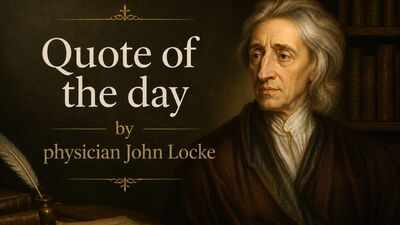
Quote of the day by physician John Locke
“No man’s knowledge here can go beyond his experience”.
What John Locke was actually arguing
The line comes from a fairly specific debate, not a general life lesson. Some philosophers of Locke’s time argued that the mind never truly stops thinking, that thought continues quietly beneath the surface even when we are not aware of it. Locke pushed back hard. He asked how anyone could possibly claim to know that, given that nobody has access to thoughts they were never conscious of in the first place. Knowledge, in his view, cannot reach further than what a person has actually experienced or perceived.That is a narrower and sharper point than the popular, watered-down version of the quote usually suggests. Locke was not simply saying “go get more life experience.” He was making a specific claim about the limits of what anyone can honestly claim to know.This mattered a great deal in the intellectual arguments of his time. Other philosophers were comfortable asserting things about the soul and the mind that went well beyond anything a person could actually check against their own awareness. Locke treated that kind of confident overreach as a mistake worth correcting, one sentence at a time.
The blank slate idea sitting underneath it
This line fits into a much bigger argument Locke was making across the whole book. He rejected the idea that people are born with certain truths already built into their minds. Instead, he argued the mind starts out closer to a blank page, and everything a person comes to know arrives through the senses and through reflecting on what those senses take in.That idea became known as tabula rasa, and it turned into one of the most influential positions in the history of philosophy. If Locke is right, nobody can simply reason their way to knowledge they have never had any actual contact with. Experience is not just helpful. It is the only raw material knowledge is built from.
Where this shows up outside philosophy books
You can see the same idea working in ordinary situations. Reading instructions on how to swim will teach you the theory of breathing and body position, but the actual skill only comes once you are in the water, adjusting in real time to things no instruction manual fully captures. A new manager can study leadership for years and still learn more from one difficult conversation with an employee than from any of it.None of this makes reading or theory pointless. It just means theory sets up the possibility of understanding, while experience is what actually produces it.Doctors, writers and teachers show the same pattern over long careers rather than single moments. A doctor becomes genuinely skilled only after years of actual patients, not case studies alone. A writer finds their voice through draft after draft, most of them not very good. A teacher learns more from one unpredictable classroom than from an entire module on classroom management. In each case, the theory came first, but it only became useful once tested against something real.
Why this still holds up when information is everywhere
It would be easy to assume Locke’s point matters less today, given how much information sits within reach of a phone. If anything, it cuts the other way. People can now watch a hundred videos about starting a business without getting any closer to the specific, uncomfortable problems that only show up once you are actually running one.Access to information has never been higher. Genuine understanding still has to be built the slow way, through direct contact with whatever you are trying to learn.
Using this idea in your own life
The practical version of this is simple. When you notice yourself relying entirely on something you have read or watched, rather than anything you have actually tried, treat that as a gap rather than as finished knowledge. Confidence built purely on information tends to be thinner than it feels.This does not mean avoiding books or research. It means treating them as preparation rather than substitutes, and looking for the earliest possible chance to test what you have learned against something real.
Other famous quotes by John Locke
- “Reading furnishes the mind only with materials of knowledge; it is thinking that makes what we read ours.”
- “New opinions are always suspected, and usually opposed, without any other reason but because they are not already common.”
- “Education begins the gentleman, but reading, good company and reflection must finish him.”
- “I have always thought the actions of men the best interpreters of their thoughts.”