


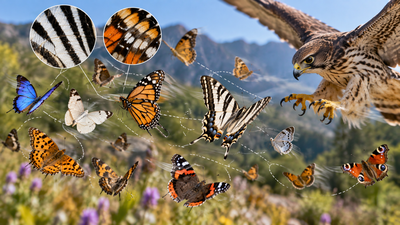
Butterfly wing patterns may work as a visual illusion against predators. Researchers at the University of Exeter and the University of Essex tested how high-contrast patterns and flight movement combine. According to the study published in Nature, titled ‘Butterfly wing patterns in flight create powerful illusory motion cues’, the team filmed take-offs at around 1,000 frames per second, simulated 757 morphotypes across 397 European species, evolved 57,600 digital wing patterns and ran 3,000 trials with 100 human volunteers. Natural patterns produced significantly more motion confusion than unpatterned wings, which the authors say is likely to affect how predators judge a butterfly’s speed and direction.
How do butterfly wing patterns fool birds
The dazzling stripes on zebras and snakes have long been thought to interfere with a predator’s perception of motion, but this hypothesis has so far received little empirical support. The authors note that earlier studies of animals such as zebras, snakes and lizards were somewhat equivocal in their findings. They also point out that those studies used rigid prey, even though animal movement often involves limbs that work against the body’s main direction of travel.The researchers argue that butterflies are well suited to testing the idea. Many species have high-contrast patterns similar to those suggested to affect motion perception, along with wingbeat frequencies low enough for bird vision to resolve. The authors add that strikingly few predators have specialised in catching butterflies in flight. Nocturnal moths, by contrast, are targeted by many avian predators on the wing, and the paper says they generally have lower-contrast patterns and higher wingbeat frequencies, which would probably blur the motion too much to create illusory cues.
How did scientists test butterfly motion confusion
To test the hypothesis, the team used elementary motion detectors, which the paper describes as the basic unit of the motion-processing system across a wide range of animal groups. They defined two measures. Forward confusion is the Michelson contrast between forward and backwards motion energy, which the authors say is likely to interfere with a predator, for example by misdirecting attacks behind a butterfly. Sideways confusion compares left–right energy with forward energy and is likely to misdirect attacks to the side. The footage was filtered to match the vision of small passerine birds, using a spatial limit of about 6 cycles per degree and a 100-Hz critical flicker fusion frequency.The first test used take-offs filmed at 1,000 frames per second. The footage covered 18 flights across seven wing morphotypes from five species: the orange tip, the common mime swallowtail’s relative Hypolimnas misippus, Papilio dardanus ochracea, the Old World swallowtail and the red admiral. Butterflies with natural wing patterns created significantly more motion confusion than versions of the same footage in which the patterns were replaced with average grey, black or white (P < 0.001 for every comparison). The authors report that patterning altered the ratio of motion energy in different directions, producing both forwards and sideways confusion by reducing the relative amount of forwards motion.
How do butterfly wing patterns confuse predators
The team then rendered simulated flight for 757 butterfly morphotypes across 397 European species at 2,000 frames per second, using illustrations from the Collins Butterfly Guide. Using random forest models, they found that forwards confusion during flapping flight was increased most by higher forewing contrast, followed by resolvable vertical stripes on the hindwing, an uneven stripe distribution (often a single stripe or a contrasting edge), brighter hindwings, rougher hindwing shape such as tails, and vertical stripes on the forewing. According to the paper, Papilionidae consistently showed high forwards and sideways confusion, while Nymphalidae ranged from the highest forwards confusion to negligible effects. The authors also report that forwards confusion can only be created by wing motion, whereas gliding flight can still generate strong sideways confusion.To check the model’s predictions, 100 human volunteers played a touch-screen butterfly-catching game at 240 Hz, giving 3,000 trials across five species chosen from across the confusion range. Attacks on butterflies with high forwards confusion were more elongated and fell further backwards along the line of travel (β = −0.15, P < 0.001). The team also used genetic algorithms to evolve 57,600 digital wing patterns under selection for motion confusion, and the paper reports that patterns selected for forwards confusion converged on those of real European butterflies. They describe the effect as “potentially representing one of the most successful visual defence strategies in moving animals”. The paper notes that further work should consider underwing patterns, a wider range of flight dynamics, viewing angles and distances, and different backgrounds.
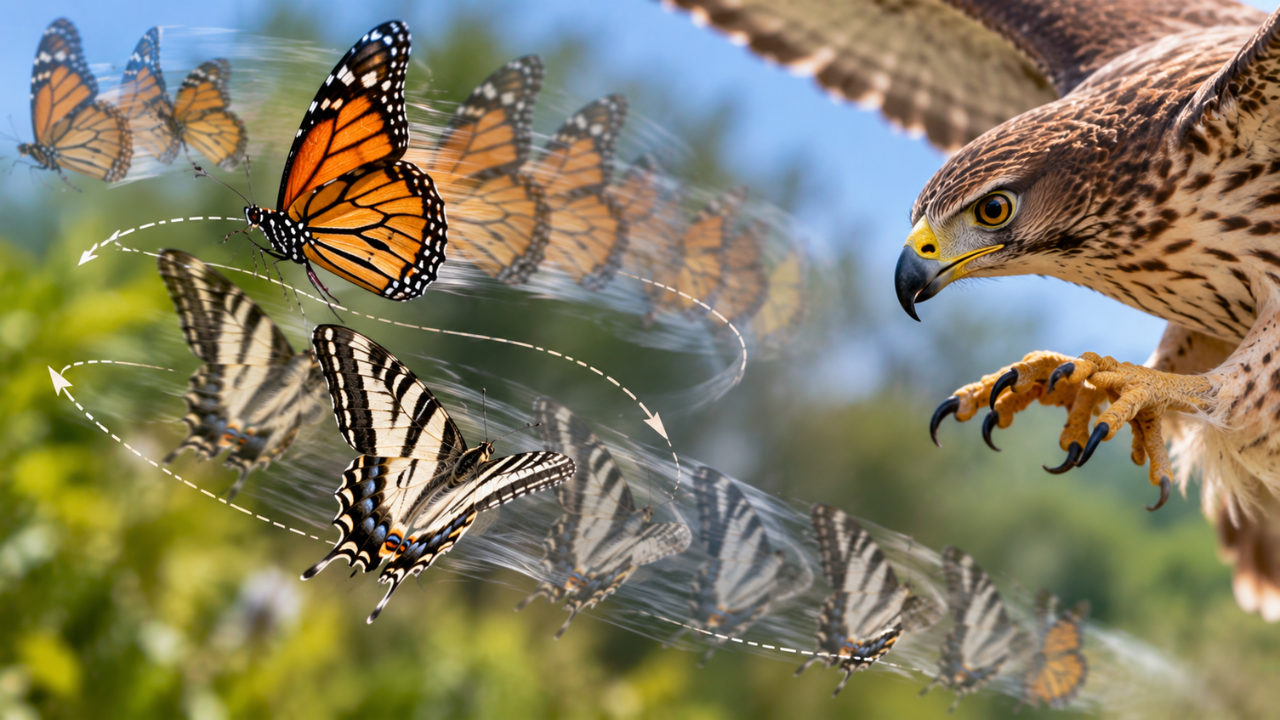
Image AI generated


