


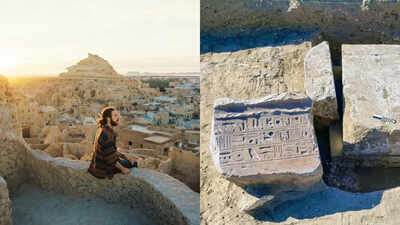
For more than three millennia, the name Mesen survived in ancient records without a confirmed place on the map. Now, a battered stone inscription found in Egypt’s northern Sinai may have given archaeologists their strongest clue yet to the city’s whereabouts, states an online report by Live Science. As per the report the discovery was made at Tell Abu Seifi, an archaeological site near the Suez Canal, close to the northern Sinai Desert and the eastern Nile Delta. Excavations have uncovered remains that appear to connect the site with Mesen, an ancient city associated with the Egyptian god Horus and a major military route leading toward the Levant. Scroll down to read the details of the discovery.
A name carved in stone
The key discovery is a massive sandstone lintel that was broken in half but remains inscribed on three sides, states the report. The inscriptions include the titles of Ramesses II, who ruled Egypt from around 1279 to 1213 B.C., along with references to restoration work involving a statue of Horus. Most importantly, the ancient text identifies Horus as the Lord of Mesen. If we go by the report, the connection is significant because Mesen has long been known from historical sources, yet archaeologists have never been able to establish its precise location.
Signs of a city beneath the site
The inscription is not the only evidence pointing toward Mesen. Archaeologists have also uncovered the remains of a temple dedicated to Horus at Tell Abu Seifi, although the structure has been heavily damaged and offers limited information about its original design. Also, excavations have revealed a mudbrick enclosure wall and its gateways, adding further evidence that the location once formed part of a substantial settlement. The repeated connection with Horus is particularly striking. A bronze seal previously discovered at the site dates to the Ptolemaic period, roughly 304 to 30 B.C., and also carries the title linking Horus with Mesen. Coffins found at Tell Abu Seifi from the same period bear similar inscriptions.
A city with a long history
If Tell Abu Seifi does turn out to be ancient Mesen, the settlement appears to have survived for centuries, adds the report. Also, the Ptolemaic finds suggest that the connection between the site and the cult of Horus continued long after the reign of Ramesses II. That would place the possible city within a much broader stretch of Egyptian history than the original New Kingdom inscription alone suggests. Archaeologists currently lack enough evidence to estimate its population or determine the full extent of the settlement, states the report as well.
The mystery isn’t quite solved
The discoveries have strengthened the case for identifying Tell Abu Seifi with Mesen, but archaeologists are stopping short of declaring the mystery closed. More excavation and analysis will be needed to establish the identification with greater certainty. The near-destruction of the Horus temple also means that important evidence may already have been lost. Still, after roughly 3,200 years, the inscriptions and ruins at Tell Abu Seifi may finally be pointing archaeologists toward a city that has existed mostly as a name in ancient Egyptian history. If the identification is confirmed, a long-lost stop along the Way of Horus could finally have a place on the modern map.Images Courtesuy: istock and Egyptian Ministry of Tourism and Antiquities


