









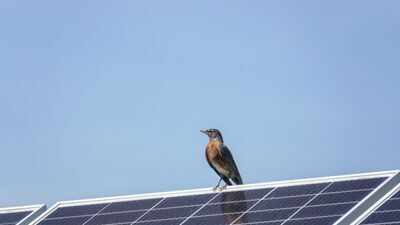
Solar farms are expanding across landscapes, but scientists still have questions about what happens to birds that live and move around these large arrays. Now, scientists and researchers at Argonne National Laboratory have developed an artificial intelligence-powered camera system that can continuously watch birds around solar panels and identify what they are doing. The system was trained to distinguish birds from insects, plants, shadows, and other moving objects, then classify behaviours such as flying over panels, flying through them, perching, landing on the ground, and possible collisions. During more than 17,000 hours of recorded footage, the cameras detected no bird collisions with solar panels. The footage shared by the US Department of Energy also revealed birds using the underside of panels for activities including foraging, nesting and roosting. The findings do not prove that solar panels are harmless to birds everywhere, but they offer a new way to study these interactions at scale. Researchers are now expanding the system to more solar sites across the United States.
How AI is helping researchers track birds around solar panels
Argonne National Laboratory’s system was created to address an important problem that researchers need more information about how birds behave around large solar photovoltaic facilities. Earlier studies in the Southwest found dead birds, raising concerns that collisions with panels might be responsible. The research published has offered a clearer picture, suggesting that bird deaths may be less common than initially believed, while birds can also use solar facilities as a place to feed, rest, and nest. To gather more reliable evidence, the project received $1.3 million from the US Department of Energy’s Solar Energy Technologies Office. The camera system combines continuous video monitoring with machine learning, allowing researchers to track bird activity without having to manually review hours of footage. This approach helps researchers analyse large amounts of video more quickly and efficiently.
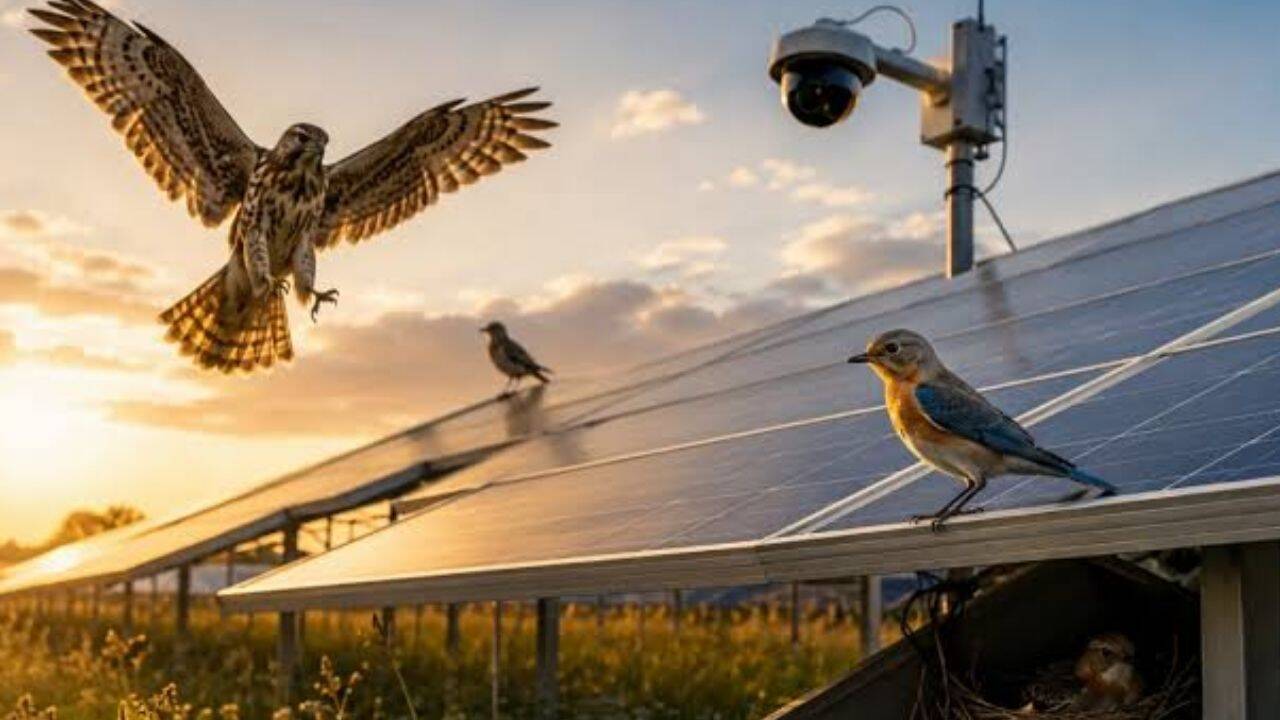
PC: AI Generated
How the machine learning system identifies bird behaviour
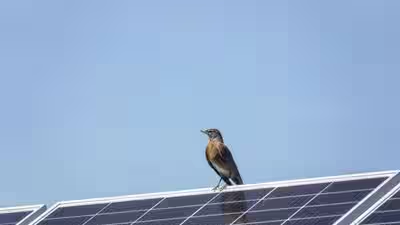
The AI-powered camera is designed to recognise birds as they enter its field of view and distinguish them from insects, other wildlife, plants, moving cables and shadows. Once a bird is detected, the system classifies its behaviour into six categories: flying over a panel, flying through the panels, perching on a panel, colliding with a panel, perching in the background or landing on the ground. Researchers collected more than 17,000 hours of video while testing the system. According to the US Department of Energy, the technology achieved up to 95% accuracy when identifying different bird behaviours.
What researchers found after 17,000 hours of bird footage
One of the most notable findings was the absence of any recorded bird collisions. Across more than 17,000 hours of footage, the cameras did not capture a single bird hitting a solar panel. However, researchers caution that this does not provide a complete answer about collision risks, as the system was tested at only a limited number of sites. The footage also showed birds perching on panels and flying around the solar structures. Researchers observed other behaviours that the AI system was not specifically trained to identify. Birds were seen using the underside of solar panels for activities such as foraging, nesting and roosting.
Where the AI bird monitoring system will be tested next
The research is now expanding to more locations to examine how birds interact with solar panels in different environments. Argonne has received an additional $2.1 million from the Solar Energy Technologies Office to deploy the camera system at seven solar facilities across California, Georgia, Massachusetts, Michigan, Texas, Virginia and Wyoming. The sites cover a range of landscapes, including forests, deserts, urban areas and farmland. This wider testing will allow researchers to compare bird behaviour across different habitats and bird communities.