

At the age of seven, Onkar Singh Batra built a website—an achievement that earned him recognition as the world’s youngest male webmaster. At 12, he wrote a book. At 13, he started a company.Then, while still a school student in Jammu, he turned his attention towards space.At 16, Batra built a satellite. By 19, he had moved to Silicon Valley and raised $4.3 million for a startup attempting to solve one of the persistent problems facing satellites in low Earth orbit: how to stay connected when they disappear from the view of ground stations.Today, at 20, the Jammu-born entrepreneur is building what he describes as a continuous communication layer for satellites in space.
From building websites at 7 to a satellite at 16
Born and raised in Jammu, Batra’s interest in technology began early. His father worked in information technology, giving him an early exposure to computers.He built his first website at the age of seven and later founded Batra Technologies. At 12, he wrote a book, When the Time Stops, while his technology experiments and projects continued alongside his school education.During the Covid-19 pandemic, he built an interactive platform, an effort for which he received the Pradhan Mantri Rashtriya Bal Puraskar.But it was space technology that would eventually take him in an entirely different direction.While studying in Class 12 at a school in Jammu, Batra worked on InQube, a satellite weighing around one kilogram. Described as India’s first open-source satellite, its design was made publicly accessible, allowing others to study and build upon the technology.At around the same time, he was invited to teach space systems to engineering students at IIT Jammu—before completing his own school education.
The problem he found while building a satellite
Building InQube exposed Batra to a problem that affects the wider satellite industry.Satellites orbiting in low Earth orbit cannot remain in constant contact with a ground station. For portions of their orbit, they move beyond the ground station’s line of sight, creating communication gaps or so-called dead zones.For an Earth-observation satellite monitoring a flood, wildfire or other event, this could mean that valuable data cannot immediately be transmitted to the ground.Building additional ground stations can be expensive, while existing relay systems may require satellites to carry specialised hardware.Batra’s answer was to move the communication infrastructure into space itself.
From Jammu to Palo Alto with a $4.3 million bet
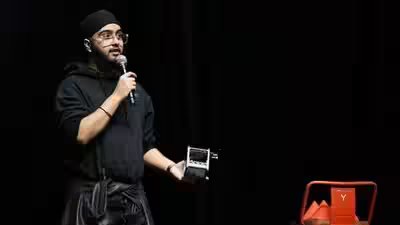
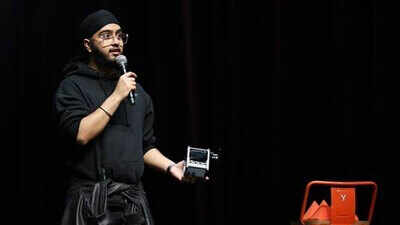
In 2024, he founded Apolink, a Palo Alto-based space technology startup, to address this communication challenge.The company’s plan is to build a network of small satellites equipped with radio and optical communication systems. These satellites would function as relay points, helping other satellites send and receive data even when they are outside the direct view of a ground station.In 2025, Apolink raised $4.3 million from investors, including Y Combinator, at a reported valuation of $45 million.The company took another step towards testing its technology in 2026 when its first demonstration satellite was launched on a SpaceX mission.
A 20-year-old building infrastructure for space
Batra’s journey is unusual not simply because he became an entrepreneur at a young age.It is because each stage of his career appears to have led naturally to the next: a childhood interest in computers, early technology projects, a satellite built during school and finally a company focused on a problem he encountered while working in space technology.His story also offers a different lesson for students who see engineering only as a route to a conventional job or a high-paying placement.For Batra, formal education was only one part of the journey. The bigger pattern was learning by building—starting with a website at seven, progressing to a satellite at 16 and eventually taking a homegrown idea from Jammu to Silicon Valley.At 20, his challenge is considerably larger: building communication infrastructure that could help satellites stay connected when Earth can no longer see them.Disclaimer: This article is based on publicly available information and social media posts shared by the individuals or sources cited. The views and claims expressed are those of the respective sources and do not necessarily reflect the views of TOI Education.