








Headlines

Solar Storm Forecasts: New model may improve solar storm forecasts

Representative image of CME (Image credit: Nasa) BENGALURU: Scientists have developed a computer model that could help predict how quickly powerful eruptions from the Sun will travel towards Earth, potentially improving warnings for disruptions to satellites, power grids and communication systems.The three-dimensional model was developed by researchers at the Indian Institute of Astrophysics (IIA), an…

Read More

A dose of insecticide killed 97.91% of mosquitoes that spread dengue; a tiny fraction that survived has researchers in Delhi worried

While India is a country filled with annual cultural traditions, a natural one that returns every year without fail is the buzzing around the bed as soon as the monsoon rains begin pelting the ground. Most of the mosquitoes that entered homes and offices were removed with the help of α-cypermethrin, a widely used pyrethroid…

Read More

Butterfly wings inspire a breakthrough solar panel design that could boost electricity production by 66% |

Ornithoptera priamus. Image Credit: Robert Nash/Curator of Entomology Ulster Museum/Wikipedia Butterfly wings could offer a unique solution to one of the biggest problems faced by solar panels, which is ‘sunlight that bounces away before it can be used.’ A study published in ‘Solar Energy’ explored how the tiny structures found on the black scales of…

Read More

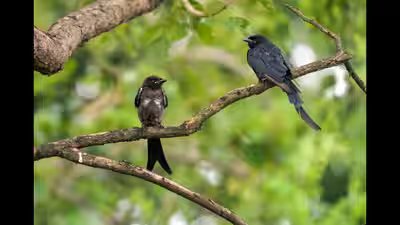
In 1935, black drongos were introduced on Rota to control crop pests; decades later the aggressive birds spread to Guam and became a threat to native birds

A juvenile and an adult Black Drongo perch on a tree branch (ANI Photo) In 1935, the Japanese South Seas Development Company made a decision that would have repercussions for Mariana Islands’ ecosystems for nearly 100 years. In search of a natural method for controlling agricultural pests, they imported black drongos (Dicrurus macrocercus) from Taiwan…

Read More

Meet Max Hung Nguyen, the 17-year-old California student who used Nasa data and AI to predict which stars are most likely to have giant planets |

Max Hung Nguyen was 17 when he began looking at a problem that astronomers have been studying for decades: whether the chemical make-up of a star can offer clues about the planets that form around it. The Leland High School student from San Jose used data from Nasa’s Exoplanet Archive and the Hypatia Catalogue for…

Read More

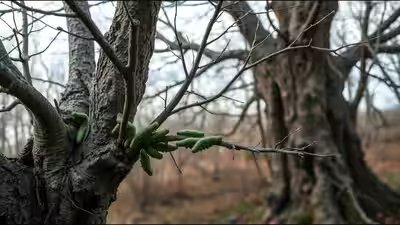
In 2026, scientists found oak trees can delay spring leaf growth by three days to starve hungry caterpillars |

​Representative Image of oak trees with delayed budburst as caterpillars wait for young leaves to emerge (AI-generated image) In temperate forests, spring timing can determine whether newly hatched caterpillars find a feast or almost nothing to eat. Many herbivorous insects emerge around the time trees produce their first young leaves, when the foliage is soft…

Read More

Scientists found a mysterious mark inside a 236-million-year-old fossil in Argentina that may reveal ancient mammal relatives gave birth instead of laying eggs

Reconstructed Triassic landscape at the Museum am Löwentor, Stuttgart (Germany), with Chiniquodon theotonicus (left), Batrachotomus kupferzellensis (right), and, poorly visible in the foreground below the water table, a large temnospondyl. Image Credit: Ghedoghedo/Wikipedia A 236-million-year-old fossil from Argentina may have provided the earliest evidence yet that an animal on the evolutionary lineage leading to mammals…

Read More

Meet Rohan Naidu, the MIT astronomer who left engineering at 18; now he is helping uncover how the Universe’s earliest black holes formed

Image(s): Left/Department of Physics, MIT/Right/MoM-BH*-1 A Hyderabad-born astronomer who left engineering school at 18 and counts Test cricket among his favourite pastimes is now helping scientists look deeper into the earliest chapters of the Universe. Rohan P. Naidu, an MIT Pappalardo Fellow in Physics, is the lead author of a new Nature study that examines…

Read More

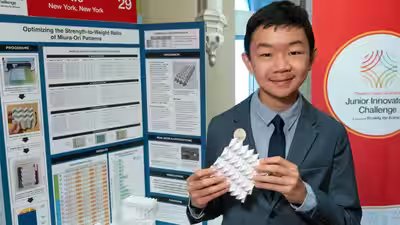
Meet Miles Wu, the 14-year-old New York student using origami to explore stronger, foldable emergency shelters |

Image: Society for Science At 14, Miles Wu is exploring how an ancient paper-folding technique could inspire stronger and more portable structures for emergencies. An eighth-grade student at Hunter College High School in New York, Wu spent the past year investigating the Miura-ori, a geometric origami pattern known for folding flat sheets into compact forms….

Read More