









Headlines

In 1937, Australian scientists released infected rabbits on an island to test a virus that would later transform rabbit control across the continent |

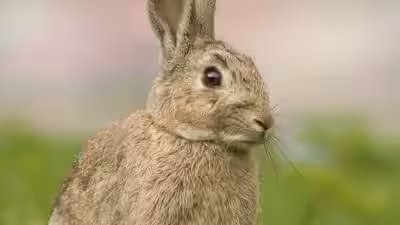
A European rabbit in Tasmania. Image Credit: JJ Harrison/Wikipedia In 1937, Australian scientists took an unusual step in the fight against one of the country’s most destructive pests known as ‘rabbits.’ They released rabbits carrying ‘myxoma virus’ on Wardang Island, off South Australia, to see whether the disease could spread naturally. The experiment was part…

Read More

In 1885, New Zealand released European hedgehogs as garden pest killers; 140 years later, DOC calls them a major threat to native wildlife and one can empty an endangered tern colony of nesting birds

European hedgehog (Image Credit: Canva) What was once seen as a useful garden helper in New Zealand has become an unexpected threat to some of the country’s most vulnerable wildlife. European hedgehogs were deliberately introduced to New Zealand in the 19th century, with acclimatisation societies releasing them in the hope that they would help control…

Read More

Quote of the day by Florence Nightingale: “So never lose an opportunity of urging a practical beginning, however small” |

Florence Nightingale, widely remembered as the “Lady with the Lamp”, became one of the most influential figures in the history of nursing and healthcare. Born in 1820, she challenged the expectations placed on women of her time and devoted her life to improving the treatment of sick and injured people. Her work during the Crimean…

Read More

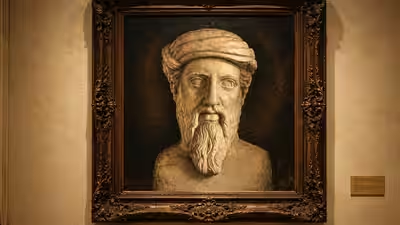
Quote of the day by Pythagoras: “Of all the rest of mankind, make him your friend who distinguishes himself by his virtue” |

Pythagoras is best known today for the mathematical theorem that bears his name, but the ancient Greek thinker was also associated with a broader philosophical tradition that explored morality, discipline, friendship and the pursuit of a virtuous life. One saying attributed to him offers a timeless reflection on the people we choose to keep close:…

Read More

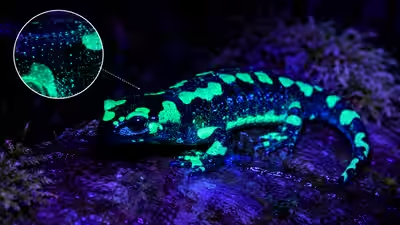
Scientists found fire salamanders glow blue-green under ultraviolet light, with their skin glands producing fluorescent secretions |

At first glance, the fire salamander appears much as it always has: black skin broken by irregular yellow markings, a pattern long associated with the species’ chemical defences. But under ultraviolet light, that familiar appearance changes. According to the 2026 study published in the Royal Society, titled ‘Glandular biofluorescence in fire salamanders (Salamandra salamandra): first…

Read More

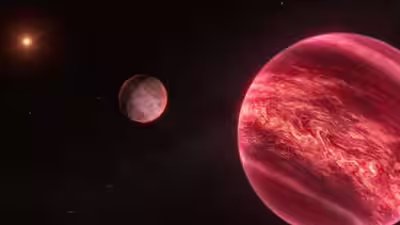
Exomoon: Have we found first exomoon? Strange object forcing astronomers to rethink what a moon is

A conceptual illustration of CD-35 2722, featuring an object resembling a moon (Credit: ESO) For decades, astronomers have been finding planets orbiting stars far beyond our solar system. More than 6,000 exoplanets are now known.But there is one glaring omission.Not a single moon outside our Solar System has been confirmed with the same level of…

Read More

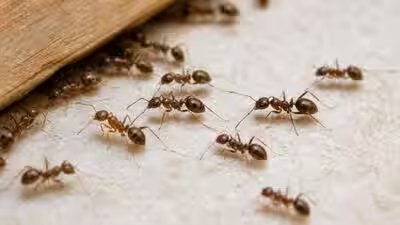
California scientists poisoned invasive Argentine ant colonies with two common baits; one sent workers roaming before death, the other made them stop searching for food and cluster near water

Argentine ants are invasive ants commonly found in homes and gardens in Southern California Seeing more Argentine ants after putting out pesticide bait may not mean the treatment has failed. A new University of California, Riverside, study found that the chemicals can change the ants’ behaviour, with the response varying depending on the type of…

Read More

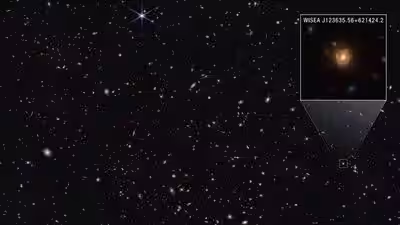
Since Webb discovered mysterious “little red dots” in 2022, astronomers have struggled to explain them; a galaxy seen 3.3 billion years after the Big Bang may finally reveal their hidden evolution

Photo credit: NASA, ESA, CSA, STScI, Pierluigi Rinaldi (Steward Observatory); Image Processing: Alyssa Pagan (STScI) Since NASA’s James Webb Space Telescope first revealed mysterious “little red dots” (LRDs) in 2022, astronomers have been racing to understand what these strange objects really are. Compact, extremely distant and glowing red, they appear throughout the early universe, but…

Read More

Solar Storm Forecasts: New model may improve solar storm forecasts

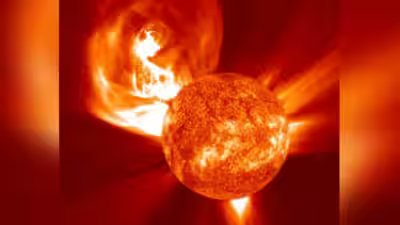
Representative image of CME (Image credit: Nasa) BENGALURU: Scientists have developed a computer model that could help predict how quickly powerful eruptions from the Sun will travel towards Earth, potentially improving warnings for disruptions to satellites, power grids and communication systems.The three-dimensional model was developed by researchers at the Indian Institute of Astrophysics (IIA), an…

Read More