









Headlines

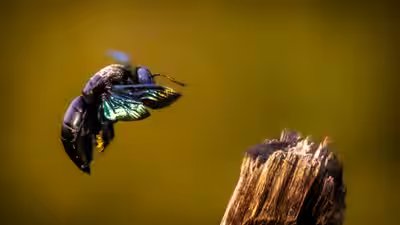
Scientists exposed bumblebees to low doses of a modern pesticide; the bees survived, but genes linked to producing the next generation began changing

Scientists exposed bumblebees to low doses of a modern pesticide Scientists exposed bumblebees to low doses of a modern pesticide Scientists exposed bumblebees to low doses of a modern pesticide Scientists exposed bumblebees to low doses of a modern pesticide Scientists exposed bumblebees to low doses of a modern pesticide Bumblebees are among the world’s…

Read More

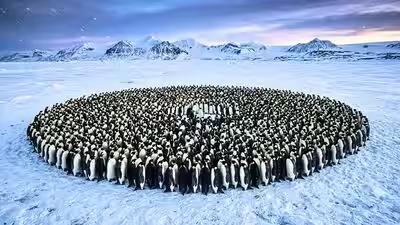
Emperor penguins survive Antarctica’s brutal winters by huddling together, but a maths study reveals the hidden system behind their remarkable teamwork |

Every winter in Antarctica, emperor penguins gather in large groups called huddles to survive the cold. Temperatures can fall to -40 degrees Celsius, and strong winds make the weather even harsher. Without huddling together, these penguins would not be able to survive.But a penguin huddle is much more than a group of birds standing close…

Read More

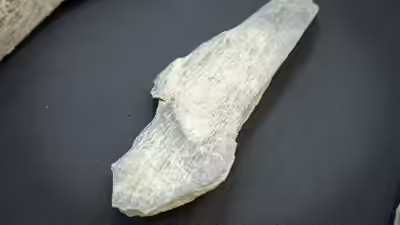
NASA’s curiosity rover spots mysterious honeycomb pattern on Mars, leaving scientists puzzled over its origin

Space and its mysterious world never fail to surprise humans. According to the latest report, 14 years after touching down on the Red Planet, NASA’s Curiosity rover has snapped a photo of a mysterious honeycomb-like texture on the Martian surface, lending yet another mystery to an ever-expanding list of Martian geological features.NASA’s veteran Curiosity rover…

Read More

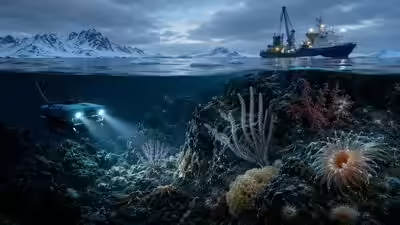
Norway opened parts of its Arctic seabed for future mining, but scientists have now discovered rare deep-sea life living there |

Far below the Arctic Ocean surface, beyond the reach of sunlight and largely untouched by human observation, a month-long expedition has been documenting a world that few people have ever seen. Scientists working aboard a Greenpeace research mission used remotely operated vehicles to explore seamounts, hydrothermal vents and deep seabed habitats off Norway’s coast, recording…

Read More

NASA’s New Horizons travelled 3 billion miles over 9 years to reach Pluto – but it was moving too fast to stop when it arrived

Representative image of Pluto If you’ve ever waited years for something important – a degree, a promotion, a long journey – you know how strange it feels when the defining moment itself is over in what seems like an instant. That’s exactly what happened with NASA’s New Horizons mission to Pluto. Engineers and scientists spent…

Read More

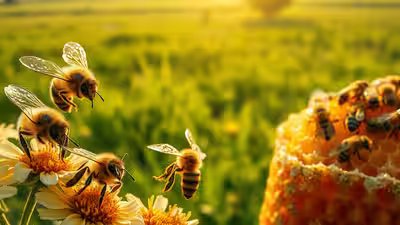
Scientists tagged thousands of bees and found that just a few do most of the work in every hive |

Bees have a reputation for being tireless workers, but it turns out that reputation only really applies to some of them. Researchers at the University of Illinois glued tiny numbered tags onto thousands of individual honeybees and tracked their comings and goings for almost two months across several separate colonies. What they found flips the…

Read More

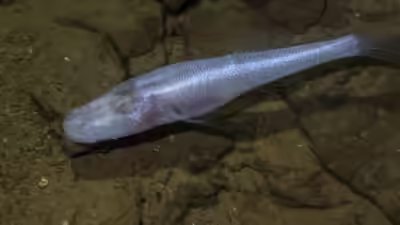
A scientist slipped into a pool beneath a US military base and found a fish later named ‘demon cavefish’ after the Demogorgon from Stranger Things

The Demogorgonichthys arcanus was discovered in a well-known area monitored by biologists for decades (Photo: Matthew Niemiller) A clumsy fall into an underground pool beneath an active US military base has led to the discovery of a strange, eyeless fish named after a TV series monster.Matthew Niemiller, an associate professor of biological sciences at the…

Read More

Quote of the day by Charles Darwin: “An American monkey, after getting drunk on brandy, would never touch…” – a witty observation on why humans often repeat the mistakes they already know can harm them |

Charles Darwin (Image source: Wikipedia) A bad experience is supposed to teach a lesson, yet people return to habits they already know are harmful more often than logic would suggest. Charles Darwin noticed the same contradiction and put it more bluntly than most. “An American monkey, after getting drunk on brandy, would never touch it…

Read More

Are data centres harming bees? Scientists are investigating the impact of electromagnetic fields |

Bees are among the world’s most important pollinators, helping sustain ecosystems and supporting the production of many fruits, vegetables, nuts and seeds. Yet bee populations have been declining for years due to habitat loss, pesticides, diseases, parasites and climate change. More recently, another potential threat has entered the conversation: the rapid expansion of data centres….

Read More