


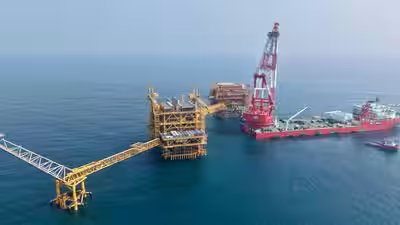
Months of turmoil in the Middle East have wrecked global energy supplies, forcing countries to rethink their energy security strategies. India, however, is looking inward. Rather than relying more heavily on imports, the government is betting on finding more oil and gas beneath its own seas by sharing the financial risks of deepwater exploration, an area companies have long avoided because of the high costs and uncertain returns.Last week, the Union Cabinet approved the Rs 84,084 crore Samudra Manthan National Offshore Exploration Scheme, under which the Centre will fund 50% of the cost of drilling a deepwater or ultra-deepwater exploration well, or up to Rs 650 crore per well, whichever is lower. Officials said the support will cover 60 exploration wells over the next five years.“This perhaps is the first time that any government in the world is funding risk exploration from the budget,” an official said.The programme comes as India continues to depend heavily on imported energy. Officials said crude oil imports have risen from 77% to 88% of the country’s requirement over the past decade. India also imports around half of the natural gas it consumes, which is used for fertiliser production, power generation, CNG and piped cooking gas.According to officials cited by PTI, the recent conflict in the Middle East, which disrupted energy supplies, highlighted the need to strengthen domestic production and reduce reliance on overseas supplies.Officials said companies have largely focused on producing oil and gas from known discoveries while investing little in searching for new reserves, as unsuccessful exploration wells result in complete financial losses.“They were spending money only on development drilling — producing already established discoveries. Hardly any money went into risk exploration, which is key to finding new resources,” an official said.To encourage companies to drill in deepwater and ultra-deepwater areas, the government will absorb part of the exploration cost.“Samudra Manthan is, in that sense, a game-changing scheme,” another official added.
How the scheme will work
The benefit will be available to companies holding blocks awarded under previous Open Acreage Licensing Programme (OALP) rounds as well as those securing acreage in the ongoing bidding round. Eligible companies can claim government support of up to Rs 650 crore for each qualifying exploration well.Officials said the scheme has also been designed to attract global energy companies to India’s offshore basins.The biggest share of the Rs 84,084 crore outlay has been earmarked for exploration itself.Of the total allocation, Rs 43,200 crore has been set aside over five years till 2031 for deepwater and ultra-deepwater drilling, translating to roughly Rs 650 crore each for the 60 planned exploration wells.Another Rs 28,534 crore will be spent on offshore seismic and geological surveys to identify prospective drilling locations.The scheme also earmarks Rs 10,000 crore for common infrastructure, including subsea pipelines and onshore oil and gas receipt and processing facilities, while Rs 2,000 crore has been allocated to develop oil and gas manufacturing and services zones.Apart from funding exploration, the government plans to create infrastructure that can be shared by multiple operators.Through its Common Hub Infrastructure (CHI) component, the scheme aims to develop shared pipelines and processing facilities so discoveries made by different companies can be commercialised using common assets instead of building separate infrastructure for every project.Officials said this could lower development costs, improve project economics, optimise marine engineering and offshore resources, make hydrocarbon evacuation more efficient, simplify offshore logistics, speed up commercialisation of smaller discoveries and improve the viability of deepwater and ultra-deepwater projects.
What are experts saying
Prashant Vashisht, senior vice president, ICRA Ltd, said the scheme addresses two major challenges in offshore exploration. “The scheme provides funds for offshore seismic data acquisition especially in erstwhile No-Go zones, which is a key issue hampering commercial exploitation of oil and gas reserves in these areas due to lack of good prospectivity data.“Additionally, the scheme provides support for drilling deepwater/ultra-deepwater wells where the domestic Upstream sector has limited experience and technical expertise and exploitation of the same remains highly capital intensive and risky. The scheme aims to add incremental annual production of 10-15 million tonne of oil equivalent which would reduce the dependence on imports of oil and gas but only to the extent of 3-5%,” he told PTI.
A long-term exploration push
Officials expect the scheme to increase exploration across India’s offshore basins, attract investment from international energy companies and help unlock hydrocarbon reserves that remain unexplored.They said the initiative is intended as a long-term effort, noting that deepwater exploration is inherently uncertain and not every well drilled under the programme will lead to a commercial discovery.Officials also said the government’s decision to directly fund exploration risk marks a departure from its earlier approach of supporting only proven development.The scheme builds on a series of policy reforms introduced since 1997. India shifted from production-sharing contracts to the Hydrocarbon Exploration and Licensing Policy (HELP) in 2016, introducing Revenue Sharing Contracts, the Open Acreage Licensing Policy (OALP), a uniform licence, and marketing and pricing freedom.The government later adopted a hybrid allocation model for under-commercialised basins, giving greater weight to work commitments in unexplored areas. These reforms were consolidated under the Oilfields (Regulation and Development) Amendment Act, 2025, which came into effect in April and laid the foundation for the 50 exploration blocks offered under OALP, small-field and coal-bed methane bidding rounds in December 2025.


