


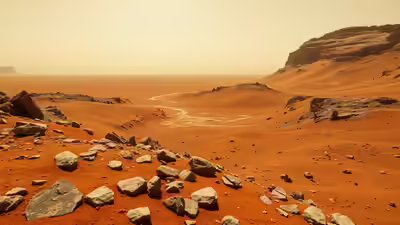
Today, Mars is a cold, dry planet covered in dust, but scientists believe it looked very different billions of years ago, with a much thicker atmosphere, flowing rivers and lakes, and possibly even conditions that could have supported life. Over time, Mars lost most of that protective atmosphere, the planet cooled, and its water either froze or disappeared into space, leaving behind the barren world seen today. For decades, scientists debated exactly what caused this loss. Nasa‘s MAVEN spacecraft, short for Mars Atmosphere and Volatile Evolution, has now provided the clearest answer yet, tracing the process back through a single, chemically stubborn gas called argon.
How Nasa’s MAVEN mission studied the thin Martian atmosphere
MAVEN launched from Cape Canaveral and was built specifically to study how the Martian atmosphere has changed over time. According to Nasa’s official announcement of the findings, the spacecraft travelled in a long, looping orbit, coming as close as around 150 kilometres to the surface before swinging back out beyond 6,000 kilometres, repeatedly gathering fresh atmospheric data throughout this cycle. Bruce Jakosky, the mission’s principal investigator at the University of Colorado Boulder, said the team had determined that most of the gas ever present in the Martian atmosphere has been lost to space.
Why argon became the key to unlocking Mars’ past
To reconstruct what had happened, Jakosky and his team turned to argon, a gas that does not react chemically with rocks or soil, meaning it cannot be trapped or absorbed the way other gases can. According to the peer-reviewed study Mars’ atmospheric history derived from upper-atmosphere measurements of 38Ar/36Ar, published in the journal Science, this made argon uniquely useful, since the only way it can ever leave a planet’s atmosphere is through a physical process called sputtering. Using instruments aboard MAVEN together with data from Nasa’s Curiosity rover, the researchers measured two different isotopes of argon and found that roughly 65 to 66 per cent of all the argon ever present in the Martian atmosphere has already escaped into space.
What sputtering actually does to a planet’s atmosphere
Sputtering describes what happens when the solar wind, a continuous stream of fast-moving charged particles released by the sun, strikes the upper layers of a planet’s atmosphere. According to the study, this collision physically knocks gas particles loose and sends them drifting off into space, a process the research team compares to marbles being struck and pushed off the edge of a table. Since the lighter of the two argon isotopes escapes more easily than the heavier one, the ratio remaining in the atmosphere today let researchers calculate how much argon must have existed and been lost over billions of years.
Why losing carbon dioxide made Mars so cold
Once the team calculated how much argon had been lost through sputtering, they used the same method to estimate how much carbon dioxide Mars had also lost to space. According to Nasa’s announcement, most of the planet’s carbon dioxide disappeared through this same process, and since carbon dioxide is a greenhouse gas capable of trapping heat, its loss played a major role in Mars losing its ability to stay warm. Without enough of it left in the atmosphere, the planet steadily cooled, its surface water froze or vanished, and the wet, potentially habitable environment scientists believe once existed there gradually gave way to the frozen desert Mars is today.
How Mars lost the magnetic shield that once protected it
According to Nasa, the deeper explanation traces back roughly 4 billion years, to when Mars still had a strong magnetic field, an invisible shield generated deep inside the planet that helped block much of the solar wind from ever reaching the atmosphere directly. Because Mars is considerably smaller than Earth, its interior cooled far more quickly, and as it cooled, the planet gradually stopped generating this protective field. Once that shield disappeared, the solar wind could strike the atmosphere unimpeded, steadily stripping it away over the following billions of years, a process made even more severe by the fact that the young sun produced significantly stronger solar wind and ultraviolet radiation than it does today.
A loss that continues in small amounts even now
MAVEN’s data shows that this process has not fully stopped. According to Nasa, the spacecraft’s measurements show that different gases escape more heavily at different points during the planet’s orbit around the Sun, with hydrogen loss increasing whenever Mars moves closer to the Sun and encounters stronger sunlight and solar wind. Mars continues to shed atmosphere at a rate of over 100 grams per second even today, with that figure rising further during intense solar storms, though the planet’s atmosphere is now less than one per cent as thick as Earth’s, far too thin and cold to support liquid water on the surface or human survival without protective equipment.


