








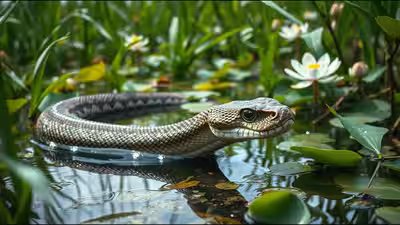
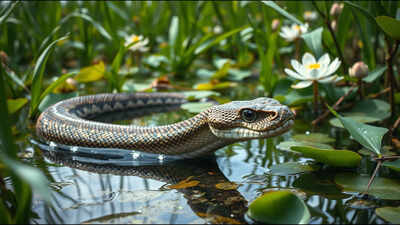
Wildlife researchers in the Everglades are using one Burmese python to help find another. Scientists at the University of Florida are fitting captured snakes with small radio transmitters and releasing them back into the wild, then following their movements during the breeding season. The strategy takes advantage of a basic part of python behaviour: when breeding season arrives, males actively search for females, which can attract several males to the same area. By tracking a male, researchers can sometimes follow him to a breeding aggregation and locate a female that might otherwise be almost impossible to spot in the vast wetlands of South Florida. The approach has become an increasingly important part of the team’s work. What began with eight tracked adult pythons in 2023 had grown to 14 snakes by spring 2024 and 25 scout snakes by March 2026. The researchers are using these tagged pythons both to locate additional snakes for removal and to learn more about how the invasive species moves and reproduces.
How researchers are turning male pythons into living trackers
The project is led by Melissa Miller, a research assistant scientist specialising in invasion biology at the University of Florida’s Institute of Food and Agricultural Sciences, or UF/IFAS. The work brings research and python removal together, allowing scientists to study the animals while also using their natural behaviour to improve the chances of finding more snakes. The method works because Burmese pythons do not necessarily mate in isolation. During the breeding season, males search actively for females, and several males may converge on a single female. The female’s chemical signals help the males locate her, creating what researchers call mating aggregations.That behaviour gives scientists an opportunity that would not exist during other parts of the year. Rather than searching the Everglades at random for a well-camouflaged female, researchers can follow the movements of a tagged male and see where he goes. If he begins behaving in a way that suggests he has located a potential mate, the research team can move into the area and search for the other snakes. Finding females is particularly valuable because of their reproductive potential. Burmese pythons are capable of producing up to 100 eggs in a single clutch. Removing a female before she reproduces can therefore have a much greater effect on future population growth than simply removing an individual snake at random. The researchers release tagged snakes into areas of the Francis S. Taylor Wildlife Management Area and use radio telemetry to monitor their movements. The technique is especially useful in the Everglades, where dense vegetation, shallow wetlands and enormous areas of difficult terrain make visual searches extremely demanding.
What the tagged snakes reveal about life in the Everglades
The transmitters are doing more than leading researchers toward additional pythons. Following individual snakes over extended periods gives scientists an opportunity to study where the animals travel, which habitats they use and how they behave during reproduction. That information can help answer questions that are difficult to investigate simply by removing snakes. Researchers want to understand where breeding takes place, where females establish nesting sites and how many offspring survive. Those observations can ultimately contribute to estimates of the size and growth of the python population.This is important because counting an invasive animal such as the Burmese python is far more complicated than counting animals in a confined area. The snakes are difficult to see and can spend long periods hidden in vegetation or water. Researchers therefore need information about movements, reproduction and survival to work out how many animals may actually be present. The tracking effort has also expanded considerably since its launch. The first phase involved eight adult pythons, but researchers were tracking 14 by spring 2024. By March 2026, reporting from the Everglades described the programme as working with 25 scout snakes. The growth reflects an effort to use the method on a larger scale rather than treating it as a small experimental project. There is still a cost to that expansion. Radio telemetry requires researchers to repeatedly locate tagged animals, maintain equipment and spend substantial time in the field. The team is therefore interested in finding ways to make the process more efficient. If researchers can use fewer resources to gather the same amount of information, the technique becomes more useful as part of a broader python management programme.
Why Burmese pythons are so difficult to control
Burmese pythons have become one of the most serious invasive species problems in South Florida. The large constrictors are capable of eating a wide variety of native animals, and researchers have documented their impact on wildlife in the Everglades. Their ability to remain hidden, move across large areas and reproduce successfully makes controlling the population particularly difficult.The problem is also not limited to simply finding adult snakes. A breeding female can introduce a large number of new individuals into the ecosystem, which makes locating reproductive animals an important part of management efforts. That is where the telemetry strategy offers a potential advantage: instead of treating every snake as equally difficult to find, researchers can exploit the behaviour of males to locate females at a particularly important point in the reproductive cycle. The project forms part of a much broader effort to understand the Burmese python invasion. UF/IFAS researchers have spent years examining how the snakes move through the Everglades, how they respond to environmental conditions and which native species are most vulnerable to predation. Other research has also examined parasites, pathogens and the wider ecological consequences associated with the snakes.