


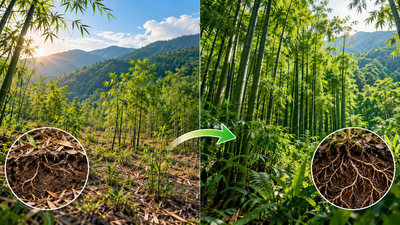
Passive rewilding, an emerging concept in restoration ecology, typically involves the cessation of management in plantations, removing both fertiliser inputs and biomass harvest. Researchers writing in the Journal of Plant Ecology examined Moso bamboo (Phyllostachys edulis) forests across rewilding durations of 0, 10, 20 and 30 years, tracking the growth of more than 4,000 culms. Contrary to the expectation of nutrient depletion, 30 years of rewilding increased total bamboo biomass by 161%. According to the study, carbon, nitrogen, and phosphorus stocks in the bamboo rose by 165%, 242% and 379%, respectively, while soil pools increased by 78%, 79% and 94%, respectively.
How does mature bamboo sustain young bamboo growth
According to the authors, the team investigated carbon (C), nitrogen (N) and phosphorus (P) dynamics in Moso bamboo forests across four rewilding durations: 0, 10, 20 and 30 years. The paper reports that they tracked the growth of more than 4,000 culms. The work was published as a research article in the Journal of Plant Ecology, and the version available at the time of writing is an accepted manuscript, meaning the author’s final manuscript as accepted by the journal before copyediting and typesetting.The researchers quantified nutrient concentrations, stoichiometric traits and nutrient stocks in four tissues: leaves, twigs, stems and roots. According to the paper published in the Journal of Plant Ecology, titled ‘Mature bamboo sustains young bamboo growth through internal nutrient redistribution during long-term forest rewilding’, they measured these in both young bamboo, defined as 1 year old, and mature bamboo, defined as 2 to 9 years old. The study also quantified nutrients in soil and in microbial biomass. The paper’s keywords are forest rewilding, plant-soil-microbe stoichiometry, nutrient redistribution, land abandonment and productivity.
How did bamboo biomass and nutrient stocks change
According to the study, long-term rewilding of 30 years increased total bamboo biomass by 161%. The authors report that carbon, nitrogen and phosphorus stocks in the bamboo rose by 165%, 242% and 379% respectively. They state that these increases were statistically significant (P < 0.05). The abstract presents this as a result that contradicts the expectation of nutrient depletion, given that rewilding removes both fertiliser inputs and biomass harvest.The soil also changed over the same period. According to the paper, soil carbon, nitrogen and phosphorus pools increased by 78%, 79% and 94% respectively, and these increases were also statistically significant (P < 0.05). The measurements covered bamboo tissues, soil and microbial biomass, which allowed the authors to follow nutrients through the plant-soil-microbe system rather than in the trees alone. The phosphorus stock in the bamboo showed the largest increase of the three nutrients reported for the plants.
How do mature and young bamboo differ in nutrient use
The authors used the coefficient of variation in stoichiometric traits to compare the two age groups. According to the paper, nutrient variability declined in young bamboo, a pattern the authors describe as homogenisation. In mature bamboo, variability increased, which the authors describe as divergence. The study reports that these two patterns were found within the same rewilded forests and refer to the traits measured across leaves, twigs, stems and roots.According to the authors, the pattern is consistent with young bamboo drawing from a shared clonal nutrient pool while mature bamboo accumulated reserves. The paper also reports a path analysis, which identified mature stem nutrients as the strongest biotic predictor of total bamboo biomass (P < 0.01). This links the nutrients held in older stems directly to the biomass of the bamboo as a whole.
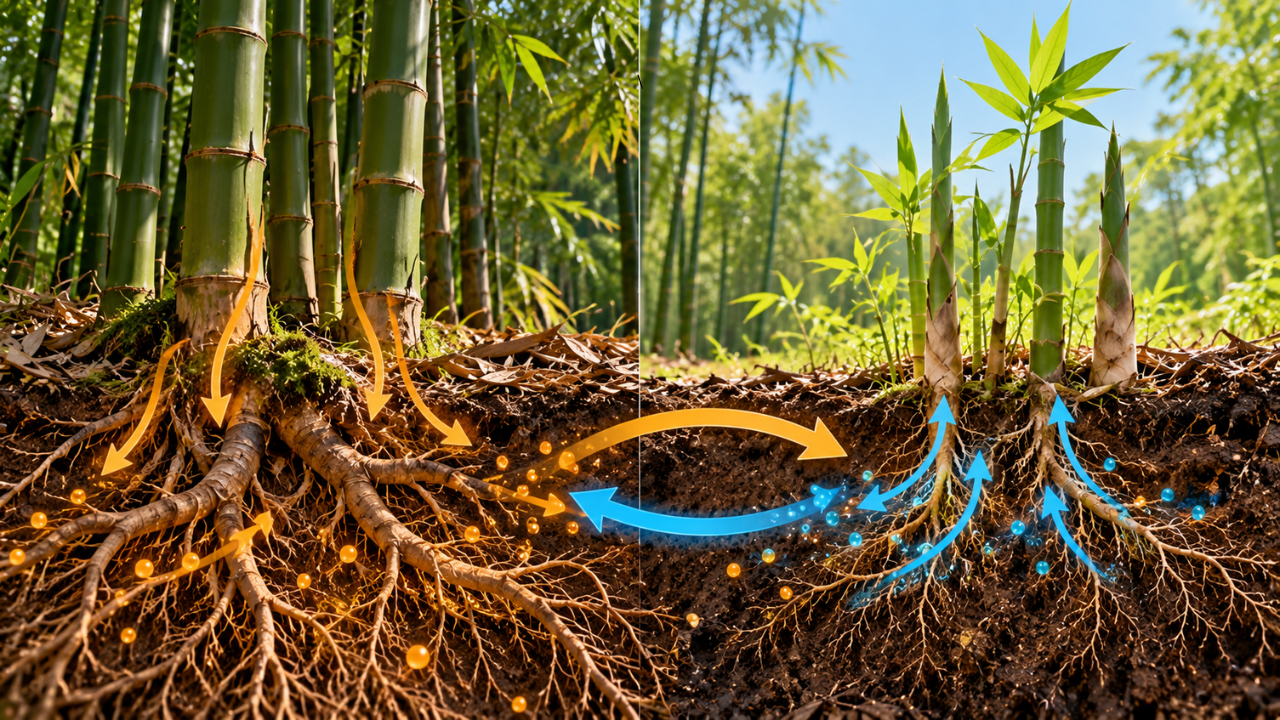
Image AI generated
How does bamboo become self-sustaining after rewilding
According to the authors, the findings reveal two pathways that sustain productivity in rewilded forests. The first is soil nutrient enrichment following the cessation of harvesting, which matches the increases in soil carbon, nitrogen and phosphorus pools reported in the study. The second is internal nutrient redistribution from mature to young bamboo, which matches the contrasting variability seen in the two age groups.The paper states that these pathways enable bamboo forests to transition from fertilisation-dependent to a “self-sustaining nutrient regime”. The authors note that the findings have implications for managing abandoned plantation forests globally. The article is published open access under a Creative Commons Attribution-NonCommercial licence, on behalf of the Institute of Botany, Chinese Academy of Sciences and the Botanical Society of China.


