


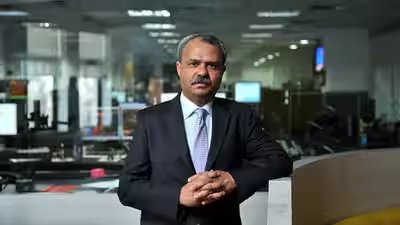
MUMBAI: HSBC has been in India since 1853 and has maintained the most consistent retail presence among global banks. Its Indian operations have doubled pre-tax profits in four years, making it the leading foreign bank by revenue and balance sheet, which stood at $50 billion. Hitendra Dave, HSBC India’s CEO since 2021, spoke about the bank’s FCNR(B) mobilisation and ambitions in affluent banking.How did HSBC lead FCNR(B) mobilisation?We are the most preferred global bank among India’s affluent. Our deposit mobilisation reflects our strength and reach in the NRI community across markets. Beyond FCNR(B) deposits, HSBC has helped Indian banks raise dollar resources, deploying about $1.5 billion to $2 billion through bilateral bonds and similar amounts through foreign currency loans. In the overseas bond issues by two private banks, we were practically the only bank participating, and these were large transactions.How will you deploy the rupees raised by swapping the dollars with RBI?Our asset-liability management tools tell us the bucket-wise gaps we can run. Even if we park the funds in G-secs, we have a spread of 75-100 bps. We have announced fixed-rate mortgages starting at 7.5% for the initial three years, addressing buyers’ concerns about rising interest rates. Our balance sheet was Rs 4.5 lakh crore at end-March and would have easily crossed Rs 5 lakh crore.Our GIFT City balance sheet would also have increased because some leverage is provided from there.Will you focus only on affluent customers?Mass affluent is the entry point for acquiring affluent customers. We are doubling down on wealth and affluent banking through digital platforms, advisory services and cross-border products spanning LRS, offshore accounts, GIFT City, mortgages and premium cards.Of 20 approved branches, eight have opened, prioritising cities with high mutual fund penetration and NRI diaspora, which has helped FCNR(B) collections. We are also setting up a stockbroking arm.Has India lost favour among foreign investors?Financial markets are inherently short-term in their thinking. Capital chases whatever is currently selling elsewhere. There is massive debt issuance by US hyperscalers, more than by some sovereigns, while equities in Taiwan and Korea are attracting capital.Currency weakness can create a self-fulfilling negative loop, with investors holding back and weaker inflows keeping the rupee under pressure. Corporate earnings have improved after weakening a couple of years ago, but valuations have not.A spark is needed to shift the narrative, such as lower oil prices, new land or labour reforms or major FDI announcements.Why has corporate capex been weak?Capex is often viewed through the 2012-14 cycle, when mega projects in power, steel and cement had virtually no genuine promoter equity and were largely bank-financed. With little equity, promoters had less incentive to fight for or stay with projects when conditions deteriorated. We do not want such projects because they involve taxpayer money. Current growth is instead seeing capacity expansion through consolidation, with well-capitalised groups such as Tata, UltraTech and Adani expanding through internal cash flows.Are you funding acquisitions now that this is allowed?We are the number one bank in acquisition financing. We were the first, and at that time the only bank, to fund the two domestic M&A directly from our local-currency balance sheet.Are large IPOs crowding out smaller players?The inverse economics of asset markets means more investors enter when prices rise. Successful giant IPOs draw in new retail investors and deeper pools of international institutional capital by demonstrating that India can handle large-scale liquidity. Whether an issue performs well on listing depends on whether the issuer has maximised its valuation and pricing.
