


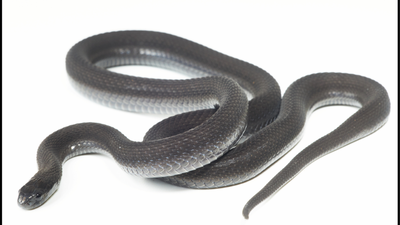
Deep in Ethiopia’s Harenna Forest, a snake that initially appeared familiar has turned out to represent a species new to science. The discovery began with a juvenile female collected from the forest and kept for observation as she grew. The appearance gradually raised questions about whether she belonged to a known egg-eating snake. What followed was a seven-year investigation involving captive breeding, detailed physical comparisons and genetic analysis. The result was the identification of Dasypeltis albigularis, a previously unrecognised species that lives in high-elevation forest and feeds on birds’ eggs. Its pale throat and underside helped give the snake its name.
The unusual feeding system of egg-eating snakes
Egg-eating snakes in the genus Dasypeltis have evolved a highly specialised way of feeding. They do not need to bite prey in the usual sense because their food is already contained inside a shell.Once an egg is swallowed, specialised vertebrae in the snake’s throat help break the shell. The contents can then be consumed while the pieces of shell are brought back up. The genus contains roughly 20 recognised species, many of which have similar-looking bodies in shades of black, brown or grey.That resemblance has made the snakes difficult to identify from appearance alone. In this case, the Harenna Forest animal initially appeared to belong to a species already known to science.
The Harenna Forest snake that was mistaken for the montane egg-eater
According to the study published in OGH Herpetozoa, titled ‘A new species of ‘black’ egg-eating snake of the genus Dasypeltis Wagler (Squamata, Colubridae, Colubrinae, Boigini)’ reveals that this started with a juvenile female obtained by Arthur Tiutenko from a local collaborator in Harenna Forest. At first, there was little reason to suspect that she represented an undescribed species.Tiutenko was looking for a male so the snake could be bred. As the female matured, however, her physical characteristics became harder to reconcile with the species she was thought to represent. The closest comparison was Dasypeltis atra, commonly known as the montane egg-eater. That species is black and occurs in forested parts of East Africa, making the two snakes superficially easy to confuse.Rather than relying on appearance, the team took the investigation further. The female was paired with a male D. atra. The resulting offspring showed a combination of characteristics inherited from both parents. That result did not, by itself, establish the animal as a new species. It did, however, give the researchers another line of evidence to consider while they examined the snake’s morphology and genetic material.The formal description eventually took seven years. The work involved comparing physical traits, analysing mitochondrial and nuclear DNA, and studying the characteristics seen through captive breeding.The genetic results separated the Harenna Forest snake from D. atra, supporting the conclusion that the two represented distinct species rather than variations within the same one.
White throats and pale scales help distinguish new species
PC: Herpetozoa
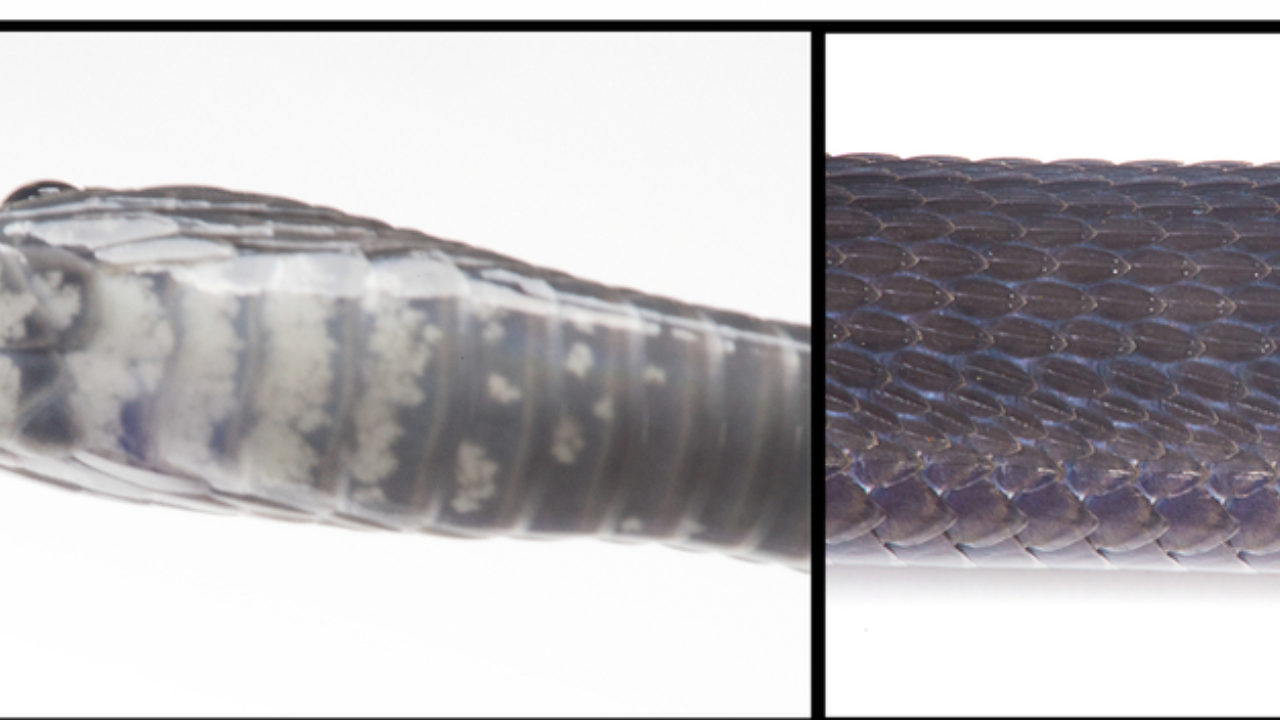
The newly described snake has several features that help distinguish it from its relatives. Pale skin can be seen between the scales, sometimes with a bluish tinge, while the throat and underside are characteristically white. That feature is reflected in the name Dasypeltis albigularis. The species name refers to its white throat.There is another difference that is less visible. Many egg-eating snakes can produce a rasping or hissing noise by rubbing their scales together, a behaviour used when threatened. D. albigularis appears not to have this ability. Adult females can grow to around 92 centimetres, or roughly 36 inches. This makes the species somewhat smaller than D. atra and some of its other close relatives.
Life among forest trees and wild coffee
The snake has so far been associated with dense forest between 1,500 and 1,700 metres above sea level in the Harenna Forest. The vegetation includes wild coffee plants, while the snake’s food comes from above: the eggs of birds that nest in trees.Its discovery adds another species to the known wildlife of Harenna, an important remaining forest landscape in the Horn of Africa. Finding a snake there also illustrates how much identification can depend on details that are easy to miss when closely related animals share similar colours and body patterns. For a group already known for its unusual feeding habits, the distinction is particularly interesting because the new species does not stand apart through a radically different lifestyle. It is an egg-eating snake like its relatives. The differences are subtler, but they are consistent enough to separate it from them.


