










Headlines

China scientists turned bamboo cellulose into a strong plastic alternative that withstands high heat, can be recycled and biodegrades in soil

Plastic alternatives made from renewable materials often struggle to match the strength, heat resistance and processing ability of conventional plastics. A new bamboo-based bioplastic takes a different approach, reorganising cellulose at the molecular level to produce a material that is both strong and easier to shape. The researchers used a hydrated zinc chloride and formic…

Read More

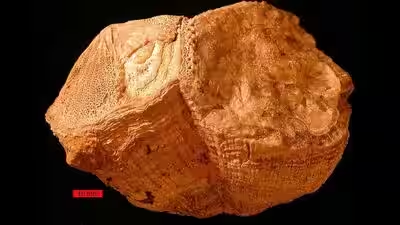
70 million years ago, Earth had 372 days a year. An ancient shell reveals days lasted just 23 hours and 31 minutes

PC: Wikipedia, Wilson44691 – Own work, Public Domain About 70 million years ago, during the late Cretaceous period, a year lasted roughly 372 days rather than 365, meaning each day was around half an hour shorter than it is today. The research team examined the growth layers of a single fossilised rudist bivalve, Torreites sanchezi,…

Read More

Romania has declared a 30-day energy alert as Danube river levels fall too low to cool its nuclear reactors, sending the country into a climate-driven power crisis

Romania has placed its energy sector under a nationwide 30-day state of alert after the Danube river levels fell to exceptionally low levels. This has forced Unit 1 at the Cernavodă nuclear plant offline and put Unit 2 under continuous review.Emergency river works have kept Unit 2 online for now, but the latest hydrological outlook…

Read More

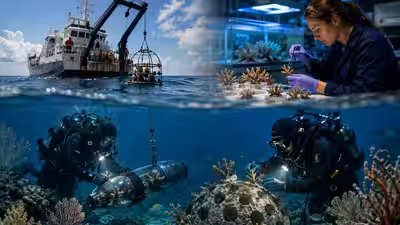
In 2010, Deepwater Horizon damaged deep-sea coral habitats; 16 years later, NOAA divers are planting lab-grown colonies to help rebuild them

Representative Image (AI-generated) Sixteen years after the Deepwater Horizon oil spill injured extensive coral habitats in the Gulf of Mexico, scientists are developing new ways to help these fragile ecosystems recover. According to NOAA Fisheries, a recent restoration mission combined laboratory-reared corals, specialised technical diving and newly designed equipment to return corals to the deep…

Read More

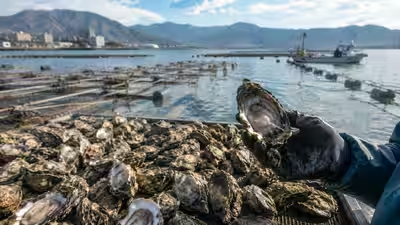
Japan’s Hiroshima produces about 60% of its farmed oysters, but up to 90% have died amid unusually warm seas

Oyster farmers across Hiroshima Prefecture are pulling up their rafts this season to find that most of what they cultivated has not survived. In several coastal districts, mortality rates have reached as high as 90%, far above the usual seasonal loss of 30% to 50%. Producers in the city of Higashihiroshima have reported losses at…

Read More

MIT engineers create a recyclable elastic yarn that can be melted and respun into new fibre 10 times and can tackle the growing problem of textile waste

MIT researchers melt resin pellets and spin them into thin, stretchy fibres designed for repeated recycling. MIT engineers have developed a new elastic yarn made from polyethylene that could offer a more recyclable alternative to conventional stretchy fibres such as spandex. The material is designed so its components can be melted together and processed into…

Read More

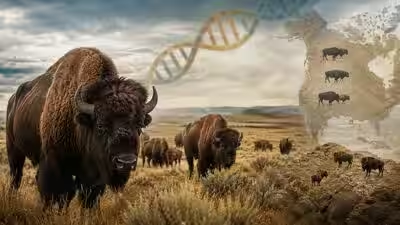
North American bison fell from millions to hundreds, but ancient DNA shows they kept much of their genetic diversity as isolated herds became different

Scientists have pieced together the deepest genetic history of the North American bison ever assembled, using DNA drawn from 115 animals that lived before the species was pushed to near extinction in the 20th century. As per the findings, led by researchers at the University of California, and featured on the cover of the 6…

Read More

More than 99% of California’s sunflower sea stars vanished, now scientists have found a mysterious colony that could help revive dying kelp forests

A decade ago, more than 99% of sunflower sea stars vanished from the depths of the ocean. Now, the discovery of a long-lost colony of these organisms is offering new hope for the region’s kelp forests.Sunflower sea stars, known as Pycnopodia helianthoides, may look like an aesthetic and purely decorative feature on the ocean floor,…

Read More

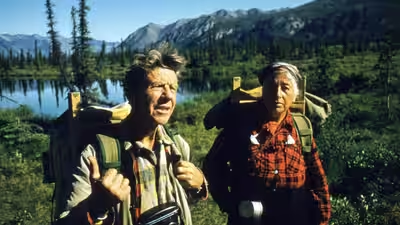
In 1922, Olaus Murie entered Alaska to study caribou, helping change how scientists understood wildlife and ecosystems

In 1922, biologist Olaus J. Murie entered Alaska’s vast wilderness to study caribou, beginning a body of field research that would eventually influence how scientists and park managers understood wildlife as part of interconnected ecosystems. Murie had been hired by the US Biological Survey as a wildlife biologist and spent much of the early 1920s…

Read More

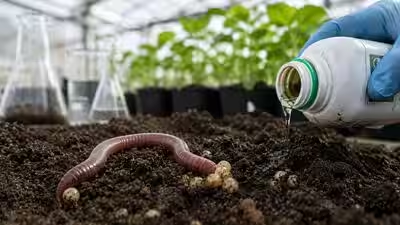
Scientists in Austria found that a glyphosate-based herbicide reduced earthworm reproduction by 56% in a greenhouse study

Across the United States, glyphosate is applied across an enormous area of farmland each year. According to the US Environmental Protection Agency, an average of 298 million acres of cropland receives glyphosate applications annually, giving a sense of how routinely the herbicide enters agricultural landscapes. Much of the attention around glyphosate has centred on weeds…

Read More