







Headlines

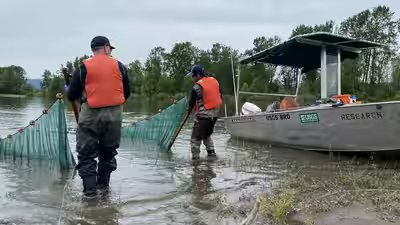
In 2020, engineers pumped 225,000 cubic yards of dredged sediment into the Columbia River; it became four new islands now being studied as salmon habitat

Brian Ekstrom and Lance Downing pulling the beach seine to collect juvenile fish at a restoration site on the lower Columbia River A routine dredging project on the Lower Columbia River has become a major long-term experiment to see whether dredged sediment can be used to restore lost wildlife habitat.In October 2020, engineers pumped 225,000…
Read More

In 2017, a total solar eclipse changed animal behaviour as scientists watched 17 species react to sudden darkness

On 21 August 2017, the afternoon light at Riverbanks Zoo in Columbia, South Carolina, began to fade. For the people gathered there, the approaching darkness was an astronomical spectacle. For the animals living outside in the zoo’s enclosures, it was something rather different: daylight was suddenly behaving as if evening had arrived. Researchers had prepared…

Read More

Total solar eclipse 2026: Will Americans see today’s eclipse? Here’s where it is visible |

The only total solar eclipse of 2026 is happening today, 12 August, as the Moon passes directly between Earth and the Sun, casting its shadow across the Northern Hemisphere. The main path of totality will stretch through Greenland, Iceland, northern Russia, the Atlantic Ocean, Spain and a small part of Portugal.For people standing inside that…

Read More

One-third of global farmland accounts for about two-thirds of agriculture-linked biodiversity and natural carbon-storage loss, a new study finds

Beef and dairy drive 41% of biodiversity damage linked to global farmland A single third of the world’s agricultural land is responsible for roughly two-thirds of all farming-related biodiversity loss and the loss of natural carbon storage, according to a global study published in Nature Food.The research, led by scientists from Leiden University’s Institute of…

Read More

In California, gas stoves leaked methane even when switched off. The same gas helps scientists search for life on distant planets |

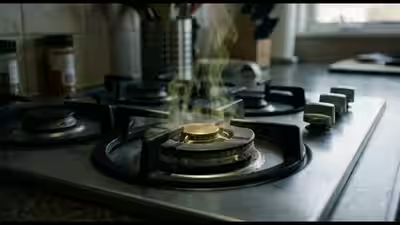
A gas stove can look completely harmless when its burners are switched off. There is no flame, no heat and apparently no activity at all. But research has found that natural-gas stoves can continue releasing methane (CH₄) even when they are not being used.A study published in Environmental Science & Technology examined 53 homes in…

Read More

Tarantula Nebula is full of young stars, but Nasa found much of its hot gas may be escaping

A dazzling new view of the Tarantula Nebula is revealing more than thousands of young stars. It is also helping astronomers investigate a puzzle about energy inside this vast stellar nursery. According to research published in the Astrophysical Journal, titled ‘Taming the Tarantula: How Stellar Wind Feedback Shapes Gas and Dust in 30 Doradus’, the…

Read More

New Orleans students turn millions of discarded glass bottles into sand to help Louisiana’s sinking coast

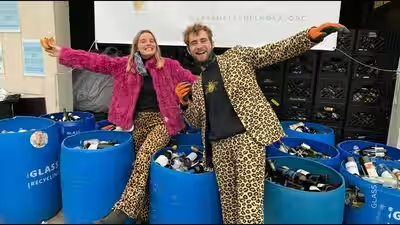
What began as a conversation over a bottle of wine between two Tulane University students has grown into an unusual experiment in recycling and coastal restoration. Franziska Trautmann and Max Steitz, the founders of Glass Half Full, have transformed millions of discarded glass bottles into sand, material that is now being tested to help rebuild…

Read More

A 12,900-year-old cave has opened a window into a forgotten world of hunter-gatherers in Türkiye, revealing ancient fires, stone tools and personal ornaments

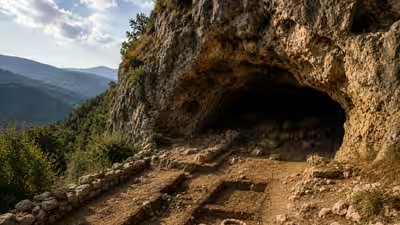
Representative Image (AI-generated) In 2019, researchers identified Koskarlı Cave near Trabzon, in Türkiye’s eastern Black Sea region. According to a study published in the journal Antiquity, later excavations at the cave revealed a 12,900-year-old hunter-gatherer layer containing a hearth, stone tools and personal ornaments. The findings provide rare archaeological evidence of human activity in the…

Read More

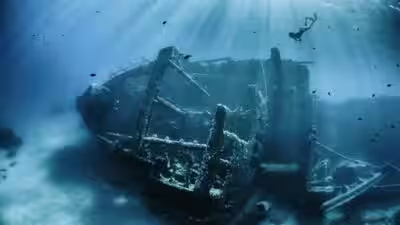
A Byzantine ship sank off Croatia more than 1,300 years ago; archaeologists have now recovered about 600 grams of gold that points to an imperial passenger

A shipwreck beneath the Mediterranean has recently revealed more gold than any other in the region to date. The vessel sank in the Adriatic Sea in the seventh or eighth century C.E. and its cargo included a gold signet ring likely associated with an emperor along with a gold belt encrusted with gems.More than 40…

Read More