








Headlines

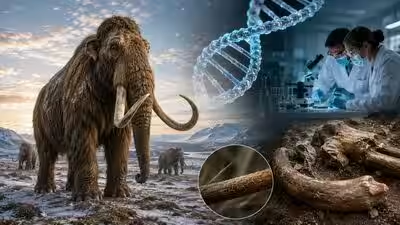
The last woolly mammoths survived for 6,000 years after the Ice Age. In 2024, scientists challenged the idea that inbreeding caused their extinction |

For years, the disappearance of the last woolly mammoths seemed to have a straightforward explanation. A tiny population became isolated, interbred for thousands of years and eventually reached a point where its own genetics made survival impossible. That idea found its way into documentaries, textbooks and scientific discussions alike. A study published in Cell, titled…
Read More

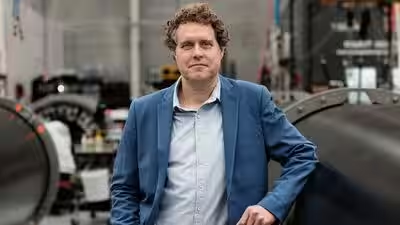
Meet Peter Beck: Rejected by NASA and Boeing, the self-taught engineer who built a $2.9 billion space company without a college degree |

Peter Beck never earned a university degree or landed the aerospace job he hoped would launch his career. Instead, the New Zealand engineer turned rejection into an opportunity that reshaped his future. After an unsuccessful trip to the United States in 2006, where attempts to gain experience with organisations including NASA and Boeing fell short,…

Read More

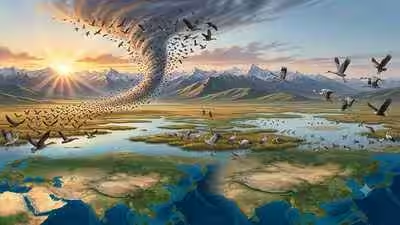
Millions of birds follow a 9,000-kilometre invisible highway every year, crossing mountains, deserts and oceans without a map |

Every year, as the seasons change, millions of birds undertake one of nature’s greatest journeys. Some travel only a few hundred kilometres, while others fly thousands without recognising political borders or national boundaries. Instead, they follow ancient migration routes known as flyways, natural aerial corridors shaped by geography, climate and the availability of food and…

Read More

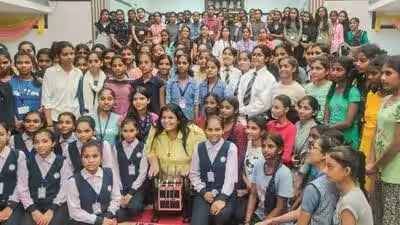
750 Indian schoolgirls conducted experiments within their schools and failed. Now their reworked satellite orbits the Earth near the ISS |

The experiments prepared by 750 schoolgirls from India failed on their first try in 2022. But later, it transformed into a space education activity that has a satellite made by them orbiting the planet near the ISS. The information was released by ISRO, the Indian government’s space agency.Under the AzaadiSAT project, 75 schools across the…

Read More

Scientists discovered how the Moken sea nomads developed an extraordinary ability to see underwater like dolphins |

For most people, opening their eyes underwater turns the world into a blur. The human eye is designed to focus light passing through air, and once submerged, much of that focusing power is lost. Yet for generations, the children of the Moken, an Indigenous sea-nomad community living around the Andaman Sea between Thailand and Myanmar,…

Read More

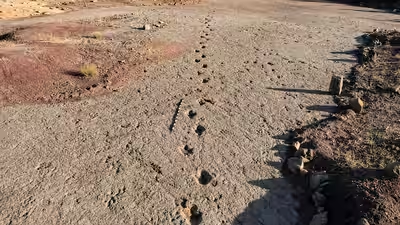
A 66-million-year-old dinosaur highway in Bolivia reveals more than 16,000 fossil footprints from the final days of the dinosaurs |

Millions of years before roads connected modern cities, dinosaurs were already following well-worn routes across ancient landscapes. A remarkable fossil site in central Bolivia has preserved this prehistoric movement in extraordinary detail. Scientists have documented more than 16,000 dinosaur footprints at the Carreras Pampa tracksite in Torotoro National Park, making it the world’s largest known…

Read More

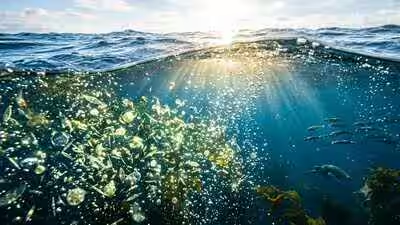
The world’s biggest oxygen producer isn’t the Amazon. It’s the ocean filled with tiny invisible life |

The first place people consider when thinking about the source of the oxygen that humans breathe is usually the big rainforest areas like the Amazon. Although forests play a very important role in storing carbon and conserving biodiversity and climate, the oceans provide a greater share of the oxygen in the atmosphere than forests. Almost…

Read More

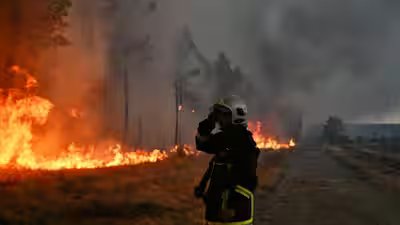
Canada’s 2023 wildfires burned 15.1 million hectares and released 554 million tonnes of carbon; scientists found most came from soil and peat beneath the trees

Burning soil and peat drove most emissions in Canada’s record 2023 wildfire season, study finds Underground stores of rich soil and thick peat were the main fuel behind the record emissions created during Canada’s 2023 wildfire season. Rather than standing trees and leaves, carbon locked beneath the forest floor accounted for 76 per cent of…

Read More

A sea turtle left the ocean to lay eggs in Costa Rica with a remora attached; the fish held on for 19 minutes and survived outside the water

A nesting olive ridley sea turtle on Playa Pejeperro in Costa Rica with a common remora attached to its shell (Credit: Megan Bullock) A mother sea turtle crawled onto a Costa Rican beach to lay her eggs, carrying an unexpected passenger that refused to let go even after leaving the ocean.Gripping tightly to the turtle’s…

Read More

Before helping transform electric lighting, Lewis Howard Latimer’s first patent made one overlooked part of train travel far more bearable |

For many people, Lewis Howard Latimer is remembered for his later work on electric lighting and his association with Thomas Edison. Yet years before he became involved in the electrical industry, he helped solve a far more ordinary problem that affected railway passengers every day. Travelling by train in the nineteenth century was becoming increasingly…

Read More