










Headlines

Meet Hikaru Kuribayashi: The 18-year-old teen who started with paper folds and ended with a $100,000 global science win |

At first glance, a sheet of folded paper may seem far removed from advanced engineering. But for Japanese student Kuribayashi, origami became the starting point for a scientific investigation into how structures move. The student from Sapporo Kaisei Secondary School studied the complex folding patterns of a ladybug wing, exploring how its delicate design allows…

Read More

Scientists drilled 1,640 feet beneath Michigan and found 689 kinds of fungi living in water that last touched the surface 11,000 years ago

A research team led by University of Michigan isolated and grew more than 200 kinds of fungi from the deep subsurface (Credit: Quinn Moon University of Michigan) Scientists drilling 1,640 feet beneath Michigan have discovered 689 kinds of fungi living in water that last touched the surface 11,000 years ago.The University of Michigan study shows…

Read More

Scientists warn that more than 1.7 million planned satellites could create a new form of space pollution and permanently change the night sky |

The rapid expansion of artificial satellite constellations is changing the appearance and accessibility of the night sky, creating a new challenge to the field of astronomy. For decades, the primary concern for astronomers was light pollution present on earth, but the introduction of large-scale telecommunication networks, such as SpaceX’s Starlink, has introduced a new form…

Read More

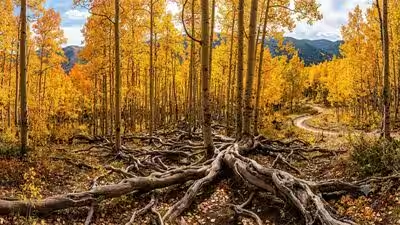
The 16,000-year-old Pando appears to be a forest, but scientists say all 47,000 trees belong to a single living organism |

At first sight, Pando appears to be an ordinary forest of thousands of trembling aspen trees stretching across Utah’s Fishlake National Forest. As reported by PBS, the reality beneath the ground is far more unusual. Those estimated 47,000 trunks are not separate trees competing for space, but parts of a single living organism connected by…

Read More

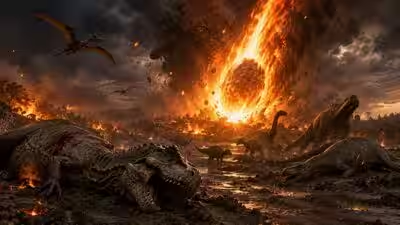
New study suggests many dinosaurs may have died within hours, not months, after the asteroid struck Earth |

For decades, the extinction of the dinosaurs has usually been pictured as a slow collapse. An asteroid struck Earth, sunlight faded behind dust, temperatures changed, and ecosystems gradually unravelled. That broad sequence still stands, yet a new study argues that the first chapter of the catastrophe may have unfolded far more quickly than many imagined….

Read More

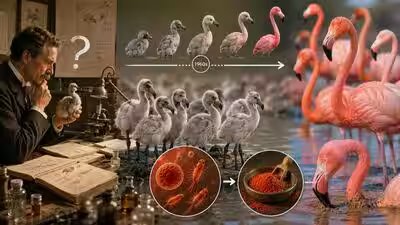
For centuries, scientists couldn’t explain why flamingos aren’t born pink until a breakthrough in the 1960s revealed the answer |

For centuries, flamingos were recognised by their vivid pink feathers, yet the reason behind that striking colour remained uncertain. Early naturalists could describe what they saw, but they could not explain why young flamingos emerged from the nest in muted shades before gradually becoming brighter as they matured. The answer only began to take shape…

Read More

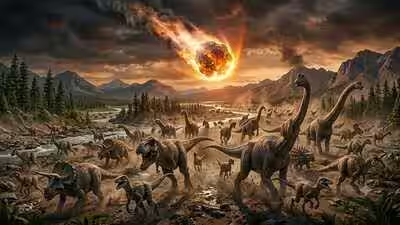
Why the dinosaurs disappeared: The asteroid that ended their reign struck Earth with a force of around 100 million megatons |

For more than 160 million years, dinosaurs dominated life on Earth. They survived shifting continents, volcanic eruptions, changing climates and countless evolutionary challenges, becoming the planet’s undisputed apex animals. Then, around 66 million years ago, their reign ended with astonishing speed in geological terms. Today, scientists overwhelmingly agree that the extinction was triggered by a…

Read More

Quote of the day by David Attenborough: “No one will protect what they don’t care about; and no one will care about…” |

Few people have inspired a deeper appreciation for the natural world than David Attenborough, whose documentaries have introduced generations to Earth’s extraordinary wildlife and ecosystems. Among his many memorable observations, one quote continues to resonate with conservationists, educators and nature lovers alike: “No one will protect what they don’t care about; and no one will…

Read More

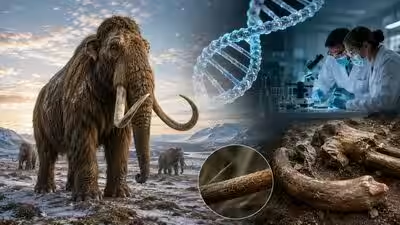
The last woolly mammoths survived for 6,000 years after the Ice Age. In 2024, scientists challenged the idea that inbreeding caused their extinction |

For years, the disappearance of the last woolly mammoths seemed to have a straightforward explanation. A tiny population became isolated, interbred for thousands of years and eventually reached a point where its own genetics made survival impossible. That idea found its way into documentaries, textbooks and scientific discussions alike. A study published in Cell, titled…

Read More