






Headlines

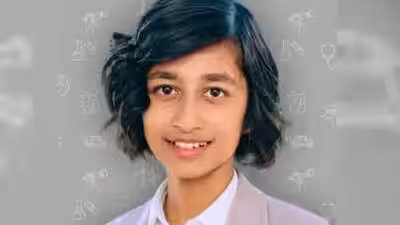
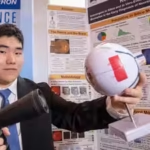
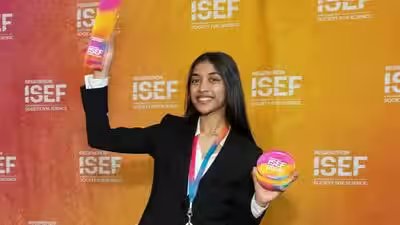
Washington teenager Lakshmi Agrawal made a jute-waste sponge for salmon-killing tyre pollution; after it removed up to 80% in lab tests, she won $75,000

Lakshmi Agrawal (Image Credit: Society for Science) An 18-year-old student from Bellevue, Washington, has turned an agricultural waste product into a promising solution for one of the Pacific Northwest’s most pressing environmental challenges. According to the Society for Science, Lakshmi Agrawal won the $75,000 Regeneron Young Scientist Award at the 2026 Regeneron International Science and…
Read More

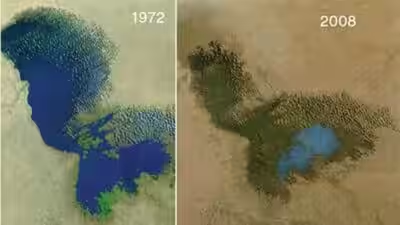
Africa’s Lake Chad has shrunk by 90% since 1960, now the government is paying $50 billion to redirect water from the Congo River Basin into the lake

In 1823, British explorers Hugh Clapperton, Dixon Denham and Walter Oudney were some of the first Europeans to document the lake and the surrounding kingdoms. He was struck at the sight of one of Africa’s largest inland lakes. But two centuries later, about 905 of the lake’s surface area has shrunk, leaving only a sliver…

Read More

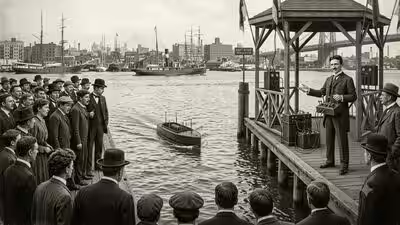
In 1898, a mysterious boat moved without a captain and left New York crowds speechless until Nikola Tesla revealed his secret |

In the autumn of 1898, visitors at Madison Square Garden witnessed something that looked impossible. A small metal boat moved across a pool without a visible person guiding it. It changed direction, responded to commands, and appeared to act with a mind of its own. The demonstration came from Nikola Tesla, an inventor already known…

Read More

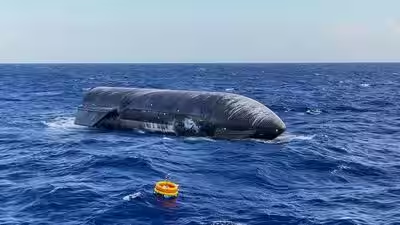
Elon Musk’s previous Starships exploded or broke apart after splashdown; Flight 13 landed so gently that the 171-foot spacecraft remained afloat in the Indian Ocean for five days

A rocket has been floating on the surface of the Indian Ocean for the past five days and its pictures are all over the internet. While one would assume it to be a scene from a sci-fi movie, the image is of SpaceX‘s most recent spacecraft that made a successful return from space.On Friday, SpaceX…

Read More

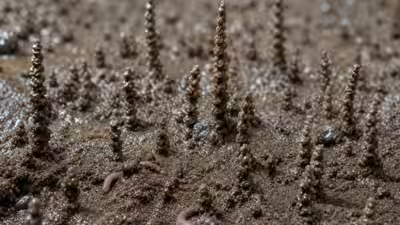
Physicists reveal why these tiny worms stack their poop into delicate towers that seem to defy gravity |

Most animals leave behind waste that quickly disappears into the landscape. But along Europe’s sandy tidal flats, one marine worm has adopted a remarkably different approach. Instead of scattering its droppings across the beach, it carefully stacks them into tall, coiled towers that seem to defy gravity. These delicate spirals have fascinated naturalists since the…

Read More

Humans may not be the only primates with geometric intuition as monkeys recognise shapes in remarkably similar ways, study finds |

For decades, one idea has shaped discussions about human intelligence: our ability to recognise geometric patterns was thought to set us apart from other primates. People naturally notice features such as symmetry, parallel sides and right angles, and many researchers have argued that this reflects a uniquely human way of thinking.A new study was published…

Read More

Arika: Minnesota student Arika Kundu, 13, designed a method that turns peanut-shell waste into a material for removing pesticide residues from fresh produce; she is now competing for a $25,000 science prize

Arika Kundu, 13, uses peanut shells to help remove pesticide residues from produce. A 13-year-old Indian-American student from Minnesota has invented a method to reduce pesticide residues on fresh fruits and vegetables by using peanut shells, something that is usually thrown away.Arika Kundu, a seventh-grade student at Minnetonka Middle School East in Shorewood, Minnesota, developed…

Read More

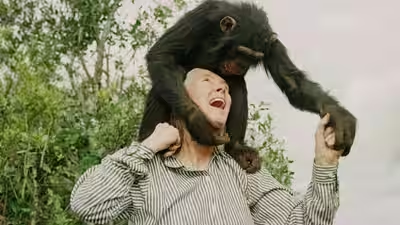
Quote of the day by Jane Goodall: Why “Even that great scientist Albert Einstein sustained a mystical outlook on life” reminds us that wonder and humility go hand in hand |

Science has answered questions that once seemed impossible from explaining how galaxies evolve to revealing the structure of DNA. Yet with every discovery comes the realisation that there is still so much we do not know. Many of history’s greatest scientists believed that knowledge does not take away the mystery of the universe; instead, it…

Read More

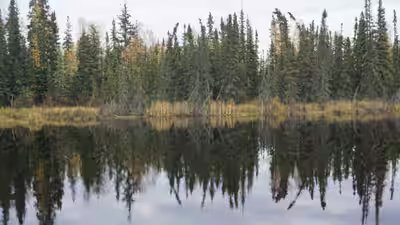
Boreal forests shade northern permafrost so effectively that summer thaw stays about one metre shallower; researchers estimate their canopies keep 59 billion tonnes of carbon frozen

Spruce and birch trees are seen tilting along the edge Stevens Pond on the University of Alaska Fairbanks campus on Sept. 18, 2022. Thick green tree canopies across northern forests act as giant sunshields, keeping permafrost cool enough to hold 59 billion tonnes of carbon safely in the ground.The discovery reveals that the forest canopy…

Read More

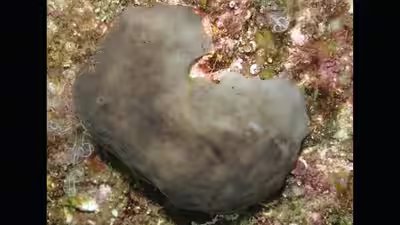
Scientists transplanted 42 sea sponges into a polluted Spanish marina; 91.7% of one species survived 455 days and began creating mobile clones

Specimen of Chondrosia reniformis transplanted into the harbor. Image credit: Carlota Escarré Scientists transplanted 42 sea sponges into a polluted Spanish marina, where 91.7 per cent of one hardy species survived for 455 days and began creating mobile clones.The study, published in Frontiers in Marine Science, shows that the chicken kidney sponge (Chondrosia reniformis) can…

Read More