



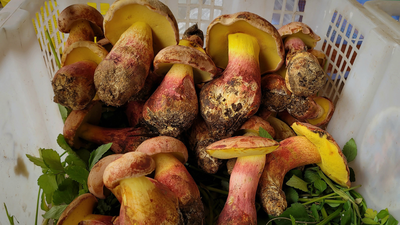
In 1934, Western scientists first heard reports from Papua New Guinea of wild mushrooms causing visions of tiny people, a phenomenon called “mushroom madness.” Nearly a century later, DNA sequencing has confirmed that a single, identical mushroom species causes these same hallucinations in communities thousands of miles apart in China and the Philippines.As reported by Science and published in the journal Mycologia, researchers at the University of Utah (U) linked these visions to Lanmaoa asiatica, a wild bolete mushroom.Surprisingly, chemical and genetic analysis showed that L. asiatica contains no known psychoactive compounds, including psilocybin. The finding suggests the mushroom contains a completely unknown hallucinogenic substance that consistently causes these specific visual distortions.Colin Domnauer, a doctoral student at the U, and Bryn Dentinger, a mycologist at the U and the Natural History Museum of Utah, co-authored the study.
Decades of mystery surrounding ‘mushroom madness’
After anthropologists and mycologists studied the reports in Papua New Guinea during the 1950s and 1960s, they narrowed the suspected mushrooms to the Boletaceae family. However, chemical testing failed to find any psychoactive ingredients. Even Albert Hofmann, the chemist who isolated psilocybin and discovered LSD, analysed samples but found no active compounds.Research slowed in the 1960s after experts concluded the visions were probably a sociocultural phenomenon rather than a biological effect.Interest returned in the 1990s after reports from Yunnan in southwest China, where people experienced similar visions after eating wild bolete mushrooms known locally as Jian shou qing. Mycologists suspected the cause was the newly identified L. asiatica.In 2024, Domnauer came across a third report while interviewing an Indigenous community in the remote Northern Cordillera region of the Philippines. People there said an edible wild mushroom called Sedesdem caused visions of tiny people if it was eaten undercooked.Domnauer collected wild specimens across Yunnan and carried out the first scientific fungal survey of the northern Philippines. DNA sequencing confirmed that China’s Jian shou qing and the Philippines’ Sedesdem are both L. asiatica. Unusually dry weather prevented Dentinger from collecting matching comparison samples during a trip to Papua New Guinea.
Specificity of Lilliputian visions
Known as Lilliputian hallucinations, a term taken from the 6-inch-tall people in Jonathan Swift’s Gulliver’s Travels, these experiences follow strikingly similar patterns.Around 90 per cent of affected people report seeing dozens or even hundreds of detailed human figures between 3 and 30 centimetres tall. These figures often look like elves, clowns or fairy-like characters wearing brightly coloured clothing.Unlike typical psychedelic hallucinations, these figures behave according to normal physical laws rather than appearing supernatural. People report seeing them walk around objects, slip off table edges or fall from spoons into soup bowls.Because two populations living far apart reported the same highly specific visions linked to a single DNA-confirmed species, scientists concluded the effects are caused by a shared chemical and neurological mechanism rather than cultural coincidence.
A new psychoactive compound
Because L. asiatica does not contain traditional psychedelic chemicals, researchers believe the mushroom produces an unknown compound that works through unidentified neurological pathways.Lilliputian hallucinations can sometimes occur during alcohol withdrawal, dementia, macular degeneration and other neurological conditions, but these cases are rare and unpredictable. Because L. asiatica reliably causes the condition, identifying its active chemical could give neuroscientists a valuable tool for studying human perception and consciousness.Domnauer and Dentinger are now working to isolate and identify the chemical responsible.
Hidden diversity in museum archives
Besides identifying the hallucinogenic species, the team completed the first comprehensive genomic analysis of the entire Lanmaoa genus.By sequencing the genomes of 53 wild and fungarium specimens collected from around the world, the researchers identified 17 distinct species within the group. These included four previously unknown species, two of which had been sitting unidentified in American museum collections.Genetic analysis confirmed that L. asiatica is the only psychoactive mushroom in the Lanmaoa genus. Domnauer said there is still a huge amount of biological diversity waiting to be discovered, pointing out that penicillin was first isolated from an obscure fungus before transforming modern medicine.


