




India’s faceless assessment regime is an important part of a broader strategy to move away from manual, officer-led discretion-based scrutiny to a technology-led standardised and transparent tax administration. It significantly reduces the need for in-person meetings, improves accountability, and ensures examination of facts via digital records.The regime evolved from e-Proceedings and the e-Assessment Scheme, 2019, and was later provided with the necessary statutory basis vide Section 144B of the Income-tax Act, 1961 (‘the Act’). Assessments are now conducted through the National Faceless Assessment Centre (NaFAC’), supported by assessment, verification, technical and review units.This article explains what faceless scrutiny is. How does it work? Why are notices issued? And what are the timelines taxpayers should be aware of? Followed by some practical tips for preparing a clear and evidence-based response.
What is a faceless assessment?
Assessments under Section 144B of the Act are often described as both “faceless” and “jurisdiction-less”. Together, these concepts helped to shift from a local, officer-specific process to an electronic, centralized team-based framework. One way to understand the concept is to compare it with 10th standard board examination, where neither the examiner nor the examinee knows the other, thereby reducing the possibility of personal influence or bias.Faceless assessment means the taxpayer cannot meet in-person as they do not get to know the officer examining the case. Notices, responses, and supporting documents are exchanged through the e-Proceedings facility, with automated allocation intended to reduce direct interaction, personal bias, improve standardization and consistency.Jurisdiction-less assessment means the assessment is not managed by any local Assessing Officer. It is routed through NaFAC and may involve assessment, verification, technical and review units. Regular scrutiny assessments under Section 143(3), reassessments under Section 147 and best judgment assessments under Section 144 are covered, subject to exclusions.
How does the faceless assessment work?
The NaFAC allocates the selected case to an assessment unit and notices are issued electronically for the taxpayer to upload replies, explanations, and documents through the e-filing portal. The assessment unit may seek further information or involve verification or technical units where required. The table below explains this process in brief:
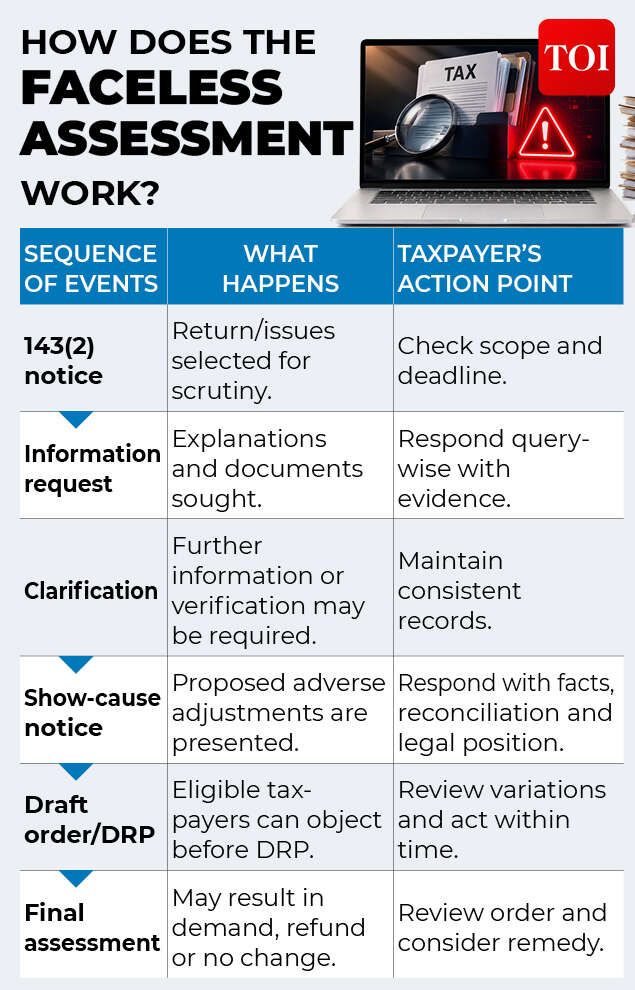
How does the faceless assessment work?
What does a Section 143 (3) scrutiny assessment mean?
A scrutiny assessment under Section 143 (3) is a detailed examination of a tax return to verify whether income, deductions, exemptions, credits, and tax liabilities have been correctly reported. It usually begins with a notice under Section 143 (2), followed by information requests, and ends with an assessment order.A scrutiny notice does not automatically mean additional tax is payable. It means the tax return, or any specific issue within it, has been selected for further detailed verification. The response should explain the facts, reconcile the figures, and support the tax position with relevant evidence.
Why is scrutiny notice issued? (Common triggers for selection)
While only a small proportion of tax returns are selected for scrutiny each year, selection is increasingly driven by risk parameters, mismatch based on third-party data or issues requiring verification. Common triggers include differences between the return and Annual Information Statement (AIS), high-value transactions, capital gains, deductions or exemptions, foreign income or assets, significant banking or property transactions, tax credits, or income requiring review.The initial notice may not disclose the full focus of the assessment and may require a lot of information. Follow-up questionnaires often identify the specific issue, such as TDS differences, interest reflected in AIS, capital gains, or transactions requiring evidence of source and tax treatment.Scrutiny may be limited or complete. In limited scrutiny, the tax department ordinarily examines only the identified issues, and any expansion of scope must follow the prescribed procedure. Understanding the scope helps taxpayers to focus on the response while addressing all relevant issues.
Practical challenges and timelines to remember
The in-person meetings and explanations offered are now replaced by electronic written submissions, therefore the response must be well crafted so that it works like an in-person explanation. Taxpayers must understand the scope of the notice, gather records quickly, respond within short timelines and present factual and legal positions clearly on the portal. Key timelines are summarised below.
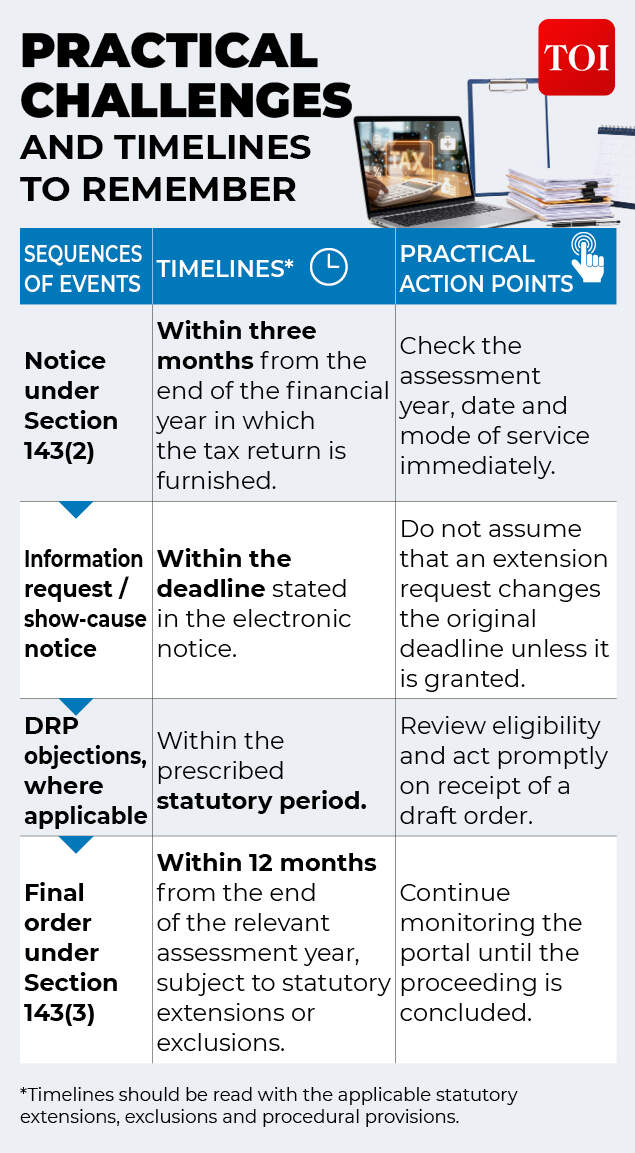
Practical challenges and timelines to remember
Any concern about service of notice should be raised at the beginning. If the taxpayer participates without timely objection, the notice may be treated as valid.Taxpayers should also ensure that portal access, registered email and mobile details, authorised representative access, and digital signature or electronic verification arrangements are in place. Delays in accessing the portal or approving a submission can become critical where the response window is short. These cannot be cited as reasons for missing any timeline.
First step: decode the notice.
A detailed notice can be intimidating, especially when it contains several questions and document requests. The first step is to understand exactly what is being asked.Check the assessment year, notice date, response deadline, scope of scrutiny, information sought and documents requested. Map each query to the relevant disclosure, transaction or claim in the return. A practical approach is to prepare a query-wise tracker that records the question posed by the tax department, taxpayer’s response, supporting evidence, and corresponding tax position.Most queries relate to tax return disclosures, third-party information such as AIS, Form 26AS, specific transactions such as property, securities, loans or foreign assets, and supporting evidence such as bank statements, tax certificates, broker statements, and agreements.Before replying, verify whether an earlier response, revised return, updated return, rectification request, or communication already addresses the issue. This helps avoid inconsistent positions and supports a coherent record.
Build the response around facts, law, and evidence.
A strong response answers each query directly, explains the facts, states the tax treatment, and connects the supporting documents to the point being made. The aim is to clarify what each document substantiates.Reconciliations should be easy to follow, totals should agree with the return, and annexures should be numbered and cross-referenced. Where interpretation is involved, the response may refer to the relevant provision, treaty article, CBDT circular or judicial precedent, provided the link to the facts is clear.For example, in a foreign tax credit claim for tax paid in the US, merely attaching the US federal return, Form W-2, pay-slips or payment records may not be enough. The response should explain the income on which foreign tax was paid, the corresponding income offered in India, the amount of tax and the basis of the credit claim, with each document linked as an annexure.The same approach applies across issues: identify the question, reconcile the facts and evidence, and explain the tax treatment in plain terms. Case laws are useful only where the facts are comparable and the principle is directly relevant.
Third-party data mismatch: explain before assuming it is taxable.
Many notices arise from differences between the tax return and information reported by banks, employers, brokers, registrars, property registries or other institutions in AIS and Form 26AS. Such differences may reflect omissions, duplications, timing issues, revised reporting, or transactions requiring explanation.A mismatch does not automatically mean the full reported amount is taxable. For instance, AIS may show the gross sale value of shares, while the taxable amount may be the capital gain after cost and other adjustments. Differences may also arise from joint holdings, incorrect PAN reporting, exempt receipts, or transactions already considered elsewhere in tax return.The taxpayer should identify the source of the mismatch, reconcile it with records, determine the correct tax treatment, and explain the difference. If the third-party report is incorrect, the response should state this and, if possible, provide evidence of a correction request.The practical rule is simple: investigate the mismatch before treating it as income.
Can you ask for more time?
Yes. If more time is genuinely required to obtain information or documents, an extension may be requested through e-Proceedings before the due date. The request should state the reason and indicate when the information is expected. An adjournment of up to 15 days can be requested through the portal, subject to approval.However, an extension is not automatic. Unless granted, the original deadline should be treated as continuing to apply. Where feasible, the taxpayer may submit the available response within time and clearly identify the limited information that remains outstanding.
After submission: stay alert and track next steps.
A response does not necessarily end the proceedings. The tax department may accept the explanation, seek clarification, conduct verification, or propose an adjustment. Taxpayers should monitor the portal and preserve every submission and acknowledgement.If an adjustment is proposed, the reply should identify the precise disagreement and address it directly with facts, reconciliations, law, and evidence. A point-by-point rebuttal is usually stronger than a broad statement that the proposed addition is incorrect.Eligible taxpayers receiving a draft order under Section 144C may accept the variations or file objections before the DRP within the prescribed period. For complex factual or legal issues, a video-conference hearing may be requested where permitted, but the written submission should still be complete.The final order may result in a demand, refund, or no change to the returned income. Taxpayers who disagree with the order should promptly review the reasoning and tax computation to determine the appropriate remedy. Depending on the issue involved, this could include an appeal on merits or a rectification application for mistakes apparent from the record.
Applicability of the old statute to earlier assessment years
For Assessment Year 2026–27 and earlier years, scrutiny, reassessment, appeal, and other pending proceedings will continue under the Income tax Act, 1961, including its limitation periods and procedural safeguards. The Income tax Act, 2025 should not be read as automatically resetting deadlines or shifting earlier-year proceedings to the new law unless a specific transitional provision says so.This is relevant because the new law applies from 1 April 2026 for tax years beginning on or after that date, while earlier-year proceedings may continue after that date under the earlier framework.
The bigger picture
Faceless assessment is not merely a change in the way scrutiny is conducted; it reflects a complete transformation in tax administration itself. As technology, data analytics and information reporting continue to evolve, assessments are increasingly likely to be driven by digital trails and data consistency rather than traditional fact-finding exercises.Looking ahead, the success of the faceless regime will depend not only on efficient technology platforms but also on the quality of data gathering and analytics which increasingly should reduce the need for engagement between taxpayers and tax administration.Faceless assessment is best viewed as a continuing evolution of the tax system, one that seeks to balance efficiency with fairness, and greater use of data with the fundamental principles of natural justice.(The author, Ravi Jain is Tax Partner at Vialto Partners. Vikas Narang, Director, and Pawan Digga, Manager at Vialto Partners, have also contributed to this article. Views are personal.)


