


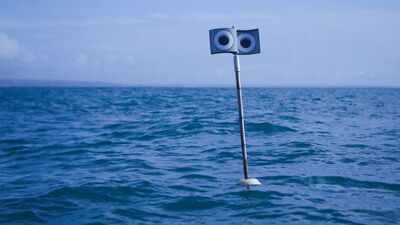
Fishing nets can pose a serious danger to diving seabirds, but a new trial off the coast of south-west England has found that simple devices placed above the water can substantially reduce the risk. A floating buoy fitted with moving eyes cut the chance of auk bycatch by 59%, while a bird-shaped kite reduced it by 71%. The findings came from a 2-year trial study involving commercial fishermen in Cornwall and were published in Conservation Letters. The research suggests that simple deterrents could help protect seabirds without requiring major changes to fishing gear.
How the floating scarecrow reduced seabird bycatch
The floating device, known as a Looming Eye Buoy, was developed by Fishtek Marine and the RSPB. It sits above the water on a modified fishing buoy and has a spinning head displaying large animated eyes. The idea is to make the area around the fishing net appear threatening, discouraging birds from diving towards it. The University of Exeter news article reported that the device was developed through an 8-year collaboration between Fishtek Marine and the RSPB.The researchers tested the buoy alongside a commercially available kite designed to resemble a bird of prey. The study refers to this as the scarybird kite. Both devices were attached to buoy systems positioned around fishing nets, allowing the researchers to compare treated nets with nets that had no deterrent.
Performance of the scarecrow and kite during the 2-year trial
The research team worked with 10 fishermen and monitored 1,057 fishing nets between October 2023 and March 2025. The fishing took place in waters between the shoreline and 6 nautical miles off south-western UK. At least 7 vessels were monitored at any one time, while cameras and other remote monitoring equipment recorded fishing activity and bycatch.The results showed a clear reduction in the chance of an auk being caught. Compared with untreated nets, the Looming Eye Buoy reduced the odds of a bycatch event by 59%, while the kite reduced them by 71%. The study found no statistically significant difference between the two devices in the chance of bycatch occurring.The trial also recorded 191 animals caught across all net types, including 153 birds, 25 seals and 13 cetaceans. Common guillemots accounted for 81 of the animals caught and razorbills for 57, together making up 72% of the total bycatch. The study reported that 98% of all recorded bycatch was found dead when the vessels reached the animals in the nets.
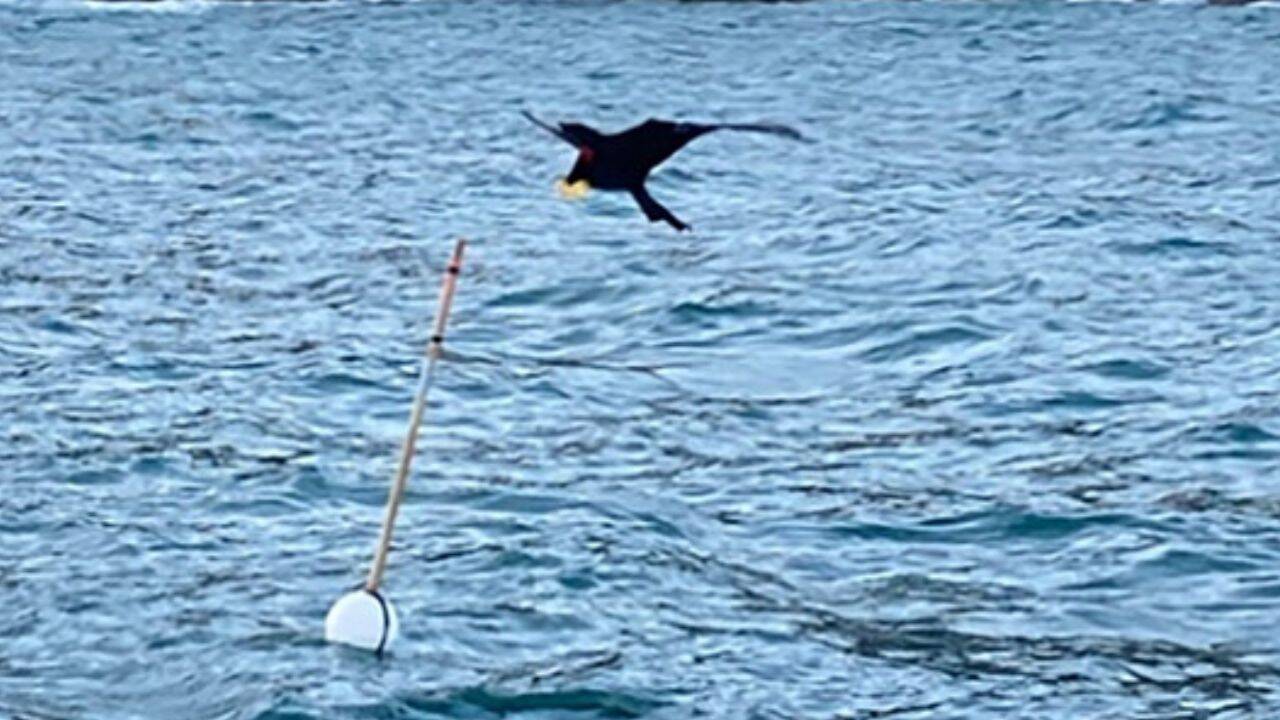
The ‘scarybird’ kite. Image Credit: Tom Hooper/Society for Conservation Biology
Why the devices work differently at sea
The research showed that distance from the deterrent mattered. The kite had a stronger effect at distances of less than 30 metres, while the Looming Eye Buoy worked more gradually across a broader area. For the buoy, 5 auk bycatch events occurred within about 7 metres of the device and 10 within about 15 metres. For the kite, 5 occurred within about 24 metres and 10 within about 33 metres.This difference matters because a deterrent cannot protect every part of a long fishing net equally. The researchers found that devices need to be positioned carefully to avoid areas where birds could still approach the net beyond the effective range. The study therefore highlights placement and spacing as important parts of any future use of these devices.
Most concentrated period of seabird bycatch in a year
The trial also revealed that the risk was not evenly spread throughout the year. The highest average auk bycatch occurred in January and February. The researchers also found the highest bycatch levels when fishermen were targeting European sea bass and Atlantic mackerel, with the strongest association occurring around nets using mesh sizes of 100 to 110 millimetres.That pattern could allow deterrents to be used more selectively rather than being deployed everywhere throughout the year. The study suggests that focusing protection on periods and fishing conditions associated with higher bycatch could provide greater conservation benefits while limiting additional work for fishermen.
What fishermen learned during the trial
The involvement of fishermen was an important part of the project. According to the University of Exeter, participating fishermen helped researchers understand how the devices behaved during normal fishing operations and provided feedback that could be used to improve their designs.The study found that both devices could be incorporated into routine fishing after an initial learning period, although there were practical differences. The Looming Eye Buoy was generally considered straightforward to handle and store. The kite was more sensitive to weather, with reduced performance in very light winds and greater handling difficulties in stronger winds. Fishermen also identified possible improvements, including lighter deployment equipment and stronger kite materials.
Importance of these findings for coastal fisheries
The researchers describe above-water deterrents as relatively simple and low-cost options that can be added to existing fishing equipment without major changes to the nets themselves. The study notes that this could make them particularly useful for smaller fisheries where more complicated measures may be difficult to introduce.However, the researchers also caution that performance can vary depending on the bird species, fishery and environmental conditions. Wind, water depth and other factors were not the main focus of this trial, and the study says further research is needed to understand how such conditions affect the devices.


