


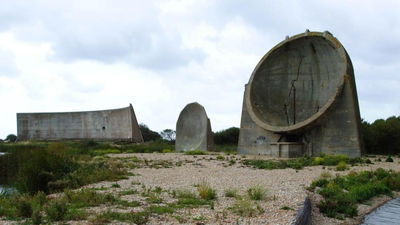
Long before radar screens tracked enemy planes, Britain tried to hear them coming. Three giant concrete structures on the Kent coast, known as the Denge Sound Mirrors, were built between 1928 and 1930 to pick up the drone of approaching aircraft and give the country a few extra minutes of warning. By 1939, they had been abandoned, made obsolete by the arrival of radar.The mirrors still stand near Greatstone Lakes, inside an RSPB nature reserve at Dungeness. From a distance they look like carved stone, but they are made of concrete. Today they draw walkers, photographers and history buffs, and they offer a rare look at how Britain built its early warning systems between the two world wars.
Britain built sound mirrors because World War 1 left its coast exposed
The project was led by Dr William Sansome Tucker, a physicist who specialised in acoustics. Britain’s coastal towns had suffered heavily from air raids during World War 1, and the government was keen to avoid a repeat. It put serious money into acoustic research that could warn of incoming bombers, and the Denge mirrors were one of the results.Each mirror has a different shape and faces a slightly different direction. Their curved surfaces reflected the sound of aircraft engines onto a focal point, amplifying it enough for operators to pick it up. Depending on which mirror caught the noise, technicians could tell where a threat was coming from and when to scramble fighters.The mirrors had a maximum detection range of about 20 miles. That sounds short today, but aircraft of the late 1920s were slow enough that 20 miles gave defenders time to respond.
Radar arrived before the sound mirrors could be perfected
The first mirror, a 20-foot dish completed in 1928, did not work as intended. Engineers kept refining the design, adding a 30-foot dish and then, in 1930, a 200-foot curved wall that covered a much wider arc of sky. The pace of that iteration was quick for its time.It was not quick enough. Aircraft were getting faster every year, which shrank the warning window, and the mirrors struggled to separate engine noise from wind and other background sounds. When radio-based detection arrived in the late 1930s, it could spot planes far beyond 20 miles, in any weather. The sound mirrors were left to the marshes.They are not the only wartime oddity still standing in England’s south. Near Shoreham Airport in Sussex, a graffiti-covered concrete dome once trained anti-aircraft gunners by projecting films of enemy planes onto its ceiling. It was one of 43 such domes built in 1943, and only six survive. The Denge mirrors belong to an earlier chapter of the same story: a country learning, one experiment at a time, how to see what was coming.


