


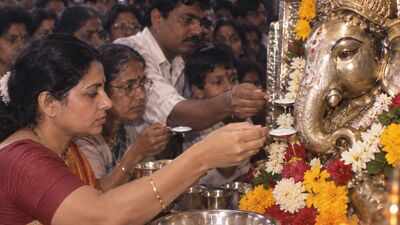
Thirty-one years ago, on September 21, 1995, I came home from school to find that something was strangely different. My aunt, who would diligently wait for me every day and was always the one to serve me lunch, was missing. She was more than just the person who fed me; she would sit with me, tell me interesting stories and make the afternoon feel special.I looked for her everywhere. Finally, the housemaid arrived with my plate of dal and rice and casually told me, “Didi has gone to feed milk to Lord Ganesha.”I was puzzled. What did she mean? After lunch, I called a friend from the landline. She had the same story. Her mother, too, was not at home. By evening, my aunt returned, visibly excited, and told my mother, who had just come back from work, what she had seen.“I took a spoon of milk to feed Ganesha, and the milk disappeared,” she said. My mother looked at her in disbelief. “Really?” she asked. “Really. I saw it with my own eyes,” she insisted, quite overwhelmed with emotions.The news spread fast, Ganesha idols were apparently drinking milk. There were no smartphones, social media platforms, WhatsApp groups or instant notifications to amplify the news. India’s internet had only just arrived, television was still dominated by Doordarshan, and newspapers remained the primary source of next-day news. Yet, within hours, temples were overflowing, milk was disappearing from shops and the story had travelled beyond India.
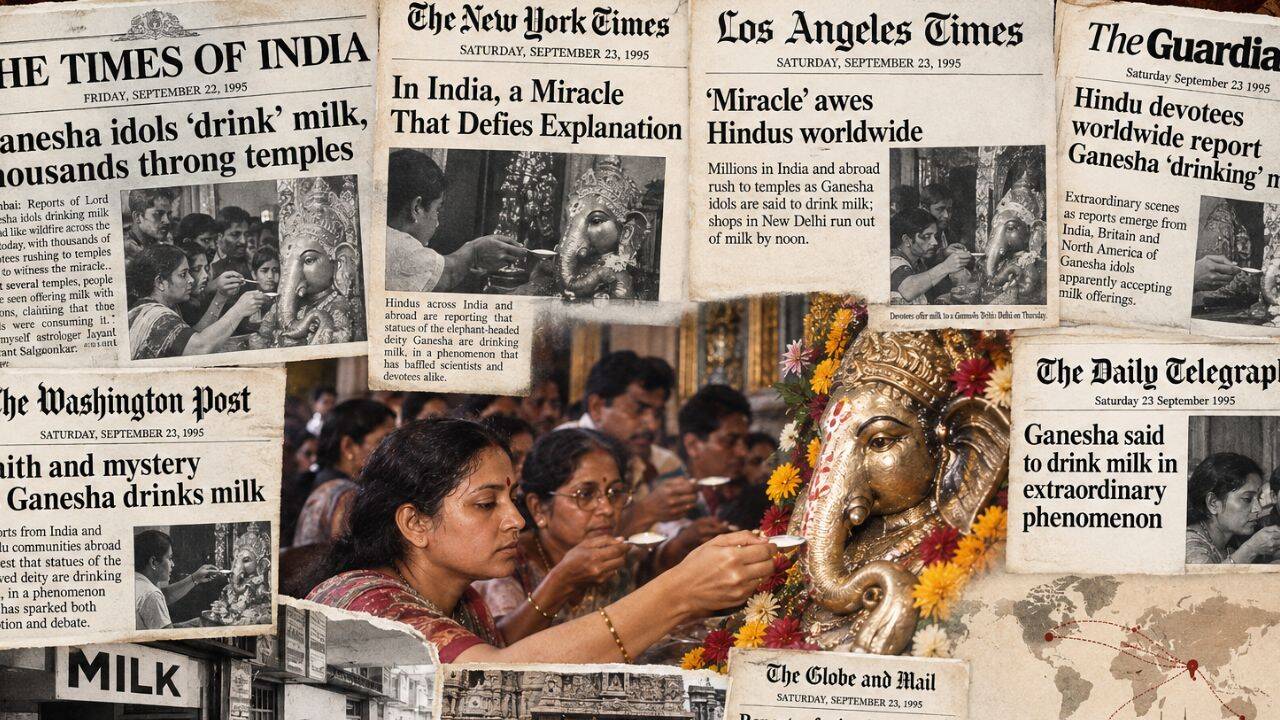
The incident got global coverage
The morning India heard an extraordinary claimIt was not the age of viral news. In fact viral was the world synonymous with just one thing-the infectious disease of influenza. There was no way to immediately search the internet, watch a viral video or check social media posts from another city. Then what caused the spread of this frenzy? According to a contemporary Times of India report preserved in the Tata Institute of Fundamental Research’s Bombay archive, Mumbai and several other parts of India were swept by reports that Ganesha idols were accepting milk offerings. The report described the news as spreading “like wildfire” as thousands of devotees rushed to temples. Astrologer Jayant Salgaonkar was quoted saying, “I myself witnessed it.” Times of India report preserved by TIFRThe crucial point was that people did not merely hear the claim. They went to temples and tried it for themselves. Devotees carried spoons filled with milk towards the trunks or mouths of Ganesha idols, and many reported seeing the milk disappear.India was still largely offlineThe episode becomes even more extraordinary when viewed against India’s technological landscape in 1995. Public internet access had only just been launched by VSNL in August that year. According to historical International Telecommunication Union data, internet use in India in 1995 stood at just 0.026% of the population.Telephones were also far from universal. India had approximately 11.98 million fixed telephone connections in 1995, equivalent to around 1.24 fixed lines per 100 people.This meant that the mechanisms of mass communication were fundamentally different from those available today. A person could call a relative, but there was no instant group messaging system through which hundreds of people could receive the same information simultaneously. News moved through conversations, local networks, religious communities, radio, television and newspapers. And yet the Ganesha story moved extraordinarily quickly.Not an age of 24-hour newsIt would be inaccurate to suggest that India had only Doordarshan in 1995. The country’s television landscape had already begun changing. Zee TV had launched in 1992, Star TV had entered the Indian market in 1991 and Sony Entertainment Television launched in 1995. But the explosion of private, round-the-clock news channels that would later transform India’s news culture was still years away.Doordarshan nevertheless remained hugely influential. An academic study citing Ministry of Information & Broadcasting figures puts India’s television universe in 1995 at approximately 40 million television households and 250 million viewers.There was therefore a very different relationship between an event and the news cycle. Newspapers generally reported what had happened the previous day, television had scheduled programming rather than today’s constant breaking-news stream, and there was no digital ecosystem continuously refreshing itself. The Ganesha phenomenon had to travel through people before it could become a mass media story.When the milk became part of the storyThe reports quickly produced visible consequences. A contemporaryLos Angeles Times report published on September 23, 1995, said millions of Indians had rushed to test the phenomenon and reported that milk had “virtually disappeared” from shops in New Delhi by noon.
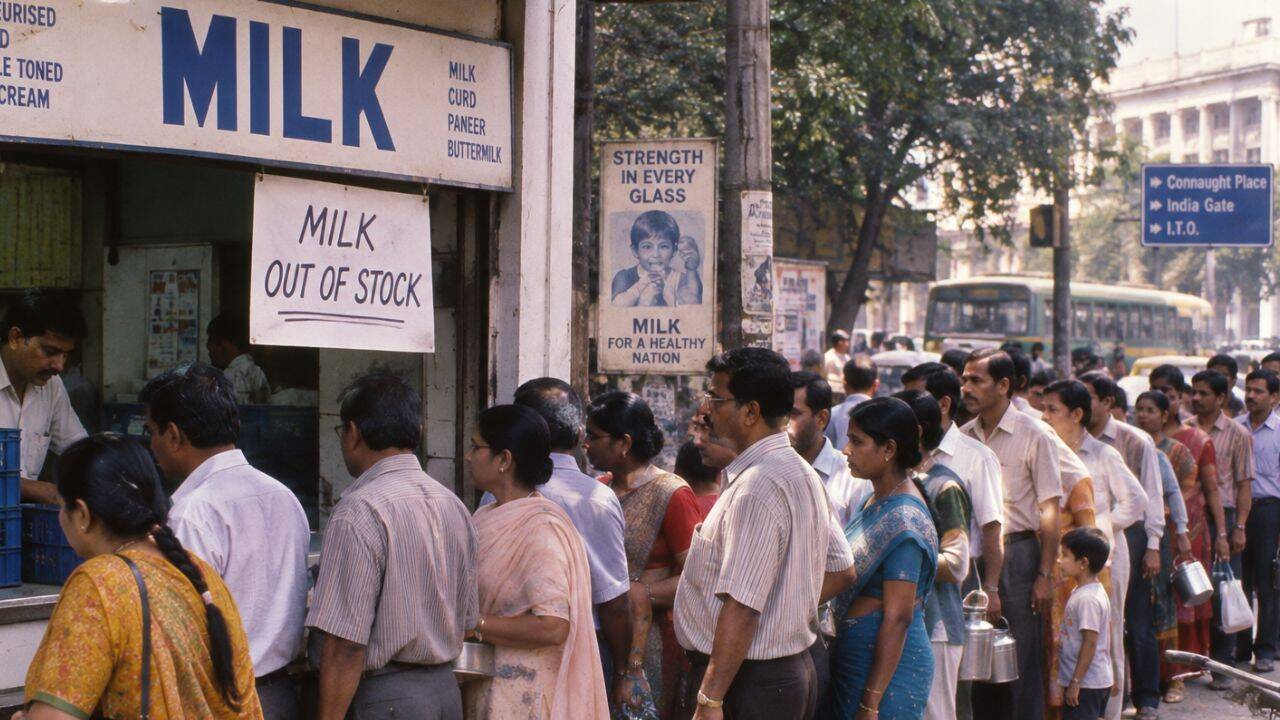
There was a milk shortage nationwide
That detail captures the extraordinary feedback loop created by the phenomenon. People heard that Ganesha was drinking milk, went out to buy milk, took it to temples and offered it to idols. The resulting rush itself became evidence of how seriously the story was being taken.Contemporary reports described crowds gathering at temples, with devotees carrying spoons, bowls and containers of milk.From one temple to the worldThe most remarkable part of the episode was perhaps how quickly it crossed India’s borders. Reports soon emerged from Hindu communities in Britain, the United States, Canada, Nepal and elsewhere. A contemporary Los Angeles Times reportnoted that the reports had spread beyond India to Hindu communities in other countries, including Britain and Los Angeles.Hinduism Today later recalled receiving telephone calls and fax messages from different parts of the world reporting similar experiences. Its contemporary account provides a fascinating glimpse into how an international religious community communicated before email, social media and messaging apps became commonplace.The technology may appear primitive by today’s standards, but the human network was remarkably effective. Someone in India could telephone a relative abroad, that person could contact a local temple, and within hours another community could be trying the same experiment.The story did not need an algorithm to travel. It travelled through relationships.The science behind the phenomenonAs the reports spread, scientists and sceptics began examining what devotees were observing. One of the principal scientific explanations involved capillary action and surface tension. Rather than the idol literally consuming the milk, the liquid could move along the surface of the material, creating the appearance that it was being absorbed by the idol.For devotees, however, the scientific explanation did not necessarily invalidate what they had experienced. The same physical observation could be interpreted through very different frameworks: as a religious sign by believers, as a scientific phenomenon by researchers, and as an extraordinary mass social event by journalists.
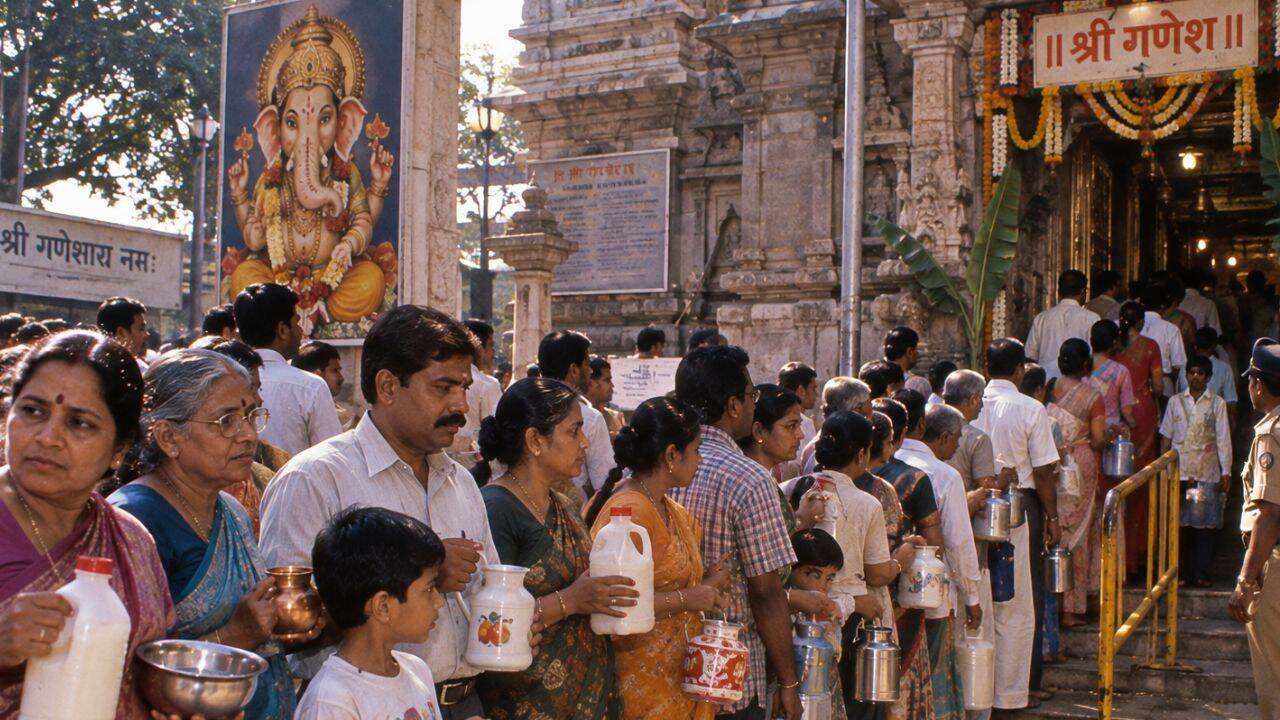
People queuing up in temples for offering milk to Lord Ganesha
What made the episode so unusualLooking back from the age of smartphones, the 1995 episode is remarkable not simply because of what people believed they were seeing, but because of how quickly the information travelled.India’s public internet had only just begun. Fixed telephone connections were limited, television was expanding but had not yet become the 24-hour news environment of today, and newspapers operated on a fundamentally different news cycle. Yet within hours, a local report had become a national phenomenon and then an international story.A telephone call led to another telephone call. A conversation at one temple led to another. Newspapers carried the story forward, television added another layer of coverage and international media transformed what had begun as a local religious phenomenon into a global news story.The first great pre-social-media viral phenomenon?Calling the Ganesha milk episode the world’s first viral phenomenon would be too absolute. Stories travelled internationally long before 1995, through newspapers, radio, television and word of mouth.But the episode offers a remarkable case study of mass communication before the social-media era. Millions of people participated in the same rapidly spreading story without having access to the tools that today make such mass participation almost instantaneous.
Share your thoughts in the comments
Be respectful · TOI community guidelines
That is what makes September 21, 1995, worth remembering 31 years later. The question is no longer simply whether Ganesha idols were actually drinking milk. The episode has another story to tell, about technology, faith, communication and human networks.In 2026, information can travel around the world in seconds. In 1995, it travelled from person to person, from telephone to telephone, from temple to temple and eventually from newspaper to newspaper.And somehow, by the end of that extraordinary day, a spoonful of milk had become a global story.(All images are AI Generated)


