


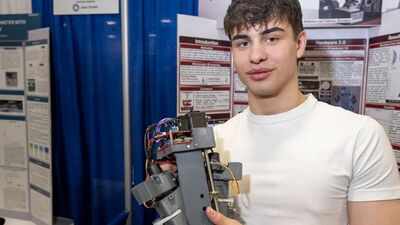
A Slovak student has developed an affordable microscope system that can create 3D models of tiny objects without destroying samples. Filip Lajciak, from Secondary Technical High School Dubnica nad Vahom, developed the system as a stereo vision solution for microscopic samples. It uses a stereo camera integrated into an optical microscopic effector to capture views from multiple angles.The images are processed to generate disparity maps, which are then used to create point clouds and 3D models. The system is designed as an affordable alternative to expensive laser scanning microscopes. According to Fairfolio, the project was presented at ISEF 2026 in the Embedded Systems category, where it received a First Award of $6,000 and the Dudley R. Herschbach SIYSS Award.
How does the microscope create 3D models without destroying tiny objects
The system was developed to address limitations in 3D scanning. 3D scanning of microscopic objects relies on laser scanning microscopes, which can be inefficient or unusable when samples need to be viewed from multiple angles. The project uses stereo vision by placing a stereo camera into an optical microscopic effector. The camera collects views as it rotates around the sample.These views are used to generate disparity maps, which provide data for 3D reconstruction. The system is designed to create non-destructive 3D reconstructions from multiple viewing angles. The project lists welding lines and irregularly shaped objects among samples that can be difficult to analyse using laser scanning microscopes. The approach focuses on making this scanning more affordable and accessible.
How did the scanner’s design change through its development
The student developed several versions of the hardware during development. The initial version used a rigid aluminium frame measuring 350 × 500 × 600 mm. It included 3D-printed rotary guide rails and 3D-printed NEMA-17 cycloidal actuators. A stereo camera was integrated into individual microscope lenses, allowing the lenses to rotate around the microscopic sample during scanning.Later versions were approximately half the size and introduced custom motorised optical effectors to make the system more modular. This allowed the scanner to be integrated with an industrial robotic arm. The hardware evolved through several iterations, with each version refining the design while retaining the stereo scanning approach. The subsequent setup was smaller, more modular, and compatible with an industrial robotic arm.
The technology used to turn microscopic images into 3D models
The system turns captured microscopic images into 3D information through processing steps. Stereoscopic images are processed using semi-global matching to generate a disparity map. The disparity map is then converted into a point cloud through triangulation. Image processing and additional transforms are computed on an NVIDIA Jetson Nano SBC.Through a parallel GPIO connection, it interfaces with a Teensy 4.1, which controls the actuators. The software was developed using the Robot Operating System, or ROS. It publishes data channels to RViz, a graphical user interface used to monitor camera images, disparity maps, point clouds, and the system state. The acquired data are processed into a 3D model.
Potential uses of the microscope’s 3D models
The resulting 3D model can be used for detailed cross-sectional visualisation and analysis of internal structures without destructive sampling. The project identifies applications for the scanner. These include the analysis of micro-particle structures, biological samples and material defects.The system is also intended for samples such as welding lines and irregularly shaped objects, where multi-angle views can be difficult to obtain with conventional approaches. The project was entered in the Embedded Systems category at ISEF 2026. It received a First Award of $6,000 as well as the Dudley R. Herschbach SIYSS Award and Herschbach SIYSS Award. The work combines a stereo camera, optical microscope components, motorised hardware, and software processing in one system to produce 3D models of microscopic samples.


