


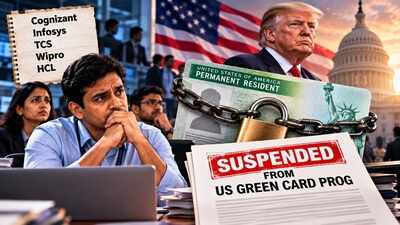
In yet another blow to the Indian IT sector and its professionals, the Donald Trump administration has barred as many as eight technology companies from participating in a programme that is used to seek green cards for foreign workers. The move has the potential to affect tens of thousands of India’s IT professionals.The list of companies which have been suspended from the Permanent Labour Certification Programme (PERM) includes IT sector majors like TCS, Infosys, Microsoft, Wipro, and Cognizant. Indian professionals account for more than 70% of H-1B petitions approved each year.India accounts for a large share of H-1B beneficiaries. As a result, the recent developments could potentially have a significant impact on Indian technology professionals and engineers working in the United States.Also Read | ‘Death by restriction’: As Trump sours H-1B visa dream, which Indian IT professionals face the biggest hit?
What is PERM?
PERM essentially acts as a bridge between being a temporary foreign worker in the US and a realistic pathway to permanent residency in America.It is a crucial stage in the process of getting employment-based green cards in the US. An employer requires certification from the Department of Labour (DoL) that confirms that no willing and qualified US workers are available for that position, before they are allowed to sponsor the green card of a foreign worker. The certification must also establish that employing the foreign national will not adversely affect wages or working conditions in the US.
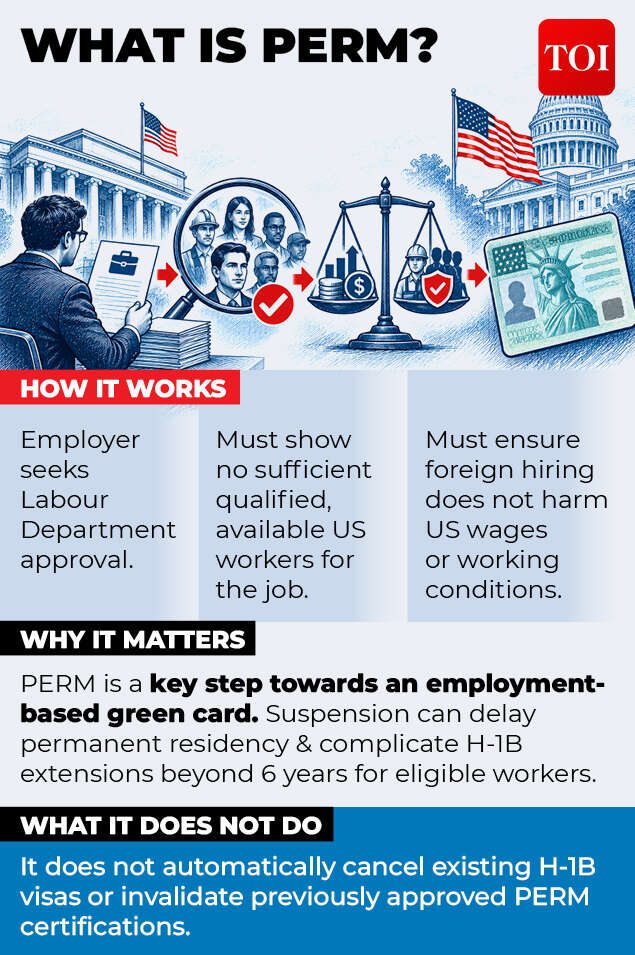
What it PERM?
These eight firms have been suspended from that programme, effectively putting a halt to their ability to offer employment-based green cards to their employees.It does not, however, revoke H-1B visas or immediately stop the companies concerned from employing foreign nationals.US immigration rules allow certain H-1B workers to extend their stay beyond the standard six-year limit once they have reached specified stages of the employment-based green-card process.The companies affected by the decision have the option of challenging it before a federal court.
What has been announced?
The step was announced by US Vice President J D Vance, Labour Secretary Keith Sonderling and Attorney General Todd Blanche under the US Anti-Fraud Task Force initiative.“I am hereby suspending from the Permanent Labour Certification Programme some of the largest IT outsourcing firms in the world, Cognizant, Infosys, Tata, Wipro, HCL, and Capgemini,” Sonderling said.He added that the Department of Labour was also suspending Microsoft and Adobe from the programme because both companies are facing multiple active federal investigations.
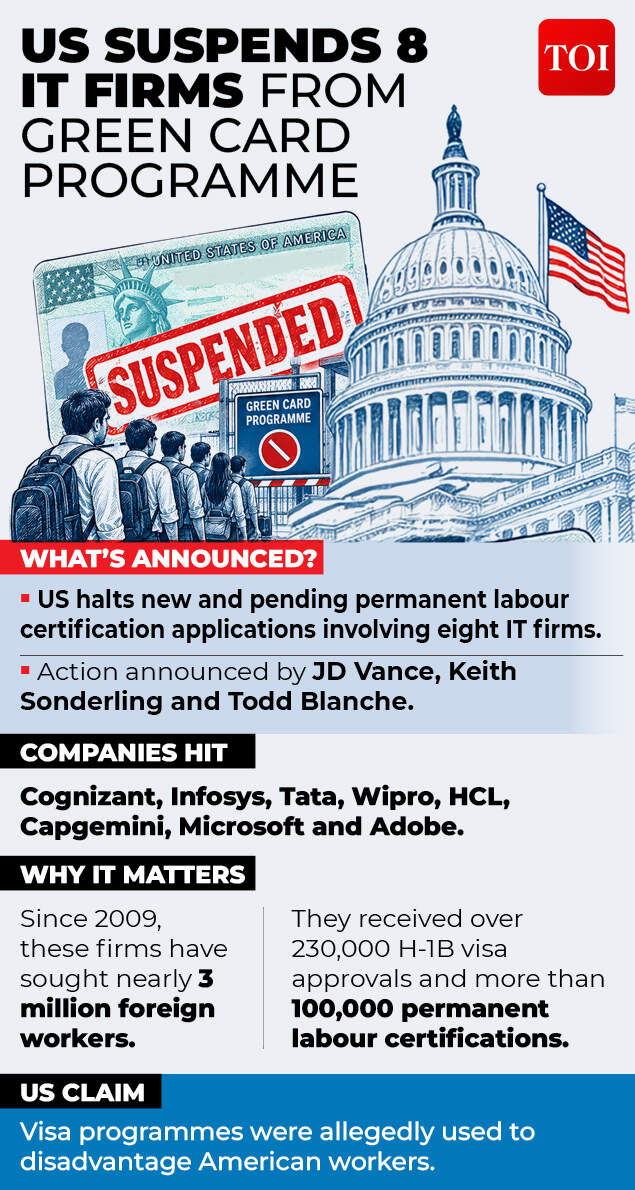
US Suspends 8 IT Firms From PERM
Vance alleged that Microsoft has laid off 6,000 American workers in 2025, certifying that it could not find US workers who were suitably qualified for the jobs. Yet, Microsoft has got the approval for over 6,000 H-1B visas. It also submitted over 3,600 applications for permanent labour certification.“There has been no company in the United States, unfortunately, that has abused this system more than Microsoft,” Vance said.The Department of Labour will now stop accepting fresh applications from the companies and would not process any of their permanent labour certification applications that were already pending.“Since 2009, just these companies alone have requested almost three million foreign workers. They’ve received over 230,000 H-1B visa approvals and over 100,000 permanent labour certifications,” Sonderling said.He claimed that the numbers represented hundreds of thousands of employment opportunities taken away from American workers.Vance described foreign employees recruited through H-1B visas as “foreign indentured servants” and labelled companies that rely on the programme as “visa mills”.
Why has Trump administration taken this step?
The move comes after allegations that the PERM system has prevented Americans from getting jobs.According to Rajiv Dabhadkar, Founder, National Organization For Software and Technology Professionals, the most important message here is that Washington is no longer looking only at whether an H-1B worker is legally qualified. It is increasingly questioning the business model through which foreign labour is recruited, deployed and paid.“The US administration’s stated concern is that some employers and body shops may have used foreign workers in ways that disadvantage American workers, through wage suppression and other forms of programme abuse. These allegations need to be investigated on their merits. Hence it is not about Indian professionals being treated as the problem. The focus is on employers and intermediaries that may have exploited the system,” he tells TOI.Rajiv Dabhadkar explains with an example:Suppose, a US company pays $150,000 for a technology position. An intermediary recruits an H-1B worker and constructs an employment chain where the worker receives substantially less than the economic value of the position. The difference becomes the intermediary’s margin.If a similarly qualified American worker would cost more, the employer may have an economic incentive to use the intermediary. In that situation, the real problem is not: Indian worker vs American worker.It is: transparent market wage vs labour arbitrage.“That is why the current federal investigation into employers, staffing companies and labor brokers is potentially more consequential than the headline debate,” Dabhadkar explains.
What is the impact on Indian IT professionals?
Indian IT sector companies and thousands of IT professionals now face multiple uncertainties. Every route to securing a job and permanent residency in the US is becoming tougher.A $70,000 fee to get a job after you do education in the US, a proposed $100,000 H-1B visa fee, and now the suspension of major technology firms from PERM all add up to a difficult scenario.
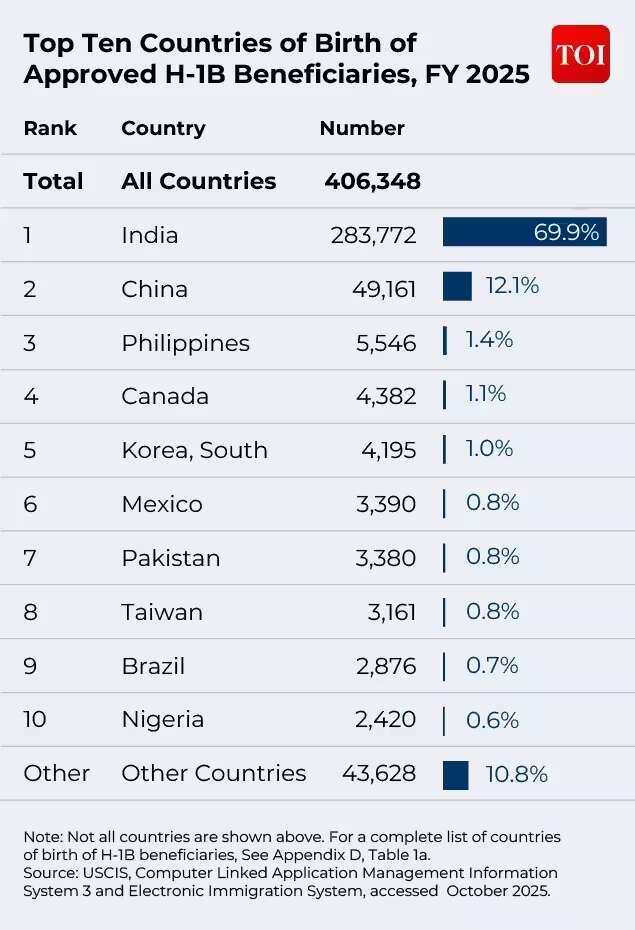
Top 10 countries of birth of approved H-1B visas
By suspending major IT companies from the PERM programme, the US government is effectively putting another barrier in front of thousands of Indian professionals who may already have spent years working, paying taxes and building careers in the United States.The important thing to understand is that the PERM move does not by itself affect the validity of H-1B status for employees who are already in the United States.“But, it could have a more significant impact on H-1B workers who are approaching the six-year limit and are dependent on the PERM-based employment Green Card process to extend their stay in the United States,” says Kuldip Kumar, Partner at Mainstay Tax Advisors LLP.Separately, the Trump administration’s earlier $100,000 payment requirement in relation to certain new H-1B petitions has also been extended through September 21, 2027. However, the implementation of the fee is currently blocked by federal court orders while the litigation continues.“Taken together, these developments reflect the Trump administration’s stated focus on protecting US workers and increasing scrutiny of programmes that allow US employers to hire and retain foreign workers,” Kuldip Kumar tells TOI.“The longer-term impact on Indian technology professionals, particularly those dependent on the H-1B-to-Green Card pathway, will depend significantly on how these measures are ultimately implemented and how long they remain in effect,” he adds.
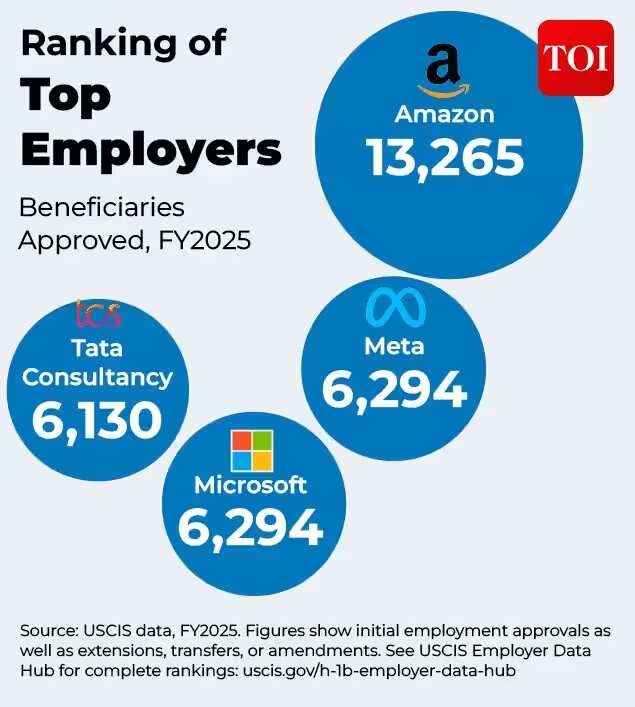
H-1B visas: Top employers
Xiao Wang, CEO of Boundless Immigration breaks down the impact into two categories of Indian IT professionals:Those already in the US at a suspended firm: H-1B status is fine for now. The problem is for anyone counting on their employer to start the green card process.“PERM is step one, and if TCS, Wipro, Infosys, HCL, or Cognizant can’t file new applications, those workers’ green card clocks don’t start. For someone near the six-year H-1B limit without an approved I-140, this is serious and employees need to find new jobs if they want more confidence around being able to stay in the US long-term,” Wang tells TOI.IT professionals looking to come to the US through these firms: The path just got harder! These companies have historically been the biggest H-1B sponsors for workers coming from India.“With PERM suspended and H-1B registrations already down sharply, the traditional IT consulting pipeline is effectively frozen to the US,” Wang warns.The biggest takeaway, however, is that this move is not an isolated step or a temporary blip.“The DOL suspension, combined with the $100,000 H-1B fee and the wage-weighted lottery, is systematically dismantling the staffing model that brought hundreds of thousands of Indian engineers to the US over 30 years,” Wang says.He believes that senior engineers at US tech firms are largely insulated.”Early-career and mid-level professionals at the Indian IT consulting firms are the ones getting squeezed,” he notes.


