


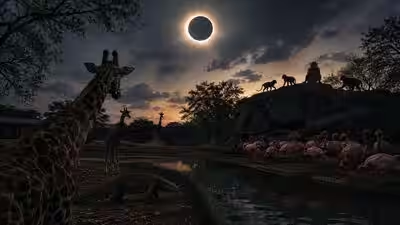
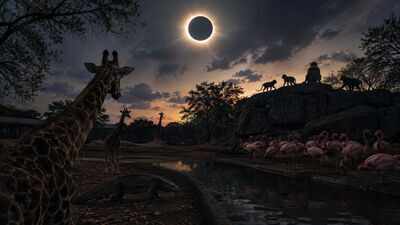
On 21 August 2017, the afternoon light at Riverbanks Zoo in Columbia, South Carolina, began to fade. For the people gathered there, the approaching darkness was an astronomical spectacle. For the animals living outside in the zoo’s enclosures, it was something rather different: daylight was suddenly behaving as if evening had arrived. Researchers had prepared for the event by watching the same animals on the preceding days, giving them a point of comparison when the Moon covered the Sun. Across 17 species, the changes were varied. Some moved towards their night-time shelters. Others became restless or tightly grouped. A pair of Galápagos tortoises began mating. Giraffes ran together. The study did not find one universal “eclipse reaction”. It found something more complicated: animals responding to a sudden environmental cue in very different ways.
How the 2017 total solar eclipse changed animal behaviour at Riverbanks Zoo
The eclipse passed across the United States from Oregon to South Carolina, placing Riverbanks Zoo directly in the path of totality. At the zoo, near-total darkness lasted for roughly two and a half minutes. That sounds brief, but the animals were not exposed to an ordinary change from afternoon to evening. The researchers were interested in what happened as the light declined, reached totality and then returned.According to the study published in the National Library of Medicine, titled ‘Total Eclipse of the Zoo: Animal Behaviour during a Total Solar Eclipse’, to make sense of any unusual behaviour, teams had already spent two days observing the animals during comparable afternoon periods. They watched between 1 pm and 4 pm, recording where animals moved, whether they were feeding, resting, vocalising or interacting with others. The same teams then returned during the eclipse. Twenty-one university affiliates, 19 zoo staff members and 13 volunteers took part in the observations. For the siamangs, researchers also made continuous audio and video recordings so that changes in their calls could be examined more closely.The animals included mammals, birds and reptiles: gorillas, baboons, siamangs, elephants, grizzly bears, giraffes, seals, sea lions, flamingos, lorikeets, cockatoos, lapwings, kookaburras, tawny frogmouths, Galápagos tortoises and a Komodo dragon. They did not all react. Four of the formally observed species, grizzly bears, harbour seals, California sea lions and kookaburras, showed no clear departure from their normal behaviour. That difference mattered. The researchers were not simply looking for animals doing something unusual and calling it an eclipse effect. They compared what happened during the event with what those animals had been doing before it. Out of the 17 species, 13, or about 76 per cent, showed some form of behavioural change.
Gorillas, elephants and Komodo dragons showed evening-like behaviour during the eclipse
The most common response was surprisingly ordinary. Animals began behaving as though the day was ending. Gorillas moved towards the entrance of their indoor enclosure, following a route they normally took in the evening. The elephants also approached their barn. The Komodo dragon, normally almost motionless beneath a bush, became active and headed rapidly towards the entrance of its evening den. The researchers described these behaviours as an “evening” response; essentially, the animals appeared to interpret the abrupt reduction in light as a cue associated with their usual night-time routine. Birds showed similar changes, although their reactions did not always look like simple settling down.The lorikeets were scattered around their enclosure during normal afternoon activity. As totality approached, their calls became louder and more frequent. Then the entire flock flew together towards the area containing their indoor enclosure and nest boxes. At totality, they became silent, after which many began preening. The researchers noted that this kind of synchronised movement had not appeared during their baseline observations.The tawny frogmouth provided almost the opposite pattern. It is a nocturnal species and normally spent the afternoon perched almost motionless. During totality, it became more active, opened its eyes fully, moved around its perch, preened and repeatedly scanned its surroundings. Once daylight returned, it went back to its usual resting posture. In a matter of minutes, an event that looked like the arrival of night to a daytime animal effectively resembled the beginning of activity for a nocturnal one.The distinction is important because the study points towards light and possibly the accompanying fall in temperature as a major environmental signal. The researchers wrote that the predominant reaction “mimicked evening/nighttime behaviours”, suggesting that the sudden environmental change could disrupt the animals’ normal daily rhythms.This was not entirely unexpected. Earlier eclipse observations had recorded birds returning to roosts, animals becoming quiet and other species beginning behaviours normally associated with dusk. Reports from India, Venezuela and the United States had described similar changes during previous eclipses. Historical observations, however, were often anecdotal and sometimes contradictory.
How the 2017 total solar eclipse unsettled giraffes and triggered unusual behaviour
As totality approached, the giraffes stopped feeding and gathered towards the back of their enclosure, close to the barn. Their behaviour then became more unsettled. One male paced and swayed his neck and body, while the group formed a tight cluster. Once totality had passed, two males and one female galloped together for several minutes, something the observers had not seen during the baseline periods. One male continued pacing for more than an hour after the eclipse. The behaviour was classified as apparent anxiety, although the researchers were careful about the wording. They could observe pacing, swaying, huddling and running, but they could not directly establish what the animals were experiencing internally.The baboons responded in their own way. As the sky darkened, two normally separate social groups came together. The troop became highly vigilant and ran around the enclosure as a unit. One female repeatedly paced and walked in circles for about 25 minutes. The unusual activity began to disappear within roughly half an hour of totality ending.Flamingos also became unusually synchronised. Instead of remaining in their usual subgroups, the flock moved close together on a central island. Juveniles were surrounded by adults, while the birds held their heads high and repeatedly looked around. They vocalised loudly and became relatively still. During totality, many adults ruffled their feathers and flapped their wings. As light returned, the flock gradually spread out again.
Galápagos tortoises showed novel behaviour as darkness swept across the zoo
They normally moved slowly, spending periods feeding, resting in shade or interacting with one another. Shortly before totality, the group gathered together. A male and female then began mating. During totality, all four tortoises became markedly more active, moving faster than they had during the baseline observations and scattering into different parts of the enclosure. When the eclipse ended, they looked towards the sky before gradually returning to their usual level of activity.It is tempting to attach a simple explanation to that sequence, but the researchers did not. The mating and increased movement were classified as novel behaviour, rather than being confidently attributed to a particular cause. The study simply records what happened. The siamangs were similarly difficult to categorise. Their vocal behaviour changed around the eclipse, with both the organising and great-call portions of their vocalisations becoming shorter than during comparison periods. Their calling also became less orderly after the final sequence. Quantitatively, their eclipse calling bout lasted 388 seconds, compared with an average control duration of 673 seconds.The researchers could not say whether this represented anxiety or simply an unusual response to changing environmental conditions. Siamangs are known to respond to changes in weather and daily cycles, leaving several possible explanations open.
How human activity at the zoo complicated the 2017 solar eclipse animal behaviour study
There was an obvious complication at Riverbanks Zoo that day: the humans were behaving unusually too. The eclipse attracted a large crowd. Visitors cheered and applauded, while a helicopter flew overhead and fireworks were reported near the zoo during totality. The baboons, for example, had already displayed threat behaviour towards visitors after a group of people shouted. That makes it difficult to separate a reaction to darkness from a reaction to noise and human activity. There were other changes to the zoo routine as well. The seals and sea lions were fed an hour earlier than usual so that feeding could happen before the eclipse. That kind of alteration can affect behaviour independently of the eclipse itself.The researchers therefore did not present the results as proof that every unusual movement was caused directly by the Moon blocking the Sun. Their observations were largely qualitative, and the eclipse could not be repeated under identical conditions. They also acknowledged that the zoo environment itself introduced variables that would not exist for animals living in the wild.Still, there were reasons to think the darkness itself played an important role. The strongest clue was the number of species that moved into behaviours associated with evening. Gorillas approached their night enclosure. Elephants moved towards the barn. Birds headed towards roosting areas. The nocturnal frogmouth became active. These changes fit a pattern linked to the sudden alteration in daylight rather than simply to the excitement of a crowd. The findings also resembled observations from wild animals. The researchers noted that giraffes in Zambia had previously been seen galloping during an eclipse, while earlier observations had recorded birds reducing their activity and apparently moving towards roosting areas.That leaves the 2017 eclipse as something of a brief interruption to the normal timetable of animal life. It did not produce the same reaction everywhere. Some animals carried on almost as usual. Others behaved as if night had arrived. A few became visibly unsettled, while the tortoises and siamangs produced responses that did not fit neatly into either category.The study’s authors described the responses as complex rather than uniform. That may be the most useful finding of all. The disappearance of daylight was the same physical event for every animal in the enclosure, but its behavioural meaning differed between species, and sometimes between individual.
What happened to the animals after the 2017 total solar eclipse ended
As the Sun returned, most of the unusual behaviour faded. The giraffes eventually settled, the baboons re-formed their normal social groups, the flamingos spread through their enclosure and the Komodo dragon returned to its earlier inactivity. The darkness had lasted only minutes. Its behavioural traces, in some animals, lasted considerably longer.Future eclipses could offer a better test. The researchers suggested observing wild populations, reducing human interference and collecting more quantitative measurements. Citizen-science projects could also broaden the number of species observed beyond what a single zoo can provide. Their source study points out that future eclipse paths would pass through habitats containing animals such as baboons, siamangs, elephants, giraffes and flamingos.For the animals at Riverbanks Zoo, though, the experiment happened once, in the middle of an ordinary August afternoon that suddenly stopped being ordinary. The result was not a single mysterious “eclipse behaviour”. It was a collection of small changes, a run, a huddle, a call, a return to a barn, a sudden burst of movement, revealing just how much animal routines can depend on something as basic as the amount of light in the sky.


