



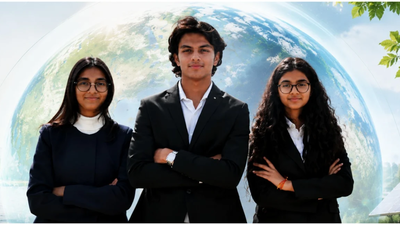
What started with concerns about access to clean drinking water eventually led three Indian teenagers to an idea that could offer a remarkably simple way of tackling microplastic contamination. Vivaan Chhawchharia, Ariana Agarwal and Avyana Mehta, all 16, developed Plas-Stick, a biodegradable powder made from discarded tamarind seeds that can bind tiny plastic particles in water.Their invention went on to win The Earth Prize 2026, making the trio the first Indian team to become global winners of the international environmental competition for teenagers. The students were recognised for developing a low-cost approach that does not depend on complicated filtration systems or large amounts of infrastructure. The three also spoke about their invention and its journey in an interview with CNN.
Three teenagers turned a discarded kitchen waste into a possible answer to microplastic pollution
Microplastics are tiny fragments of plastic that can enter water through the breakdown of larger plastic products, synthetic materials and other sources. Because they are so small, removing them from contaminated water can require filtration systems that may be expensive or difficult to operate in communities without reliable infrastructure.The students’ idea was shaped by seeing how drinking water is stored and shared in rural communities. They were looking for something that could work in places where sophisticated purification equipment may not be readily available.That led them towards a material that is common across India and would otherwise often be treated as waste: tamarind seeds.
Why tamarind seeds became the unlikely ingredient in Plas-Stick
The team developed a powder from discarded tamarind seeds and found that, when introduced into contaminated water, it could interact with microplastic particles and cause them to gather together into larger clumps.This is important because individual microplastic particles can be extremely difficult to capture. Once the particles are brought together, however, they become easier to separate from the water.Plas-Stick takes that principle a step further. The resulting tamarind-seed and microplastic clumps can be collected using a handheld magnet, according to the Earth Prize’s account of the project. The approach therefore avoids the need for electricity, conventional filter cartridges or complicated machinery.
From a school project to an idea that could work beyond the laboratory
One of the most striking aspects of Plas-Stick is its emphasis on simplicity. Instead of designing an expensive piece of equipment, the teenagers focused on using materials that are inexpensive, accessible and already available as agricultural waste.The project also received support from researchers at IIT Guwahati, helping the students develop and test their concept further. Their work had already reached thousands of students and teachers during the development process, giving the team an opportunity to demonstrate the idea beyond their own school environment.The use of tamarind seeds also gives the project a second environmental angle. Rather than requiring a new synthetic material, the invention gives an agricultural by-product another purpose while addressing a growing pollution problem.
The three teenagers who took the idea to the world stage
Vivaan Chhawchharia, Ariana Agarwal and Avyana Mehta worked together to develop Plas-Stick and eventually represented India at The Earth Prize.Their achievement became particularly significant because they were not simply regional winners. In May 2026, the trio was selected as the global winner of The Earth Prize, becoming the first Indian team to claim the top honour. Their selection followed a public vote involving roughly 23,000 people, according to reports on the competition.For Agarwal, the connection between the invention and India was especially meaningful because tamarind, or imli, is such a familiar part of everyday life in the country. A material that might ordinarily be discarded had become the basis of an environmental innovation with global attention.
What makes the idea different from conventional water filtration
Traditional water purification can involve filters, membranes, treatment chemicals or energy-intensive equipment. Those approaches can be effective, but their cost and infrastructure requirements can make them harder to deploy in some communities.Plas-Stick takes a different route by attempting to make the contaminant itself easier to collect. The tamarind-derived powder binds the microplastics into larger masses, after which the material can be separated using a magnet.That does not mean the invention is already a finished replacement for established water-treatment technologies. The project remains at a development stage, and further testing, refinement and validation will be needed before it can be considered a widely deployable water-purification system.
Why a simple solution could matter in the fight against microplastics
The significance of Plas-Stick lies not only in what it does but also in how the teenagers approached the problem. Instead of beginning with expensive equipment or complex industrial processes, they looked for locally available material and asked whether it could be repurposed to address a modern environmental threat.Microplastic pollution is difficult precisely because the particles are so widespread and often invisible. Finding practical ways to remove them from water is therefore an important area of environmental research.Plas-Stick is still being developed, but its underlying idea illustrates how environmental innovation does not always require sophisticated machinery. Sometimes, an overlooked agricultural waste product can provide the starting point for a completely different way of approaching a problem.
The prize could be only the beginning for Plas-Stick
Winning The Earth Prize gave the three students international recognition as well as support to continue developing their project. As the first Indian team to win the global title, Vivaan, Ariana and Avyana have also demonstrated how young researchers can contribute ideas to problems that extend far beyond their classrooms.The real test for Plas-Stick will now be whether the promising concept can be developed into a reliable, safe and scalable method for removing microplastics from real-world water supplies.If further development proves successful, a material as ordinary as discarded tamarind seed could find an unexpected second life, helping turn one form of agricultural waste into a tool for tackling one of the world’s increasingly visible pollution problems.


