


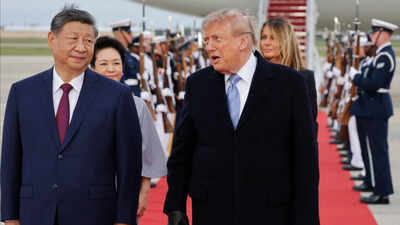
Chinese President Xi Jinping arrived in Washington on Wednesday for a three-day state visit that began with an unusual gesture from US President Donald Trump, who personally went to Joint Base Andrews to welcome the Chinese leader and his wife, Peng Liyuan.Trump and first lady Melania Trump were at the Maryland air base for the arrival ceremony, marking a rare occasion in which a US president personally greets a visiting foreign leader at the airport rather than waiting for the guest to arrive at the White House. The visit is Xi’s first state visit to Washington in more than a decade.The welcome comes as the US and China remain at odds over trade, artificial intelligence, Iran and Taiwan. The three-day programme is expected to combine high-level diplomatic discussions with extensive ceremonial events, including a formal state dinner at the White House on Thursday.
Trump, Melania personally welcome Xi at Joint Base Andrews
Trump and Melania arrived at Joint Base Andrews aboard Marine One ahead of Xi’s arrival. The president then moved with his motorcade to the location of the arrival ceremony, where a military honour guard, band and other formations were assembled.The airfield was prepared for a formal welcome, with black SUVs and limousines positioned near the tarmac and the Air Force band marching in formation. Members of different branches of the US military were also present as preparations continued for Xi’s arrival.Trump’s decision to greet Xi at the air base instead of waiting for him at the White House is being viewed as an unusually personal welcome for a visiting foreign leader. The gesture is part of an elaborate programme intended to match the ceremonial reception Trump received during his visit to China earlier this year.Melania said her husband decided to personally greet Xi because “they have a great relationship.”“He’s coming on our soil, and we need to welcome them with the most respect,” she said during an interview with Fox News Channel’s “Fox & Friends.”Melania also said she had been closely involved in planning the itinerary for Xi and Peng.“Every detail, I was involved,” she said, adding that the visit involved extensive protocol and planning.
Three-day visit comes amid tensions over trade, AI, Iran and Taiwan
Xi’s visit comes at a time when relations between Washington and Beijing remain tense despite efforts to maintain what the Trump administration describes as “strategic stability”.Trade, artificial intelligence, Trump’s war with Iran and China’s designs on Taiwan are among the major issues surrounding the visit. Expectations for a major breakthrough are low, even as the two leaders prepare for closed-door discussions.The visit also follows Trump’s trip to China in May. The elaborate reception in Washington is intended to reciprocate the ceremonial grandeur surrounding Trump’s visit.When Trump arrived in Beijing, Xi did not personally meet him at the airport. Chinese Vice President Han Zheng was there instead. Air Force One was met by a red carpet, a military honour guard, a military band and about 300 Chinese youths carrying Chinese and American flags and chanting, “Welcome, welcome! Warm welcome!”The children wore white and light blue uniforms that mirrored the traditional colours associated with the presidential aircraft.
Wicker criticises ‘lavish welcome’
The ceremonial reception has also drawn criticism from within the US.Sen. Roger Wicker, the Republican chairman of the Senate Armed Services Committee, criticised the “lavish welcome” for Xi.Wicker said during a speech in the Senate on Tuesday that Trump should not have invited the Chinese leader “based on all of the troubling issues we have with President Xi and the Chinese Communist Party.”Wicker suggested that Trump could use the state dinner to discuss issues including “the purposes of China’s massive military buildup, or about China’s clear support for Iran.”He also said that “during every minute of dialogue” Trump should keep in mind that “his guest is a brutal, unelected and oppressive dictator who seeks to dominate his neighbors and whose massive military arsenal is aimed directly at the United States of America.”
Rubio says US must engage China at highest levels
US Secretary of State Marco Rubio defended the need for high-level engagement with Beijing, saying the United States and China are “the two largest economies in the world” and “probably the two most powerful militaries in the world.”“The idea that we would not interact with them at the highest levels is irresponsible. It’s outrageous. We have to,” Rubio told reporters Wednesday while he was in New York.The administration has presented the engagement as part of efforts to maintain strategic stability between the two countries despite their disagreements.
White House state dinner to follow on Thursday
The airport welcome is only the beginning of a packed three-day programme.On Thursday, Xi and Peng are scheduled to return to the White House for a formal arrival ceremony. The programme will include a review of troops before Trump and Xi turn to discussions on the major issues facing the two countries.The day will culminate in a black-tie state dinner at the White House.The dinner is expected to include prominent technology industry figures, including Nvidia’s Jensen Huang and SpaceX’s Elon Musk. The broader guest list is expected to feature several major US technology executives.Trump has repeatedly signalled that he wanted the visit to have an elaborate ceremonial character. In recent weeks, he spoke positively about his new helicopter landing pad being ready for Xi’s visit while expressing regret that the White House’s large ballroom would not be completed in time.
Melania and Peng to visit Asian art museum
Melania has also planned a separate programme with Peng Liyuan.The two are expected to visit the Smithsonian National Museum of Asian Art, where they will explore cultural connections between the United States and China.Melania said she had been involved in planning the major components of the visit, including the state dinner and the cultural programme for the two first ladies.The visit reflects the broader effort to combine formal diplomacy with cultural events during Xi’s stay in Washington.
Xi and Peng to visit National Archives
On Friday, Xi and Peng are scheduled to return to the White House for private tea with Trump and Melania.The two couples will then travel to the National Archives in Washington, where they are expected to view historic documents connected to the relationship between the United States and China.The White House has said the documents will underscore the historical relationship between the two countries. The National Archives visit will form the concluding part of Xi’s three-day state visit.
Who is travelling with Xi?
Peng Liyuan is confirmed to be travelling with Xi and will return to China with him on Friday.The exact composition of Xi’s business delegation was not confirmed in the material provided. The visit comes after Trump travelled to China with several prominent US technology executives, including Apple’s Tim Cook, Tesla’s Elon Musk and Nvidia’s Jensen Huang.Xi’s delegation is expected to include business representatives, but the names of the executives travelling with the Chinese president had not been confirmed.
Why Xi’s Washington visit matters
The visit is Xi’s first trip to Washington since 2015, when he was received by then-US President Barack Obama.It comes as the two countries continue to manage disagreements over trade, technology and broader geopolitical issues. Artificial intelligence, Taiwan and Iran are among the sensitive subjects surrounding the talks, while trade remains a central part of the bilateral relationship.A US-China trade agreement reached last year is also due to expire in November, adding another economic issue to the backdrop of the visit.Against that setting, Xi’s arrival has combined an unusually elaborate ceremonial welcome with closed-door diplomacy. Trump has sought to demonstrate warmth towards the Chinese leader, while critics in Washington have questioned the extent of the welcome and urged the administration to raise contentious security and geopolitical issues directly.


