










Headlines

Texas A&M researchers built a 17-foot fire whirl over crude oil on water; it burned 40% faster, cut soot 40% and consumed up to 95% of the fuel

A giant, tornado-like flame may offer a cleaner and faster way to respond to oil spills at sea. In a large-scale experiment, researchersfrom Texas A&M University and the University of California, Berkeley created a nearly 17-foot-tall fire whirl over crude oil floating on water. The spinning flame burned the oil about 40% faster than a…

Read More

Meet Arya Satheesh: High school student invents plant-based plastic that removes microplastics as it naturally breaks down, named European winner of The Earth Prize |

Eighteen-year-old Arya Satheesh, a high school student from Letterkenny in County Donegal, Ireland, has earned international recognition for inventing Eco Purge, a plant-based biodegradable plastic. The material is designed to help tackle the growing problem of microplastic pollution. As it naturally breaks down, Eco Purge releases specialised enzymes that are designed to help degrade nearby…

Read More

Scientists in China create a self-healing dress from living fungus that repairs its own tears and biodegrades naturally |

PC: Study: A programmable fungal platform for engineered living textiles Researchers in China have created a textile made from living fungal mycelium that can heal its own cuts, grow new surface layers on command, and biodegrade completely within weeks. The material, built from Cordyceps militaris fungus, keeps its cells alive throughout the manufacturing process, unlike…

Read More

Moon: Scientists develop a new way to detect hidden water ice on the Moon using seismic waves |

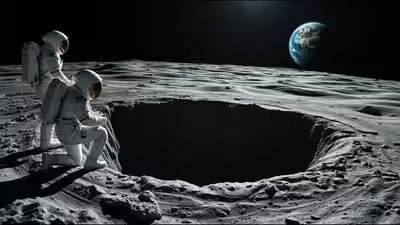
Representative Image of astronauts investigating potential water ice reserves on the Moon (AI-generated image) Beneath the permanently shadowed craters near the Moon’s south pole, scientists believe significant deposits of water ice may be buried out of reach of the instruments currently used to search for it from orbit. A new study led by researchers at…

Read More

This 6,000 km long underground city stretching from Portugal to Italy is built by the Argentine ants across the coasts of four European countries |

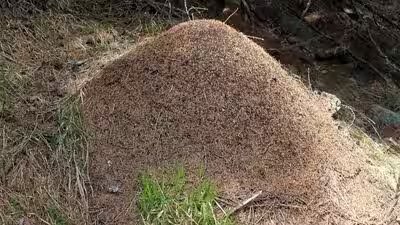
Ant Supercolony. Image Credit: Anagoria/Wikipedia The Argentine ant (Linepithema humile) has created one of the most remarkable biological phenomena ever recorded: a super-colony stretching around 6,000 kilometres along the Mediterranean and Atlantic coasts of Portugal, Spain, France and Italy. According to a study published in the Proceedings of the National Academy of Sciences (PNAS), these…

Read More

A new island has emerged in Alaska after a glacier melted away: Nasa images reveal a stark sign of climate change |

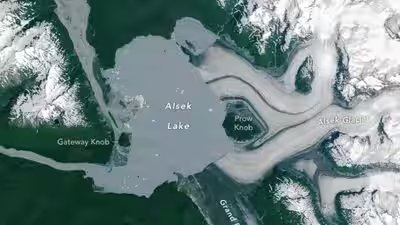
Alsek on July 5, 1984. Image Credit: NASA Earth Observatory images by Michala Garrison, using Landsat data from the US Geological Survey. The coastal plain of southeastern Alaska is currently witnessing a rapid transformation where water is replacing ice at an unprecedented rate. Glaciers in this region are melting, which leads to the formation of…

Read More

Scientists discover Black pine jewel beetles use heat, smoke and infrared organs to find wildfires using nature’s most sophisticated sensory system |

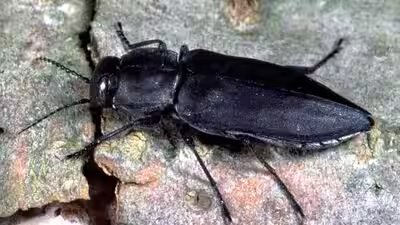
Black fire beetle, Melanophila acuminata. Image Credit: Prof. Schmitz/Wikipedia Black pine jewel beetles, scientifically named Melanophila acuminata, belong to a unique group of insects that exhibit pyrophilous behaviour, which means they are naturally attracted to forest fires. These beetles are primarily found across boreal and temperate forests of the north, where they play a vital…

Read More

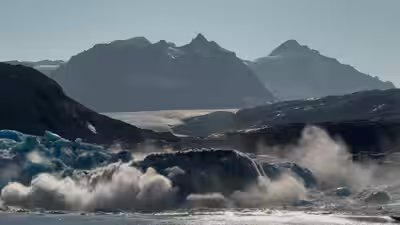
British scientists were studying Greenland’s Sorgenfri glacier when a 1km-wide section calved at once; the block weighed an estimated 18 million tonnes

A scientist on board captured the moment the glacier crashed into the ocean. Credit: Alice Fremand Scientists aboard Britain’s flagship polar research vessel, RRS Sir David Attenborough, watched an estimated 18 million metric tonnes of ice crash into the ocean when a massive section of Greenland’s Sorgenfri glacier broke away in a single evening event.The…

Read More

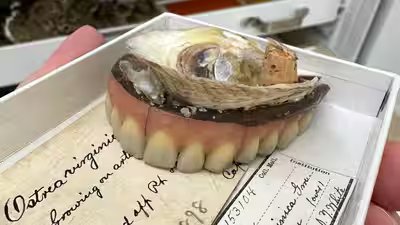
In 1898, Chesapeake Bay was so full of oysters that one grew on a lost set of dentures; today, more than 99% of the historic native population has disappeared

An eastern oyster (Crassostrea virginica) attached to an upper set of artificial teeth (Source: Smithsonian Institution) In 1898, a dredging boat pulling debris from the floor of the Chesapeake Bay made a discovery that looked like something from a biological nightmare: a set of human dentures with a live oyster firmly attached to them.The unusual…

Read More