








Headlines

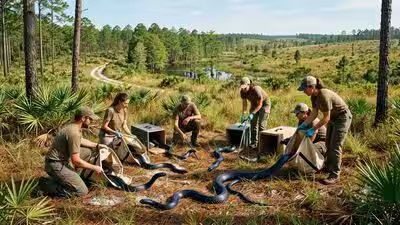
A giant snake vanished from parts of the US decades ago. Scientists are now releasing 42 eastern indigo snakes to bring it back |

In Spring 2026, conservationists released 42 eastern indigo snakes into their historical habitats in Florida and Alabama. After a year of specialized care, these reptiles have adapted well, with monitoring indicating successful survival and breeding in the wild. This significant reintroduction effort seeks to restore self-sustaining populations of this unique snake species to their native…

Read More

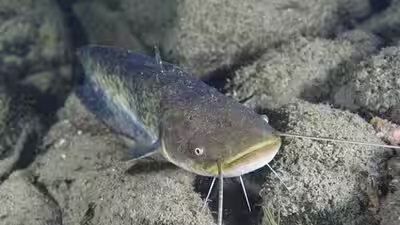
In 1974, a German fisherman released thousands of baby catfish into a Spanish river; 50 years later they are threatening native wildlife as an ‘ecological time bomb’

German biologist and recreational fisherman Roland Lorkowsky released thousands of juvenile Wels catfish into Spain’s Ebro River in 1974. His goal was simple and positive: to create a world-class sport fishery by introducing one of Europe’s biggest freshwater fish. But today, the Wels catfish has become one of the dominant predators in many Spanish waterways….

Read More

Scientists created the world’s whitest paint that reflects 98.1% of sunlight and it could cool buildings without air conditioning |

Keeping buildings cool has become an increasingly difficult challenge as temperatures rise and air conditioning demand continues to grow. While cooling systems provide comfort, they also consume large amounts of electricity, adding to energy costs and greenhouse gas emissions. That has encouraged scientists to look for alternatives that work with nature rather than against it….

Read More

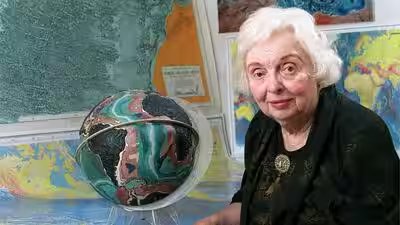
Meet Marie Tharp: The woman who never went to sea but discovered the hidden world beneath the oceans in 1957 and changed Earth science forever |

For much of the twentieth century, the deepest parts of the oceans remained among the least understood places on Earth. Ships crossed vast stretches of water every day, yet almost nobody knew what lay beneath them beyond scattered depth measurements collected for navigation. The seabed was often imagined as a broad, featureless plain interrupted only…

Read More

Meet Aakash Manaswi, the Florida student whose CO2 mite blower made bees healthier and increased honey across 60 hives while killing a parasite that harms 50% of them annually

Honey bees are one of the most important insects across the globe. The buzzing bees do more than just make sweet nectar, they pollinate crops, maintain ecosystems and produce natural goods. According to the UN Environment Programme, they directly contribute to food security and a third of the world’s food production depends on bees. However,…

Read More

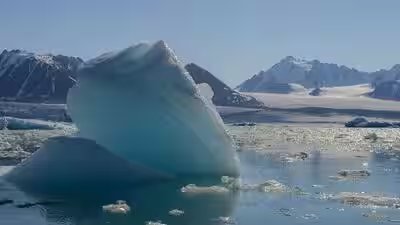
Scientists discover the hidden process in the Arctic that could reshape Earth’s future climate by changing cloud cover |

Image Credit: Hannes Grobe The Arctic region is warming three times faster than the global average since the past 40 years, which makes it one of the most sensitive areas on the planet. Recent scientific findings published in Nature Geoscience have uncovered a previously unknown natural process that massively increases the number of cloud-forming particles…

Read More

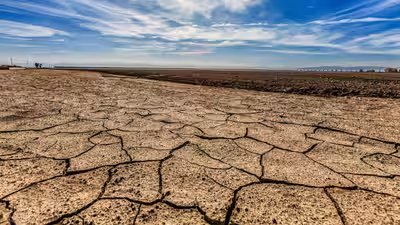
Scientists say California’s 2020 drought may have permanently damaged a massive underground water reserve that can no longer store as much water |

California’s ongoing drought has inflicted lasting harm on its underground water reserves. The over-extraction of groundwater has resulted in aquifer compaction, diminishing the earth’s capacity to store water. In certain areas of Sacramento Valley, land subsidence has exceeded half a meter. This irreversible damage casts a shadow over future agricultural water security, serving as a…

Read More

Colorado scientists convert carbon dioxide into durable plastic: Solving two biggest environmental problems of planet Earth |

Image Credit: (Representational Image: iStock) Carbon dioxide is a naturally occurring gas, abundant in quantity but its chemical stability makes it difficult to convert into useful materials. Since the 1960s, scientists have been attempting to transform carbon into polymers, which require specific catalysts to overcome the energy barriers. Some success was achieved in creating various…

Read More

James Webb’s ‘little red dots’ may be 100,000-sun monster stars; their collapse could have seeded the universe’s first giant black holes

‘Little red dots’ may be pulsating monster stars that created early-universe black holes, study finds Mysterious, compact objects discovered in the early universe may actually be enormous “monster stars” with masses up to 100,000 times greater than the Sun.According to a new study by the Center for Astrophysics | Harvard & Smithsonian, these giant stars…

Read More