







Headlines

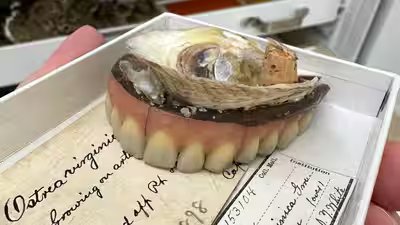
In 1898, Chesapeake Bay was so full of oysters that one grew on a lost set of dentures; today, more than 99% of the historic native population has disappeared

An eastern oyster (Crassostrea virginica) attached to an upper set of artificial teeth (Source: Smithsonian Institution) In 1898, a dredging boat pulling debris from the floor of the Chesapeake Bay made a discovery that looked like something from a biological nightmare: a set of human dentures with a live oyster firmly attached to them.The unusual…


Read More

In 1934, scientists heard reports of mushrooms causing visions of tiny people; in 2026, DNA linked the phenomenon to one species in China and the Philippines

Lanmaoa asiatica is a popular edible mushroom species sold in Yunnan that induces Lilliputian hallucinations when undercooked. In 1934, Western scientists first heard reports from Papua New Guinea of wild mushrooms causing visions of tiny people, a phenomenon called “mushroom madness.” Nearly a century later, DNA sequencing has confirmed that a single, identical mushroom species…

Read More

Max: Quote of the day by Max Planck: “Science cannot solve the ultimate mystery of nature. And that is because…” |

Few scientists have reshaped humanity’s understanding of the universe as profoundly as Max Planck. Celebrated as the father of quantum theory, the German physicist not only revolutionised modern physics but also left behind timeless reflections on science, philosophy and the limits of human knowledge. One of his most quoted observations is: “Science cannot solve the…

Read More

For more than 125 years, horses have quietly helped save snakebite victims. Here’s how their blood becomes life-saving antivenom |

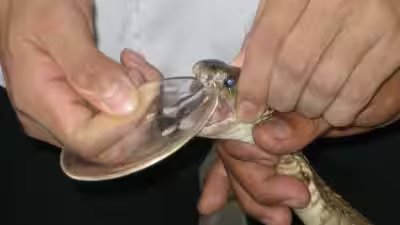
Milking a snake for the production of antivenom. Image Credit: Barry Rogge/Wikipedia Snakebite envenomation(condition where toxic venom is injected into a body via the bite, sting, or puncture of a venomous animal such as a snake, spider, scorpion, or insect), remains a global health issue, causing up to 100,000 deaths per year and affecting millions…

Read More

Scientists discover humans and mice may use the same hidden brain system to recognise smells |

Representative Image of a mouse and a human side by side, both engaged in sniffing (AI-generated image) A mouse hunting for food might sniff several times a second. A person checking whether a cantaloupe is ripe usually leans in for a single, unhurried breath. On the surface, these look like completely different behaviours. Two complementary…

Read More

Butterflies are changing where they live across the planet, with climate and extreme weather driving most documented shifts

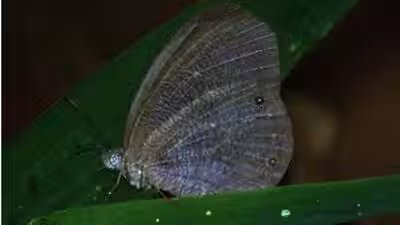
In Brazil, the blue butterfly Godartiana byses has expanded from the states of Rio de Janeiro and Bahia to Sao Paulo. Butterflies are relocating across the world as climate change and extreme weather continue to alter their habitats. According to a new global study, many species are expanding into new areas, while others are disappearing…

Read More

In 2012, a wildfire scorched 42 sq km of the Rwenzori alpine zone; lake cores showed it was the first large-scale fire there in 12,000 years, with charcoal jumping over 100-fold

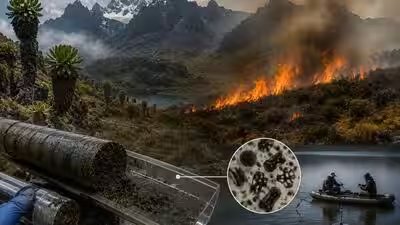
Representative Image (AI-generated) A wildfire that swept through the high-altitude alpine zone of Africa’s Rwenzori Mountains in 2012 has been identified as the first large-scale fire to strike the region in at least 12,000 years, according to a study published in Nature. By analysing ancient lake sediment cores (cylindrical samples of layered mud from the…

Read More

Scientists studied animal bones in South Australia’s underwater caves; those near light carried algae marks while bones in total darkness remained remarkably pristine

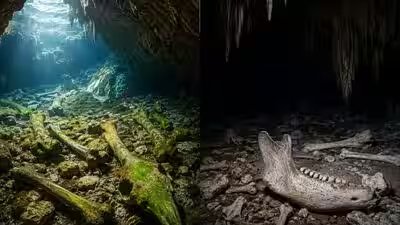
Representative Image (AI-generated) Animal bones resting on the floors of South Australia’s underwater caves are revealing far more than the identity of the creatures they once belonged to. According to a new study published in PLOS One, the cave environment itself leaves distinct “fingerprints” on bones, helping scientists reconstruct how they were deposited, the environmental…

Read More

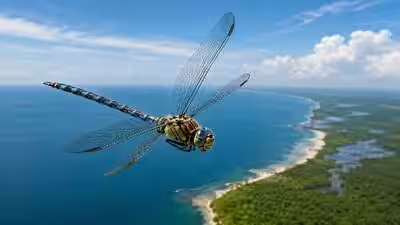
In 2016, Biologists at Rutgers University discovered that the globe skimmer dragonfly is the world’s longest-distance flying insect

In March 2016, researchers identified the globe skimmer dragonfly, Pantala flavescens, as the world’s longest-distance flying insect. Led by researchers at Rutgers University-Newark, the study used genetic analysis rather than direct observation to reach its conclusion, comparing DNA samples collected from dragonfly populations scattered across multiple continents. Rutgers University-Newark findings suggested these insects were travelling…

Read More

Meet Millie Pradawong, the 14-year-old Virginia student using machine learning and CRISPR to make microalgae produce more biofuel

Millie Pradawong developed an AI and CRISPR tool to improve microalgae biofuel production. A fourteen-year-old teen in United States has developed a computational tool with the help of machine learning and CRISPR gene editing to improve biofuel production. Millie Pradawong is one of the ten finalists in the 3M Young Scientist Challenge this year.Her project…

Read More