










Headlines

Leonardo: Quote of the day by Leonardo da Vinci: “Iron rusts from disuse; water loses its purity from stagnation; even so does inaction sap the vigour of the mind” |

In an age of constant notifications, endless scrolling and instant entertainment, Leonardo da Vinci’s centuries-old warning about an inactive mind feels surprisingly modern. “Iron rusts from disuse; water loses its purity from stagnation… even so does inaction sap the vigour of the mind,” Leonardo wrote in his notebooks. The Renaissance polymath used familiar examples from…


Read More

This food package can tell when meat is spoiling by changing colour from purple-red to yellow-green before the damage is obvious

A packet of meat can look fresh on the supermarket shelf even while bacteria are already multiplying inside. By the time a spoiled smell, discolouration or slimy texture becomes obvious, indicating that the meat has gone stale, the food may no longer be safe to eat.To find a solution to this, researchers at Kyushu University…

Read More

Venus clouds may contain 60% water, challenging decades-old theories about the planet’s sulfuric acid aerosols |

Cloud aerosols on Venus contain far more water than scientists have assumed for decades, alongside comparable amounts of iron sulfate and sulfuric acid. Researchers led by R. Mogul revisited previously uncharacterised data from the Pioneer Venus Large Probe, which descended through the planet’s atmosphere in 1978, and found that the probe’s instruments had unknowingly captured…

Read More

In 1876, Alexander Graham Bell patented the telephone, but an Italian inventor had already built the Telettrofono years earlier |

In 1849, Italian-born inventor Antonio Meucci began developing an early voice-transmission device that would later be known as the “teletrofono.” Decades of experimentation, financial hardship and a lapsed patent caveat meant that credit for the telephone ultimately went to Alexander Graham Bell in 1876. Meucci’s story, however, did not end there. Nearly 113 years after…

Read More

IN-SPACe moves to privatise operations of Rs 986 crore spaceport

To identify a suitable industry partner, IN-SPACe has issued an expression of interest (EoI) inviting proposals from eligible Indian entities to operate and manage the new launch complex, which is being built primarily for launches involving small rockets. BENGALURU: Space promoter-cum-regulator IN-SPACe has begun the process of handing over the operations and management of the…

Read More

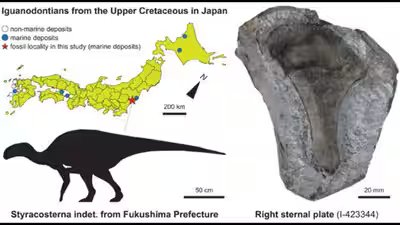
In 1999, a dinosaur bone was found on Japan’s Fukushima coast and left unstudied; in 2026, scientists identified it belonged to a 3-metre iguanodontian that lived 90 million years ago

Photo credit: Jstage.jst.go.jp A small dinosaur bone discovered in Fukushima, Japan, more than two decades ago has given scientists a new glimpse into the diversity of ancient life along East Asia’s coast.The fossil, found in 1999 and left largely unexamined for years, has now been identified as part of the breastbone of a plant-eating dinosaur…

Read More

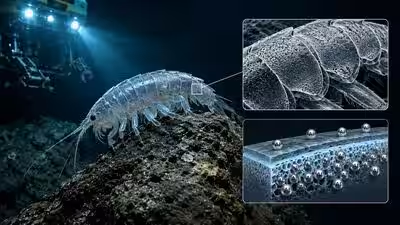
Scientists uncover the aluminium shield that helps a tiny crustacean survive darkness, near-freezing water and crushing pressure in the Mariana Trench |

Nearly seven miles beneath the surface of the Pacific Ocean lies a place so hostile that only a handful of human beings in all of history have ever seen it. Total darkness, near-freezing water, and pressure equivalent to a jet’s weight bearing down on a single postage stamp define this world. According to Guinness World…

Read More

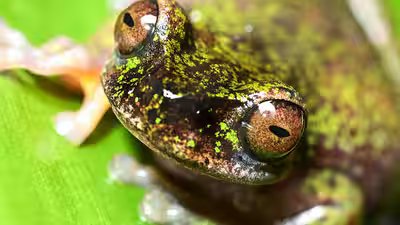
Meet Costa Rica’s tiny ‘coffee frog,’ a nocturnal species found living among coffee shrubs

Image Credit: X/ @AFP News Agency A tiny nocturnal frog has been discovered in Costa Rica’s coffee-growing region. Researcher Wagner Chaves-Acuña told AFP that the newly identified species lives among coffee plantations and nearby waterways, according to findings from colleagues at the University of Costa Rica and Argentina’s National Council for Scientific and Technical Research….

Read More

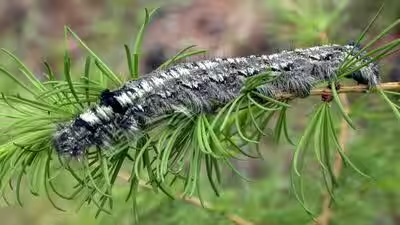
A moth outbreak has killed off forests across Siberia, now the flammable wood is causing wildfires that humans are unable to contain

An insect outbreak has left Siberia’s forests dead while also transforming the region into a tinderbox where wildfires are now spreading beyond human control. The trees burning across Krasnoyarsk this year were, in a lot of cases, already dead. Not from the fire or the drought, but because of a small moth.Dendrolimus sibiricus, the Siberian…

Read More