


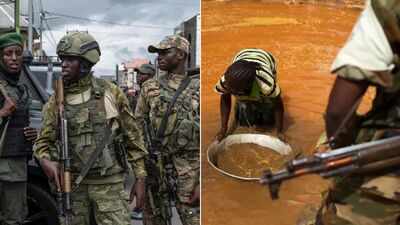
In a remote mining village in the Democratic Republic of Congo, teenagers carrying Kalashnikovs guard a gold mine while claiming to fight for their country. But behind the language of patriotism lies another reality: a growing militia economy fuelled by war, mineral wealth, road tolls and ransom.Around 100 heavily armed militiamen now call the small village of Mwala in southeastern DRC home. Many came from South Kivu after government forces retreated following an offensive by the Rwanda-backed M23 armed group. They now provide “security” at an artisanal gold mine operated by a Chinese company and collect money from businesses and people moving through territory they control.The fighters call themselves “wazalendo”, meaning “patriots” in Swahili, a name used for local militias supporting government forces against M23. Some say they are defending the country. Residents, however, say the militias are better known for extortion, while local officials warn that the proliferation of weapons could turn the region’s unresolved conflicts into a larger security crisis.The development illustrates how the war in eastern Congo is creating space for armed groups beyond M23 to expand their influence, access weapons and profit from the mineral-rich region.
How the M23 war gave militias a new lease of life
The M23 armed group controls large areas of eastern DRC and has played a major role in the violence and instability that has long plagued the mineral-rich region.But M23 is only one part of the security challenge facing the area. Numerous armed groups and militias operate across eastern Congo, complicating efforts to end the conflict between the government and M23.In December, M23 launched an offensive against Uvira in South Kivu province, triggering a chaotic withdrawal of government forces.As soldiers retreated, weapons, uniforms and ammunition were abandoned along roads. Some government troops were also forcibly disarmed by local militias that said they were prepared to fight in their place.Weapons and fighters subsequently moved into neighbouring Tanganyika province, which had only recently emerged from a brutal communal conflict.Since then, Mwala has become one of the places where these armed groups have entrenched themselves.Claude, the head of the Mwala militia group, said his fighters are paid between $100 and $150 a month to provide security at the village’s artisanal gold mine.“I joined the wazalendo self-defence force to defend my country,” Claude said.He said he had been “at the front several times”, while some of his fighters spoke of fighting in Minembwe, where some of the most intense clashes between government and M23 forces have taken place in recent months.But residents of Mwala told AFP by phone that they mainly encounter the militiamen as a source of pressure and extortion.
From bows and arrows to machine guns
The transformation of the militias is visible in the weapons they now carry.The Mwala militia operates from a collection of huts made from wood and foliage in dry scrubland. Young fighters pose with assault rifles when cameras arrive.Claude said the fighters had little support despite being involved in the conflict.“We’re hungry, we sleep badly, we buy the weapons and ammunition ourselves, all these efforts are ignored by our authorities,” Claude said.Tanganyika is still dealing with the legacy of a violent conflict between Pygmy and Bantu communities that killed thousands between 2013 and 2019.Some militias have since been formally incorporated as auxiliaries of the Congolese army and are undergoing military training. Others, like Claude’s group, have simply declared themselves “wazalendo”.The return of large quantities of weapons has changed the character of the militias.Where village fighters once carried bows and arrows, several security and local sources say they now possess Cold War-era machine guns and even rocket launchers.Tresor Ngabo, representative of the national disarmament and reintegration programme in Tanganyika, said the development was particularly concerning because large sums of money had already been spent trying to end the region’s earlier conflict.“A lot of money has really been injected here since 2015 to put an end to the conflict. Unfortunately, the war against the M23 broke out,” Ngabo said.Although the intercommunal violence ended seven years ago, he warned that conflicts had not disappeared.“conflicts persist, but this time these people are well armed, and if there are new clashes, it will be chaotic,” Ngabo warned.
Gold mines become a source of militia income
The militias’ influence is not limited to carrying weapons or fighting.They have also found ways to profit from the economic activity taking place in their territory.Chinese companies operate several mining operations in southeastern DRC, where the country’s mineral wealth has attracted substantial foreign investment.In Mwala, the militia provides security at an artisanal gold mine operated by a Chinese company.But armed groups also impose charges on roads passing through territory they control.The Bishambuke militia, to which the Mwala group is affiliated, demands around $1,500 a month from companies travelling through its territory, according to a local mining operator.The group is also known for involvement in kidnappings of Chinese nationals for ransom.That combination of mining, road tolls and kidnapping has created a parallel source of income for armed groups operating outside direct government control.The result is a conflict economy in which controlling territory can provide access not only to weapons and recruits but also to valuable resources and businesses.
Lithium brings fresh economic hopes, security risks
The stakes could become even higher as new mineral resources are discovered.Tanganyika has deposits of lithium, a mineral essential to electric vehicle batteries. Demand for lithium is expected to double by 2030, raising hopes that the resource could provide an economic boost to the province.But insecurity threatens those prospects.Foreign companies may be reluctant to invest in areas where armed groups operate freely, impose tolls and can target workers or businesses.China has invested heavily in the DRC over recent decades, and Chinese companies now operate many mining projects in the southeast.For local militias, the presence of valuable mining operations creates another potential source of revenue.The challenge for the government is therefore not only to defeat armed groups militarily, but also to prevent them from controlling the economic networks that allow them to survive.
Army struggles to keep armed groups in check
Mwala is only about 20 kilometres from Kalemie, the capital of Tanganyika province on the shores of Lake Tanganyika.By Congolese standards, the mining village is not particularly isolated. Yet the army, which has long faced accusations of poor equipment and indiscipline, has struggled to keep the militias under control.Some of the better-armed groups have even clashed with government troops.Kalemie is itself dealing with the economic consequences of the earlier communal conflict while absorbing tens of thousands of people displaced by fighting in South Kivu.At night, gunfire can still be heard in outlying neighbourhoods as heavily armed deserters break into homes and hold up residents.Operations by security forces have produced a relative lull recently, according to local authorities and civil society representatives.But the underlying problem remains. Chirac Issa, a civil society representative, said trust in government forces “has disappeared”.He warned that the proliferation of armed groups in the province was a “time bomb”.“Even if the war ends, would the government be able to collect all the weapons? The answer is ‘no’,” he said.
The conflict could outlive the war
The spread of armed groups into Tanganyika shows how the consequences of the M23 conflict extend beyond the front lines in eastern Congo.A government offensive against M23, a peace agreement or even an end to major fighting would not automatically dismantle the networks that have emerged around the conflict.Some militias have acquired weapons abandoned by retreating soldiers. Others have gained access to mining sites, imposed road tolls or become involved in kidnapping.For communities already emerging from years of communal violence, the danger is that the weapons and financial incentives created by the latest conflict could sustain instability long after the main battlefields fall silent.In Mwala, the gold mine continues to operate under the watch of young men with assault rifles.For them, the war against M23 may be presented as a fight for the country. But for the communities living under their control, it has also become a business built around guns, gold and power.


