









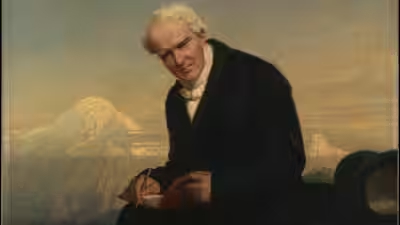
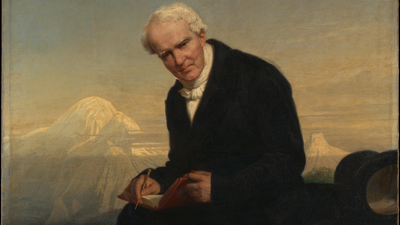
Alexander von Humboldt spent much of his life travelling through landscapes that most Europeans of his era knew only from maps, then trying to understand what connected the things he encountered. He climbed mountains, measured temperatures and atmospheric pressure, recorded plants and minerals and compared conditions across different elevations. His work eventually led him to a larger idea that became central to his scientific writing. Nature could not be properly understood by studying each part in isolation. Its forests, rivers, mountains, atmosphere, plants and animals formed relationships that only became visible when considered together. In Cosmos, the vast work through which he attempted to describe the physical world, Humboldt wrote that “The most important result of a rational inquiry into nature is… to establish the unity and harmony” of the forces and matter that make up the natural world. The idea remains striking because it describes science not merely as a search for facts, but as an effort to understand how those facts belong together.
Quote of the day by Alexander von Humboldt
“The most important result of a rational inquiry into nature is… to establish the unity and harmony of this stupendous mass of force and matter.”The sentence appears in Humboldt’s Cosmos, published in the 19th century as an ambitious attempt to bring together knowledge about the natural world. He was interested in more than collecting observations. He wanted to understand the relationships between them. For Humboldt, scientific inquiry could reveal an underlying order within the extraordinary variety of nature. He described nature as a “unity in diversity of phenomena”, suggesting that the apparent complexity of the world did not mean its elements were disconnected. Instead, the task of science was to uncover the relationships binding them together.
A scientist who travelled to see nature for himself
Humboldt was born in Berlin in 1769 and became one of the most celebrated naturalists and explorers of his generation. His most important expedition began in 1799, when he travelled to Spanish-controlled territories in the Americas with the French botanist Aimé Bonpland. Over several years, they travelled through parts of present-day Venezuela, Colombia, Ecuador, Peru, Cuba and Mexico, taking thousands of measurements and collecting vast numbers of specimens. Humboldt approached exploration as a scientific investigation. He measured altitude, temperature, atmospheric pressure and magnetic conditions while documenting plants, animals, geological formations and human settlements. His notebooks became an enormous record of the environments he encountered.
Mount Chimborazo changed the way he looked at mountains
One of Humboldt’s most famous expeditions took place in present-day Ecuador. In 1802, he climbed Mount Chimborazo, then believed to be the highest mountain in the world. Although he and his companions did not reach the summit, the ascent gave Humboldt an opportunity to examine how vegetation changed with elevation. He recognised that different climatic conditions at different heights could create ecological zones resembling those found across enormous distances on Earth. A plant found at a particular altitude in the Andes could have environmental parallels with vegetation found much farther north. Instead of seeing mountains simply as geological structures, Humboldt began using them as natural laboratories for studying relationships between climate, geography and life.
He saw connections where others saw separate subjects
Humboldt’s approach was unusual because modern scientific disciplines were not yet as sharply divided as they later became. He moved freely between subjects that would eventually become geography, geology, meteorology, botany and ecology. A change in altitude could alter temperature. Temperature could influence vegetation. Vegetation could affect soil and water. Geography could determine which species were able to survive in a particular environment. Humboldt believed these relationships mattered as much as the individual facts themselves. His observations helped advance the emerging field of biogeography, which examines how living organisms are distributed across geographical space and why those patterns occur.
His famous drawing turned a mountain into a scientific map
Humboldt’s ideas were not confined to books. He also developed innovative ways of presenting scientific information visually. One of the best-known examples is the Naturgemälde, a detailed illustration associated with his observations of Mount Chimborazo. Rather than depicting the mountain simply as a landscape, Humboldt used the image to show how vegetation, altitude, temperature and other environmental factors changed as elevation increased. The illustration allowed readers to see several relationships simultaneously. A mountain became more than a peak. It became a diagram of an ecosystem and a way of understanding how geography influences life.
Humboldt was fascinated by the atmosphere as well as the land
His curiosity extended above the ground. Humboldt studied atmospheric conditions, magnetic fields and climate, believing that these invisible forces were essential to understanding the physical world. He compared measurements taken at different locations and elevations and tried to identify broader patterns. This comparative approach helped establish a more systematic form of physical geography. Rather than describing one place in isolation, he wanted observations from different parts of the world to speak to one another. His scientific work therefore became an exercise in finding patterns across distance.
He also noticed the consequences of human activity
Humboldt’s observations occasionally brought him to conclusions that would sound familiar to environmental scientists today. During his travels in Venezuela, he examined the effects of agriculture and deforestation around Lake Valencia and linked the removal of forests with changes in the local environment and water conditions. His explanation was more complicated than some modern retellings suggest, and he did not formulate climate change theory in the modern sense. But he clearly recognised that human activity could alter relationships within natural systems. His observations contributed to a broader understanding of humans as participants capable of changing their surroundings.
His influence reached far beyond his own lifetime
Humboldt became one of the most influential scientific figures of the 19th century. His books were read across Europe and the Americas, and his ideas influenced scientists and explorers who followed him. Charles Darwin encountered Humboldt’s work before and during his own scientific career, and Humboldt’s descriptions of South American landscapes helped inspire Darwin’s interest in natural history. Other figures in geography, geology and natural science also drew upon his methods and observations. His influence was not based on a single discovery. It came from the way he connected many observations into a larger picture.
Cosmos was his attempt to describe the world as one system
Humboldt’s greatest synthesis was Cosmos, a multi-volume work published from 1845 onwards. The project attempted something extraordinarily broad for its time. Humboldt wanted to describe the physical universe while also explaining the relationships that gave the natural world its apparent order. He brought together astronomy, geography, geology, climate and living organisms, presenting scientific knowledge as part of a larger picture rather than as isolated collections of facts. His statement about establishing the “unity and harmony” of nature captures the ambition of the entire project.
His idea still resonates with modern environmental science
More than 160 years after Humboldt’s death in 1859, his central approach remains relevant. Modern ecology routinely examines relationships between climate, soil, water, plants, animals and human activity, while Earth system science studies the planet through interacting physical and biological processes. Humboldt did not possess the instruments, data or scientific frameworks available today, and it would be misleading to portray him as having anticipated every modern environmental concept. What he did offer was a powerful intellectual habit. Look beyond individual phenomena and ask how they are connected.That is what gives his quotation its enduring force. Humboldt was not suggesting that science should merely accumulate more information about nature. He believed its deeper purpose was to reveal the relationships hidden within that information. A mountain was connected to its climate. Climate was connected to vegetation. Vegetation was connected to geography. Human actions could alter those relationships. The natural world, in his view, was not a collection of separate objects waiting to be catalogued. It was a system whose parts became more meaningful when seen together.“The most important result of a rational inquiry into nature,” Humboldt wrote, was to establish its “unity and harmony”. More than a poetic description of the natural world, it was a statement about how he believed science should be done. Study the parts, but do not lose sight of the whole.