


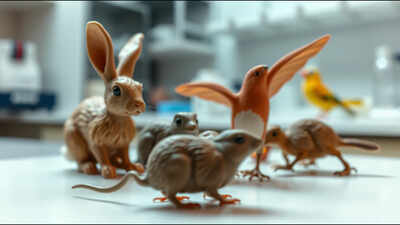
For years, ecologists have used soft plasticine models shaped like caterpillars, fruit, bird eggs, snakes and frogs to study interactions between predators and their potential prey. The idea is simple: leave the models in a natural habitat, collect them later and count the marks left by animals. A bite or peck can then be treated as evidence of an attack. But a new study suggests that this method may not always reveal the specific predator-prey interactions researchers assume it does. In a study titled Humans perceive but animals don’t: pitfalls in using plasticine models for assessing biotic interactions, published in Proceedings of the Royal Society B, researchers Xiao Huang and Si-Chong Chen tested 2,430 plasticine models with different shapes, sizes and colours across two biomes and multiple seasons. They found that attack rates were not significantly different between models with different visual characteristics, including models designed to resemble prey and an unusual tripod-shaped model.
Why ecologists use fake caterpillars
Plasticine models have become a common tool in ecological field studies because they are inexpensive, easy to deploy and leave visible marks when an animal bites, pecks or otherwise interacts with them. Unlike real prey, the models do not disappear after an attack, allowing researchers to collect them and examine the evidence later.The method is particularly common in studies of predation on insects. Researchers can make caterpillar-shaped models in different colours or sizes, place them in different habitats and compare the number of marks they receive. The assumption is that differences in those marks can provide information about how predators respond to different types of prey.But the approach also contains an important assumption: that animals recognise the artificial model as something resembling a real prey item. Plasticine models do not move, smell or otherwise behave like living animals, and different species rely on different sensory cues when locating and identifying food.Huang and Chen’s study set out to examine whether the visual differences built into these models actually affected how animals interacted with them.
The researchers tested more than 2,400 models
The researchers deployed 2,430 plasticine models varying in size, shape and colour. The models represented several types of potential prey, including caterpillars, fruit, bird eggs, snakes and frogs. They were placed in natural habitats representing two different biomes and were tested across multiple seasons.Importantly, the researchers also included models with shapes that did not correspond to the appearance of familiar prey. One of these was a tripod-shaped model, which had no obvious resemblance to an animal or other natural food item.The models were then collected and examined for imprints left by animals. The researchers recorded marks from different animal groups, including invertebrates, birds and mammals.The results did not show the expected differences between models. According to the study, attack rates were not significantly different among plasticine models with different characteristics, whether the researchers considered all attack marks together or examined marks associated with different animal groups.
Why the tripod-shaped model matters
One of the most striking observations was that the unusual tripod-shaped models received nearly as many animal imprints as models designed to resemble caterpillars or fruit. The pattern was also found across different animal groups, biomes and seasons.That finding matters because it challenges the idea that the visual resemblance between a plasticine model and a real prey item is necessarily what causes an animal to interact with it.The researchers suggest that animals may not consistently distinguish the artificial models as different types of prey based on visual characteristics alone. Instead, the marks could partly reflect the overall abundance and activity of animals in an area. The researchers also discuss the possibility that some interactions represent exploratory behaviour, with animals investigating an unfamiliar object rather than deliberately attempting to eat prey.The study does not establish that every mark on a plasticine model represents exploration rather than predation. Instead, its findings raise doubts about whether the marks can reliably be interpreted as evidence of a specific predator-prey interaction without considering the behaviour and sensory abilities of the animals involved.
What the study means for ecological experiments
The researchers describe the problem as a form of anthropocentric bias, meaning that experiments can be designed around how humans perceive the world rather than how the animals being studied actually experience it.A plasticine caterpillar may look convincingly like a caterpillar to a person, but that does not mean a bird, mammal or invertebrate will identify it in the same way. Animals can rely on combinations of visual, chemical, tactile and movement-based cues when identifying food. A stationary plasticine model lacks many of these signals.The findings therefore do not mean that plasticine models are useless. Instead, the researchers argue that scientists need to be more careful about what information the models can actually provide. If the goal is to measure a specific type of ecological interaction, experiments should account for the sensory systems, habits and behaviour of the animals being studied.The study ultimately questions a common shortcut in field ecology: assuming that because an artificial prey model looks convincing to a human observer, an animal will perceive it as the same kind of object. The researchers argue that incorporating the biology and behaviour of the species being studied could make future experiments more accurate and reduce the risk of interpreting every mark on a plasticine model as evidence of predation.


