







Headlines

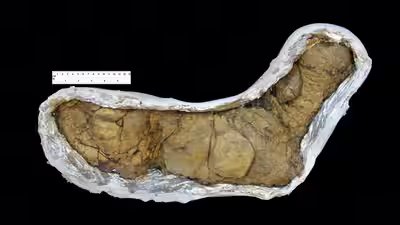
Scientists discovered that animal poop travelled across oceans 540-million-years ago and triggered the evolution of life on earth |

A large coprolite of a carnivorous dinosaur found in Harding County, South Dakota, US. Image Credit: Poozeum/Wikipedia Around 540 million years ago, the biological landscape of Earth went through a huge transformation called the Cambrian explosion. During this era, the ancestors of most modern animal groups began to appear, depicting a massive surge in biodiversity….

Read More

Meet Sirish Subash: The 14-year-old who invented an AI-powered pesticide detector for fruits and vegetables and won $25,000 |

A 14-year-old Georgia student has turned a common kitchen concern into an award-winning science project. Sirish Subash, a ninth grader from Snellville, built PestiSCAND, a handheld device designed to detect pesticide residues on fruits and vegetables. As reported by USA Today, his invention earned him the title of America’s Top Young Scientist in October 2024,…

Read More

In 2017, Antigua and Barbuda removed invasive rats and goats from Redonda; by 2023, vegetation biomass rose over 2,000% and ground dragons increased 13-fold

Redonda had become a thriving haven for wildlife within a few years, and now it has received a major new layer of protection. For years, Redonda resembled more a barren moonscape than a tropical Caribbean island. Its vegetation was destroyed, its native wildlife was wiped out, and the marine ecosystem around it was harmed by…

Read More

In 1967, US satellites hunting secret nuclear tests detected a flash from deep space; the accidental signal became the first observed gamma-ray burst

Artist’s concept of a close-up naked-eye view of a GRB. Credit: NASA For more than half a century, gamma-ray bursts have remained one of the most puzzling events observed in space. These bursts are sudden flashes of gamma rays, a very high-energy form of light. They can appear from almost any direction in the sky…

Read More

Researchers used a gene gun to make lettuce and tobacco produce cattle and pig myoglobin, the protein that gives meat its red colour and umami flavour

Scientists engineer lettuce and tobacco to produce myoglobin for meat alternatives Let us accept it: livestock farming is a heavy burden on the environment. Raising animal feed takes vast amounts of land and huge supplies of freshwater, and it adds to global warming by releasing methane and nitrous oxide. Many consumers also worry about animal…

Read More

Three Indian teens won a global prize for using tamarind seeds to remove microplastics from water |

What started with concerns about access to clean drinking water eventually led three Indian teenagers to an idea that could offer a remarkably simple way of tackling microplastic contamination. Vivaan Chhawchharia, Ariana Agarwal and Avyana Mehta, all 16, developed Plas-Stick, a biodegradable powder made from discarded tamarind seeds that can bind tiny plastic particles in…

Read More

US scientists are tagging sharks with ocean sensors; every time they surface, data is sent by satellite to help forecast how strongly hurricanes may intensify

Aaron Carlisle grasps a white shark alongside a boat off the coast of Delaware (Reuters photo) Scientists in the US are testing an unusual way to collect ocean data that could eventually help improve hurricane forecasts, by using sharks as mobile ocean sensors.Researchers from the University of Delaware are attaching small electronic tags to sharks…

Read More

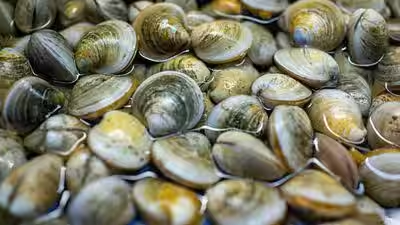
In 2018, scientists found just 39 surviving clams in Florida’s Indian River Lagoon; they bred them and have since outplanted 65 million

After decades of environmental decline, Florida’s Indian River Lagoon is beginning to show signs of recovery. With funding from NOAA Fisheries’ Office of Habitat Conservation, the Indian River Lagoon Council is leading a system-wide effort to restore the habitats that once sustained the lagoon’s fish and wildlife. A team of three scientists and one fisherman…

Read More

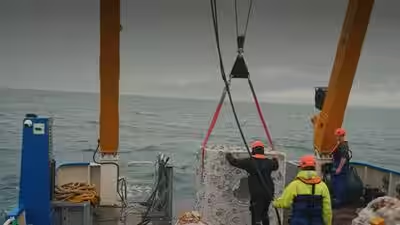
Britain is dropping 20 concrete reef cubes and 44 tons of scallop shells into the sea in the hope to bring back its native oysters who have reduced by 95% since 1800s

While one might assume that lowering huge white blocks of concrete into the sea was an attempt at dumping construction waste offshore, in Britain’s North Sea it is a conservation effort. The country is dumping 20 carefully designed structures into the deep waters to restore the population of the European native oyster, Ostrea edulis, along…

Read More