








Headlines

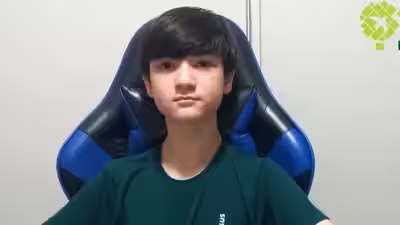
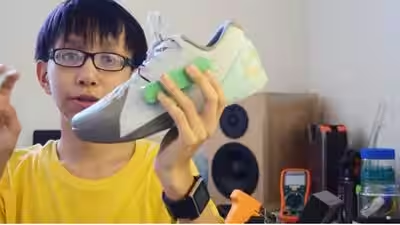
Meet Angelo Casimiro: The 15-year-old who designed shoes that generate electricity from human footsteps |

Image Credit: inhabitat.com The global energy landscape is rapidly changing as the dangers of fossil fuels are becoming visible to researchers and the public. As traditional energy sources will probably diminish by the year 2088, the search for renewable options has expanded from wind and solar farms to personal, wearable technology. A prime example of…

Read More

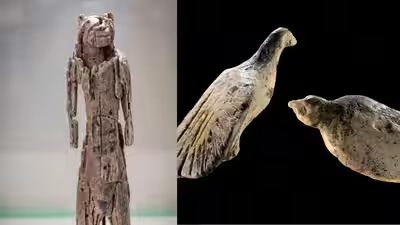
Archaeologists discover 40,000-year-old bird figurines no bigger than a thumbnail that are rewriting the story of Ice Age art |

Archaeologists excavating the renowned Hohle Fels Cave in southwestern Germany have uncovered two exquisitely carved bird figurines made from mammoth ivory that date back around 40,000 years. Although each carving is no bigger than a thumbnail, researchers say the tiny sculptures demonstrate an extraordinary level of craftsmanship and artistic sophistication among some of Europe’s earliest…

Read More

In 1997, a mysterious sound echoed across the Pacific. Years later, scientists traced the ‘Bloop’ to Antarctica |

The deep ocean has a way of turning ordinary events into unanswered questions. Far below the waves, sounds travel through water in ways that can make distant sources appear much closer or far stranger than they really are. In 1997, a powerful low-frequency noise recorded across the Pacific Ocean created one of the most unusual…

Read More

Meet Lucas Tadao: 14-year-old Brazilian student who turned cassava peels into biodegradable trays that could help replace Styrofoam and reduce plastic pollution |

As concerns over plastic pollution continue to grow, a 14-year-old student in Brazil has developed a sustainable alternative using materials that would otherwise be discarded. Lucas Tadao Sugahara Wernick, a student from Curitiba in the southern state of Paraná, created biodegradable food trays made from cassava peels and araucaria tree residues. Designed as a substitute…

Read More

Quote of the day by Richard Feynman: “The first principle is that you must not fool yourself and…” |

Richard Feynman’s most enduring quote was never intended as a memorable slogan. It came from his 1974 commencement address at the California Institute of Technology, where the Nobel Prize-winning physicist spoke about the principles that should guide scientific research. Among his remarks, one sentence has outlived the rest: “The first principle is that you must…

Read More

Eeg: San Diego student Sharvi Mahajan, 14, designed an EEG-based AI system to predict driver fatigue and microsleep; she is now competing for a $25,000 science prize

Fourteen-year-old Sharvi Mahajan has developed NeuroDrive Alert (Picture: Young Scientist Lab) Sharvi Mahajan, a 14-year-old Indian-American student from California, has been named among the 10 finalists of the 2026 3M Young Scientist Challenge. Mahajan has developed a system to predict driver fatigue before it leads to accidents.Sharvi, an eighth-grade student at Bernardo Heights Middle School,…

Read More

Texas engineers are building fish-like nano-robots that could harvest lithium from seawater and transform the future of clean energy |

Image Credit: Getty Images Lithium is of utmost importance for modern technology. It is powering the smartphones and the huge fleet of electric vehicles. As the world is shifting towards clean energy, the demand for lithium is also increasing quickly, which is placing a huge pressure on land-based mining. However, researchers at Texas A&M University…

Read More

The Southern Ocean may be Earth’s safest place to remove carbon from the atmosphere, scientists find |

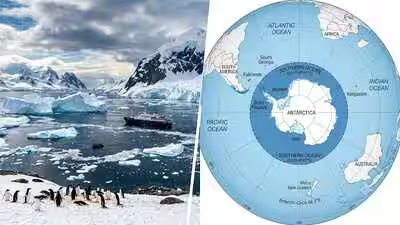
Left/Southern Ocean/Right/Southern Ocean on map/Image: AI Generated As the world searches for ways to remove carbon dioxide already accumulating in the atmosphere, ocean iron fertilisation (OIF) has emerged as one of the most debated climate intervention strategies. The idea is deceptively simple: adding tiny amounts of iron to iron-poor parts of the ocean stimulates the…

Read More

Tiny reef fish flourished beside islands filled with seabirds; where rats removed the birds, the entire underwater food chain took another route

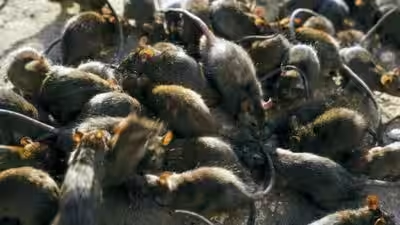
Ecosystems work with each other no matter how far or disconnected they are. Animals and birds have impacts on each other’s lives and deaths. According to a new study, invasive rats on tropical islands are creating winners and losers among tiny underwater animals near the bottom of the food chain that inhabit surrounding coral reefs….

Read More

Washington teenager Lakshmi Agrawal made a jute-waste sponge for salmon-killing tyre pollution; after it removed up to 80% in lab tests, she won $75,000

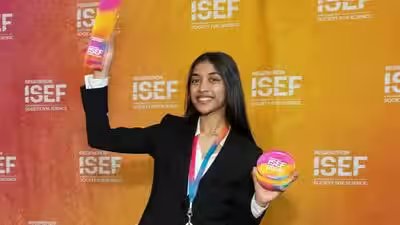
Lakshmi Agrawal (Image Credit: Society for Science) An 18-year-old student from Bellevue, Washington, has turned an agricultural waste product into a promising solution for one of the Pacific Northwest’s most pressing environmental challenges. According to the Society for Science, Lakshmi Agrawal won the $75,000 Regeneron Young Scientist Award at the 2026 Regeneron International Science and…

Read More